Meilleurs biberons anti-coliques UK 2026 : 4 vrais choix pour des repas apaises
Quatre biberons anti-coliques compares par prix, materiau et technologie de ventilation. Du MAM auto-sterilisant au biberon en verre BIBS, voici ce qui aide vraiment contre les gaz et l''agitation.
ROUNDUP · ANTI-COLIC BOTTLES
Colic is one of those first-weeks curve balls that leaves you swapping bottles at 2 a.m. and scrolling forums at 4. The good news: modern vented designs genuinely reduce the air your baby swallows. The tricky part is choosing between vented bases, internal tubes and nipple valves, all while weighing up glass versus plastic and working out which teat your baby will actually accept.
We lined up four bottles from four different brands, covering every price point from around £4.50 a bottle to £12.50. Each uses a different anti-colic mechanism, so there is something here whether you want the simplest clean-up or the most clinically tested vent system on the market.
- Best all-rounder: MAM Easy Start Anti-Colic – self-sterilising convenience and 94% breastfed-baby acceptance
- Best glass option: BIBS Baby Glass Bottle – zero plastic touching milk, beautiful Scandi design
- Best for severe colic: Dr Brown’s Options+ Glass – internal vent system with the strongest clinical evidence
- Best value: NUK Perfect Match Set – four bottles for under £19, plus a built-in temperature indicator
How Anti-Colic Bottles Actually Work
Standard bottles let air into the milk as your baby feeds, creating bubbles that end up in tiny tummies. Anti-colic bottles tackle this with some form of venting, and there are three main approaches:
- Base vents (MAM) – air enters through the bottle base and never passes through the milk at all
- Internal tube systems (Dr Brown’s) – a narrow channel inside the bottle routes air from the teat to the back of the bottle, keeping the milk completely vacuum-free
- Nipple valves (BIBS, NUK) – a small valve built into the teat itself releases air before your baby swallows it
All three approaches work. A 2026 randomised trial of over 1,000 infants found that any vented design reduced fussiness compared to standard bottles, though the specific vent type mattered less than simply having one. The real differences come down to how many parts you need to wash, what material you prefer and which teat shape your baby takes to.
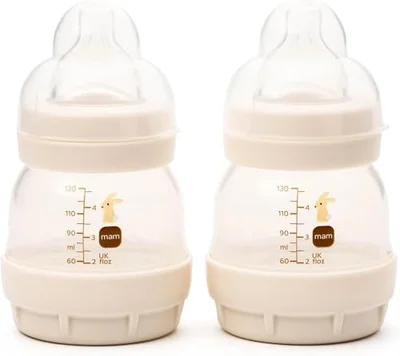
MAM Easy Start Anti-Colic (2 x 130 ml)

Key specs
- Capacity: 130 ml (also sold in 160 ml and 260 ml)
- Material: BPA-free polypropylene plastic
- Teat: SkinSoft flat silicone, Size 0 extra-slow flow (five sizes available)
- Anti-colic mechanism: Patented vented base with dimpled holes
- Price: Around £9–13 for a two-pack
MAM’s vented base is clever in its simplicity: air enters through the dimpled holes in the base and never touches the milk. That means no internal tubes, no fiddly valves and no extra brushes. The flat SkinSoft teat is designed to feel more like skin, and MAM say 94% of breastfed babies accept it on the first try.
The self-sterilising trick is the real crowd-pleaser. Unscrew the base, add 20 ml of water, pop the whole thing in the microwave for three minutes and you are done. No separate steriliser, no tablets, no waiting. For night feeds and days out, it is a genuine time saver.
“When we switched to MAM bottles, he was more settled during a feed and didn’t cry during his mid-feed burp as he usually would.”
Pros
- Self-sterilising in the microwave in three minutes, no extra equipment needed
- 94% acceptance rate among breastfed babies transitioning to a bottle
- Clinically shown to reduce colic symptoms in 80% of babies
- Very easy to clean with no internal parts to disassemble
Cons
- Multiple parts must be reassembled correctly after cleaning or the base leaks
- Some parents report dripping when the bottle is stored on its side
- Plastic construction, which may concern parents who prefer glass
Best for
- Parents who want the easiest sterilising routine possible
- Breastfed babies switching to a bottle for the first time
- Budget-conscious families who still want proven anti-colic performance
- On-the-go feeding (lightweight, self-sterilises anywhere with a microwave)
BIBS Baby Glass Bottle (2 x 120 ml)


Key specs
- Capacity: 120 ml (also sold in 225 ml)
- Material: Lab-grade borosilicate glass
- Teat: Round breast-like nipple in natural rubber latex or medical-grade silicone (slow flow)
- Anti-colic mechanism: Built-in valve in the nipple
- Price: Around £25 for a two-pack
BIBS built their reputation on those iconic round pacifiers, and the bottle range carries the same Danish design DNA. The borosilicate glass is the same grade used in laboratory equipment: it handles temperature shocks, contains zero microplastics and is noticeably lighter than standard glass bottles.
The anti-colic valve sits inside the nipple itself, so there are no extra tubes or base pieces to clean. Every surface that touches milk is either glass or silicone, which appeals to parents who want zero plastic contact during feeds. The nipples and caps are also cross-compatible with Dr Brown’s bottles, which is handy if you already have either brand.
“I hated how heavy most glass bottles are, but these are really light. My baby never loved any bottle like this one.”
Pros
- All milk-contact surfaces are glass and silicone, zero plastic in the feeding pathway
- Lighter than standard glass bottles thanks to borosilicate construction
- Beautiful Scandinavian design in a range of muted colours
- Nipples cross-compatible with Dr Brown’s, reducing waste if you switch brands
Cons
- Glass can break if dropped, even with the included silicone bumper
- Premium price point at roughly £12.50 per bottle
- Round nipple shape may not suit babies who prefer orthodontic teats
Best for
- Eco-conscious parents who want a plastic-free feeding surface
- Style-conscious parents who value design aesthetics
- Families already using BIBS pacifiers (familiar round nipple shape)
- Primarily home-based feeding where breakage risk is lower
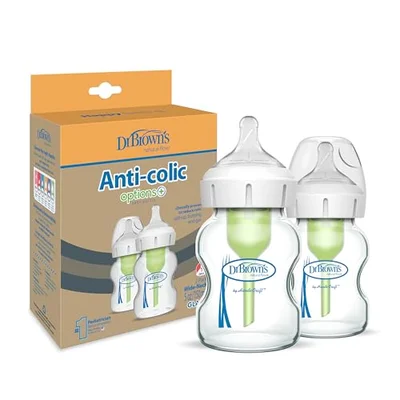
Dr Brown’s Options+ 150 ml Twin Pack Glass
Key specs
- Capacity: 150 ml (also sold in 270 ml)
- Material: Pharmaceutical-grade borosilicate glass
- Teat: Contoured breast-like silicone, Level 1 slow flow, wide neck
- Anti-colic mechanism: Patented internal vent system (removable tube and reservoir)
- Price: Around £20 for a twin pack
If your baby has serious wind or reflux, Dr Brown’s is where most health visitors will point you. The internal vent system channels air through a thin tube and reservoir, creating completely vacuum-free feeding. That means the milk flows smoothly without collapsing the teat, and your baby swallows virtually no air.
The “Options+” part means the vent is removable. Use it during the colicky newborn months, then take it out once your baby’s digestive system matures and you want fewer parts to wash. The glass construction also preserves breast milk nutrients by preventing the oxidation that happens in a vacuum.
“Let’s just say it has been a game changer after only a couple of days. Peace of mind knowing I’m not heating and reheating plastic to feed the baby.”
Pros
- Internal vent system is clinically proven to reduce colic, spit-up, burping and gas
- Preserves breast milk vitamins by eliminating vacuum-driven oxidation
- Removable vent grows with your baby, so you do not need to buy new bottles
- Pharmaceutical-grade glass handles temperature changes safely
Cons
- Most parts to clean of any bottle here: tube, reservoir and brush all needed
- Cannot shake to mix formula without causing leaks
- Heavier than plastic alternatives, which matters for longer feeds
Best for
- Babies with diagnosed colic, reflux or persistent gas
- Parents who want the most clinically tested anti-colic system available
- Breast milk feeders who care about nutrient preservation
- Parents happy to invest extra cleaning time for maximum wind reduction
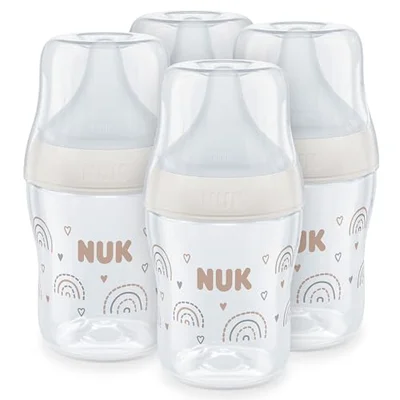
NUK Perfect Match Set (4 x 150 ml)
Key specs
- Capacity: 150 ml (also sold in 260 ml)
- Material: BPA-free polypropylene plastic
- Teat: Super-soft skin-like silicone that moulds to your baby’s palate
- Anti-colic mechanism: Integrated anti-colic vent
- Price: Around £18–20 for a four-pack
NUK’s angle is personalisation. The teat is made from an unusually soft silicone that adapts to each baby’s individual palate shape during feeding, and NUK claim a 98% acceptance rate as a result. If your baby has rejected every other bottle you have tried, this is worth a look.
The SafeTemp indicator on the side of the bottle is a quiet standout. The blue scale turns white when milk is too hot and settles at medium blue when it reaches body temperature. It is not a gimmick: at 3 a.m. when you are too tired to wrist-test properly, a visual check is genuinely reassuring. At roughly £4.50 per bottle, it is also comfortably the best value pick in this roundup.
“We tried MAM, Tommee Tippee, Nanobebe, Emulait, Dr Brown’s, and more. Our baby refused almost all of them, but she took to the NUK bottle right away.”
Pros
- 98% acceptance rate thanks to the palate-adapting soft silicone teat
- Built-in SafeTemp indicator shows at a glance when milk is too hot
- Best value per bottle in this roundup at around £4.50 each
- Simple design with fewer parts than MAM or Dr Brown’s
Cons
- Some parents find the slow-flow teat faster than expected for younger babies
- Plastic construction only (glass version sold separately at a higher price)
- Less established in the UK market, so fewer local reviews and stockists
Best for
- Babies who have refused other bottles (highest acceptance rate in this roundup)
- Budget-conscious families who need multiple bottles without a big outlay
- Parents who want a built-in temperature safety check
- Combination-feeding families moving between breast and bottle
Side-by-Side Comparison
| Feature | MAM Easy Start | BIBS Glass | Dr Brown’s Options+ | NUK Perfect Match |
|---|---|---|---|---|
| Material | Plastic (PP) | Borosilicate glass | Borosilicate glass | Plastic (PP) |
| Capacity | 130 ml | 120 ml | 150 ml | 150 ml |
| Anti-colic type | Vented base | Nipple valve | Internal tube | Integrated vent |
| Parts to wash | 4 | 3 | 5+ | 3 |
| Self-sterilising | Yes (microwave) | No | No | No |
| Temp indicator | No | No | No | Yes (SafeTemp) |
| Price per bottle | ~£5–6.50 | ~£12.50 | ~£10 | ~£4.50 |
| Rating |
Which One Should You Pick?
Start with what matters most to you:
- Convenience above all else? The MAM Easy Start self-sterilises in the microwave, has the fewest cleaning steps of the glass options, and costs under £7 a bottle. It is the easiest to live with day to day.
- Want zero plastic near the milk? The BIBS glass bottle keeps every milk-contact surface in glass and silicone. You pay a premium, but the build quality and design are beautiful.
- Dealing with serious colic or reflux? Dr Brown’s Options+ has the most robust clinical evidence. The extra cleaning is the trade-off, but parents of colicky babies say it is worth every minute.
- Need bottles on a budget? The NUK Perfect Match four-pack delivers four bottles for less than the price of two BIBS. The temperature indicator is a genuine bonus, and the acceptance rate is the highest here.
Whichever you choose, remember that no bottle cures colic on its own. Paced feeding, the right teat flow rate and plenty of upright winding time matter just as much as the hardware. If the first bottle does not click, swap rather than soldier on. Most of these come in twin packs precisely because the makers know you might need to experiment.
Prêt à créer votre liste de naissance ?
Créez votre liste de naissance gratuite dès aujourd'hui et partagez-la avec vos proches.
Commencer gratuitement