Meilleurs tire-laits UK 2026 : 5 choix du manuel au portable
Nous avons comparé cinq tire-laits de trois types différents, d'un collecteur en silicone à 16 £ à un modèle mains libres à 300 £, pour trouver celui qui convient à chaque parcours d'allaitement.
COMPARISON · BREAST PUMPS
Choosing a breast pump used to mean picking between a manual squeeze handle and a bulky hospital-grade machine. That landscape has shifted. Silicone collectors, ergonomic manuals with dual-phase technology, and discreet wearable electrics now sit side by side on retailer shelves, each solving a different problem for a different stage of your feeding journey.
The right pump depends on how often you express, whether you need portability, and how much you are willing to spend. A silicone collector that catches letdown from the opposite breast costs under £20 and needs no power source. A premium wearable lets you pump hands-free during a work call. Neither replaces the other.
We compared five breast pumps available through UK retailers, spanning three pump types and a price range from £16 to £300. We cross-referenced parent feedback across forums, review platforms, and award panels, checked live pricing, and tested each brand's claims against what parents actually report.
Lil' Bubba's verdicts
- Best Overall Manual: Medela Harmony · 8.2/10 - proven 2-Phase Expression with PersonaFit Flex shields
- Best Budget Pick: haakaa Gen.2 Silicone · 8.5/10 - Gold Award-winning passive collector for under £20
- Best for Comfort: Philips Avent Manual SCF430 · 8.4/10 - Natural Motion Technology fits 99.98% of nipple sizes
- Best Wearable Value: Tommee Tippee Made for Me Double Wearable · 8.0/10 - hands-free pumping at a mid-range price
- Best for Power Users: Momcozy M6 Double · 7.8/10 - strongest suction and largest capacity in a wearable
| Pump | Type | Price | Key feature | Rating |
|---|---|---|---|---|
| Medela Harmony | Manual | ~£25 | 2-Phase Expression | |
| haakaa Gen.2 | Silicone | ~£16 | One-piece passive suction | |
| Philips Avent SCF430 | Manual | ~£35 | Natural Motion Technology | |
| Tommee Tippee Double Wearable | Wearable electric | ~£85 | Constant Comfort Technology | |
| Momcozy M6 | Wearable electric | ~£300 | 295 mmHg suction, 180ml capacity |
How we picked the 5
We started with every breast pump currently in stock through joined UK retailers, filtering for brands with established reputations beyond Amazon-only marketplace sellers. Each pump needed genuine parent reviews, a clear product category (manual, silicone, or wearable electric), and UK availability with warranty support. We then cross-referenced parent sentiment across Mumsnet, MadeForMums, Mother & Baby, and independent lactation consultant reviews to build a shortlist that covers the full spectrum of pumping needs and budgets.
What to look for in a breast pump
Know your pumping frequency. If you express once a day to build a small freezer stash, a manual or silicone pump is perfectly adequate and far cheaper. If you pump multiple times daily, whether returning to work or exclusively expressing, an electric or wearable pump saves your hands and your time.
Flange fit is non-negotiable. A flange (the funnel-shaped piece that sits against your breast) that is too small causes pain and reduces output. Too large and you lose suction. Most brands now offer multiple flange sizes, with Momcozy including four sizes in the box. Measure before you buy.
Closed vs open system. Closed-system pumps have a barrier between the milk and the motor, preventing mould growth and making them safe to share or resell. All five pumps in this roundup use closed or sealed systems.
Battery life matters for wearables. A wearable pump that dies mid-session is worse than useless. Check how many sessions per charge a pump offers and whether it can run while plugged in.
Noise level is underrated. If you plan to pump during meetings, on the train, or next to a sleeping baby, anything above 50dB will be noticeable. Wearable pumps vary significantly here.
1. Medela Harmony Manual Breast Pump
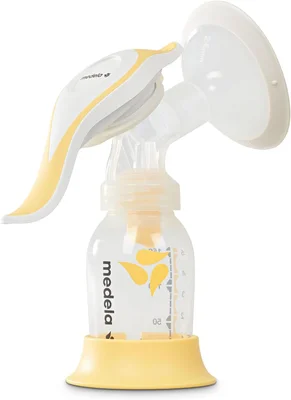
The Medela Harmony is a Swiss-designed manual breast pump that punches well above its price point. Its signature feature is 2-Phase Expression technology, which lets you switch between a faster stimulation rhythm and a slower, deeper expression rhythm by twisting the handle. This mimics the way your baby naturally feeds, starting with quick sucks to trigger letdown before settling into longer draws.
The PersonaFit Flex shields are soft and flexible, angling to fit your body rather than forcing you to lean forward. At roughly £25 and small enough to toss in a changing bag, the Harmony is the kind of pump that earns a permanent spot in your kit even if you own an electric.
What parents love
- Two-phase pumping actually works. Parents consistently report more milk in less time compared to single-phase manual pumps. The switch between stimulation and expression is intuitive.
- Excellent value. At around £25, it delivers performance that rivals pumps costing three times as much. Multiple parents describe it as a lifesaver.
- Truly portable. Lightweight, no batteries, no cables. Perfect for travel, work, or keeping in your hospital bag.
- Flex shields are comfortable. The soft, flexible rim reduces pressure and adapts to different breast shapes without the rigid plastic of older designs.
What to know before you buy
- Hand fatigue after 10 minutes. Manual pumping requires sustained squeezing. Sessions longer than 15 minutes can tire your hand, and you need both hands occupied so multitasking is not possible.
- Single breast only. You can only pump one side at a time, which doubles session length compared to a double electric pump.
- Only one shield size included. The 24mm shield fits many but not all. If you need a different size, you will need to buy it separately.
Best for
- Occasional expressers building a freezer stash
- Travel and on-the-go pumping without power access
- Backup pump for when your electric is charging or unavailable
- Budget-conscious parents who want proven technology
2. haakaa Gen.2 Silicone Breast Pump

The haakaa Gen.2 is not a traditional breast pump. It is a one-piece silicone collector that uses gentle suction to draw out milk from one breast while you feed or pump from the other. Squeeze the base, attach it, and let it work passively. No batteries, no parts, no noise. Winner of the Gold Award for Best Breast Pump at the Mother & Baby Awards 2026.
Available in 100ml and 150ml sizes, the Gen.2 adds a suction base that sticks to flat surfaces, preventing the accidental knock-overs that plagued the original. The entire thing is one piece of food-grade silicone with no joints, cracks, or edges where bacteria could hide.
What parents love
- Effortless milk collection. Parents regularly collect 30-60ml of milk per feed that would otherwise soak into a breast pad. Over a day, that adds up to a meaningful freezer stash with zero extra effort.
- Dead simple to use. One piece, no assembly, no instructions needed. Several parents mention using it successfully while half asleep during night feeds.
- Unbeatable value. At around £16, it pays for itself within days by capturing milk that would otherwise be wasted. No replacement parts, no ongoing costs.
- Easy to clean. One piece means no nooks or crannies. Boil it, steam sterilise it, or pop it in the dishwasher.
What to know before you buy
- Not an active pump. It collects letdown milk passively. If you need to stimulate and express from a breast that is not currently being fed from, you will need an actual pump alongside it.
- Can fall off. While the suction is generally reliable, a wriggling baby or a bump can knock it loose. The suction base helps on surfaces but cannot prevent detachment from your body.
- Small capacity. The 100ml fills quickly for some parents. The 150ml version costs a few pounds more and is worth the upgrade.
Best for
- Breastfeeding parents wanting to collect letdown milk during feeds
- Building a freezer stash without extra pumping sessions
- First-time parents unsure if they need a full breast pump
- Anyone wanting a no-fuss, no-power, no-noise option

3. Philips Avent Manual Breast Pump SCF430

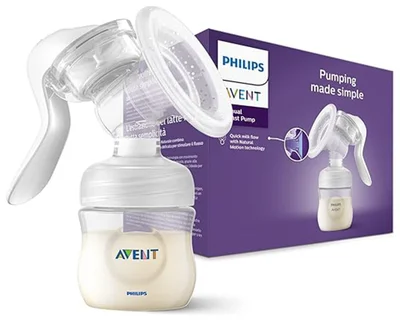
The Philips Avent SCF430 brings a standout comfort innovation to manual pumping: Natural Motion Technology. The silicone flange gently stimulates the nipple to help start milk flow, mimicking the sensation of a baby's suckling rather than relying purely on mechanical vacuum. Philips claims it fits 99.98% of all nipple sizes up to 30mm, reducing the guesswork around flange sizing that frustrates many parents.
The pump is compact and lightweight with an intuitive handle that lets you adjust both rhythm and vacuum strength. It comes in several variants (SCF430/01, /10, /13, /20) with different accessory bundles, but all share the same core pump mechanism.
What parents love
- Exceptionally comfortable. The soft silicone cushion and Natural Motion stimulation mean less soreness, even during longer sessions. Parents with sensitive tissue consistently rate comfort highly.
- Near-universal fit. The flexible flange adapts to a wide range of nipple sizes without needing to order separate shields. Less trial and error than most competitors.
- Avent ecosystem compatibility. Pumps directly into Avent Natural Response bottles. If you already use Avent bottles and sterilisers, everything clicks together.
- Quiet and discreet. No motor noise whatsoever. Ideal for pumping next to a sleeping baby or in shared spaces.
What to know before you buy
- Pricier than Medela Harmony. At £30-42, it costs roughly 50% more than the Harmony for a similar manual output. The comfort premium may not matter to everyone.
- Single breast only. Like all manual pumps, you pump one side at a time. Pair with a haakaa on the opposite breast to maximise each session.
- Handle can feel stiff initially. Some parents report the handle resistance takes a session or two to break in before it becomes truly comfortable.
Best for
- Parents who found other manual pumps uncomfortable or painful
- Those already using Philips Avent bottles and sterilisers
- Occasional expressers who prioritise comfort over speed
- Parents unsure of their flange size
4. Tommee Tippee Made for Me Double Wearable

The Tommee Tippee Made for Me Double Wearable is where hands-free pumping meets a price point that does not require a second mortgage. At around £85 (RRP £130), it undercuts premium wearables like the Elvie and Momcozy M6 by a significant margin while delivering the core functionality most parents actually need: pump both breasts simultaneously, inside your bra, without holding anything.
It features Constant Comfort Technology with smart suction that mimics your baby's suckling pattern, five massage stimulation modes, nine expressing modes, MassageTec soft silicone cups, and a closed hygienic system. Battery life covers roughly 90 minutes of cord-free pumping per charge.
What parents love
- Genuine hands-free freedom. Tuck it into your nursing bra and carry on with your day. Parents report pumping while cooking, working, and caring for older children.
- Good value for a wearable. At £85, it is roughly a third of the price of the Momcozy M6 and half the price of the Elvie Stride, with comparable core features.
- Quiet operation. Noticeably quieter than many wearable competitors, making it usable during calls or next to a sleeping baby.
- Double pumping saves time. Expressing from both breasts simultaneously halves your session length compared to any single manual pump.
What to know before you buy
- Not fully discreet under clothing. The pump units create visible bulk under fitted tops. Looser clothing hides them better, but they are not invisible.
- Fewer flange sizes. Comes with standard flanges that suit most, but the size range is narrower than Momcozy's four-size offering.
- App is basic. The companion app tracks sessions but lacks the detailed analytics of premium competitors. Most parents end up not using it.
Best for
- Parents returning to work who need to pump during the day
- Anyone wanting hands-free pumping without the premium price tag
- Double-pumping to build supply or maintain output
- Parents already in the Tommee Tippee ecosystem
5. Momcozy M6 Double Breast Pump

The Momcozy M6 is the most powerful wearable pump in this roundup by a wide margin. Its motor delivers up to 295 mmHg of suction, the collection cups hold 180ml each (larger than most competitors), and the battery lasts five to six pumping sessions per charge. It includes four flange sizes (17mm, 19mm, 21mm, 24mm) in the box, eliminating the sizing guesswork that plagues other pumps.
This is an upgrade from the popular M5, with a stronger motor, larger capacity, and improved battery life. It is available through Boots and directly from Momcozy, with UK warranty support.
What parents love
- Powerful suction for strong output. The 295 mmHg maximum suction is among the highest available in a wearable pump. Parents who struggled with weaker pumps report significantly better output.
- Four flange sizes included. No guessing, no separate purchases. Try each size to find your fit straight out of the box.
- Long battery life. Five to six sessions per charge means you can go two to three days between charges with typical use.
- Stays put in the bra. Unlike some wearables that slip or shift, the M6 sits securely once positioned. Parents report confidence moving around while pumping.
What to know before you buy
- Premium price. At £300 for the double, it is the most expensive option in this roundup by a factor of three. That is a significant investment, even if cost-per-session drops quickly for frequent pumpers.
- Leak risk when bending. The pour spout at the top of the collection cup can allow milk to escape if you bend over too far. Parents learn to move carefully, but it is an ongoing annoyance.
- Visible under clothing. Despite being wearable, the pump units add noticeable bulk. One parent described the look as unmistakable under fitted tops.
Best for
- Exclusive pumpers who express multiple times daily
- Parents who need maximum output from each session
- Those who struggled with weaker pumps and need more suction
- Anyone willing to invest upfront for long-term daily use

Final thoughts
There is no single best breast pump because there is no single pumping scenario. A breastfeeding parent collecting letdown needs the haakaa. Someone pumping once a day for a freezer stash will be well served by the Medela Harmony or Philips Avent. A parent returning to full-time work and pumping three times daily needs the hands-free convenience of the Tommee Tippee or Momcozy.
If budget is tight, start with the haakaa Gen.2 at £16 and add a manual pump later if you need active expression. If you know you will be pumping frequently, the Tommee Tippee Double Wearable at £85 offers the best balance of features and price in the electric category. The Momcozy M6 is worth its premium only if you are an exclusive or very frequent pumper who needs maximum output and battery life.
Whichever you choose, get your flange size right before committing. A perfectly engineered pump with the wrong flange fit will underperform a basic pump that fits well.
Prêt à créer votre liste de naissance ?
Créez votre liste de naissance gratuite dès aujourd'hui et partagez-la avec vos proches.
Commencer gratuitement