Baby Play: What They Actually Need at Every Stage (0-12 Months)
Your baby does not need a room full of gadgets to develop well. Here is what actually matters for play at every stage from newborn to first birthday, and the kit that earns its place.
Your baby's brain forms over one million new neural connections every single second during the first year of life. One million. Every second. It is the most extraordinary period of development a human being will ever go through, and it is happening right there on your living room floor while your baby chews a wooden block and you wonder whether you should be doing more.
Here is the reassuring truth: you do not need flashcards, structured classes, or a nursery full of blinking plastic. What your baby needs for healthy development is surprisingly simple. A safe space. Interesting things to look at, reach for, and mouth. And you, nearby, talking and responding. That is genuinely it. 🧸
But knowing which toys and activities are actually useful at each stage (and which are a waste of money) can save you a lot of guesswork. So here is your no-fluff guide to baby play, month by month.
0-3 Months: The Floor Is Your Best Friend
Newborns cannot reach, grab, or roll. They can barely focus on anything further than 30 centimetres away. So what on earth do you do with them on the floor?
Tummy time. That is the single most important "activity" for the first three months, and it starts from day one. Short bursts, just a minute or two at first, building up gradually. It strengthens their neck, shoulders, and core, and it lays the groundwork for every physical milestone that follows.
A good play mat makes this more comfortable for both of you. You want something padded enough that their little face is not squished against hard floor, large enough that you can lie next to them, and ideally with some high-contrast patterns or dangling toys to give them something to look at.
At this age, your baby is fascinated by faces (yours especially), high-contrast black and white patterns, and gentle sounds. A simple rattle shaken nearby, your voice singing something ridiculous, a crinkly fabric square - these are genuinely all they need.
Do not worry if they seem unimpressed. They are taking in far more than they show. Those wide eyes staring at the ceiling? That is a brain working overtime.
3-6 Months: Reaching, Grabbing, and Putting Everything in Their Mouth
Around three to four months, something magical happens. Your baby discovers their hands. Suddenly everything is fascinating, grabbable, and immediately headed straight for the mouth. This is not naughty. It is literally how they learn about objects, textures, shapes, and sizes. Their mouth has more nerve endings than their fingers at this stage.
This is when a baby gym or activity arch earns its keep. Dangling toys at just the right height encourage reaching, batting, and eventually grabbing. Look for one with detachable toys you can swap around to keep things interesting, and different textures for sensory exploration.
Soft activity cubes are brilliant at this age too. Multiple textures, crinkly bits, a mirror, a squeaker. They are the Swiss army knife of baby toys and fit perfectly in a changing bag for when you need two minutes of quiet in a cafe.
The golden rule for this stage: if it is safe to mouth, it is a good toy. Silicone teethers, wooden rings, fabric books with crinkly pages. Nothing needs batteries. Nothing needs to sing the alphabet.
6-9 Months: Sitting, Exploring, and Cause-and-Effect
Once your baby can sit independently (usually around six months, give or take), the world opens up dramatically. Both hands are free. They can reach for things, pass objects between hands, bang things together, and start to understand that their actions cause reactions.
This is the golden age of stacking cups, soft blocks, and anything that makes a satisfying noise when whacked against the floor. Cause-and-effect toys become endlessly entertaining. Press the button, hear the sound. Push the ball, watch it roll. Drop the spoon, watch mum pick it up seventeen times.
A padded stay-and-play mat with raised edges is perfect for this stage. It gives your baby a defined, comfortable space to explore while keeping toys from rolling away across the room every thirty seconds.
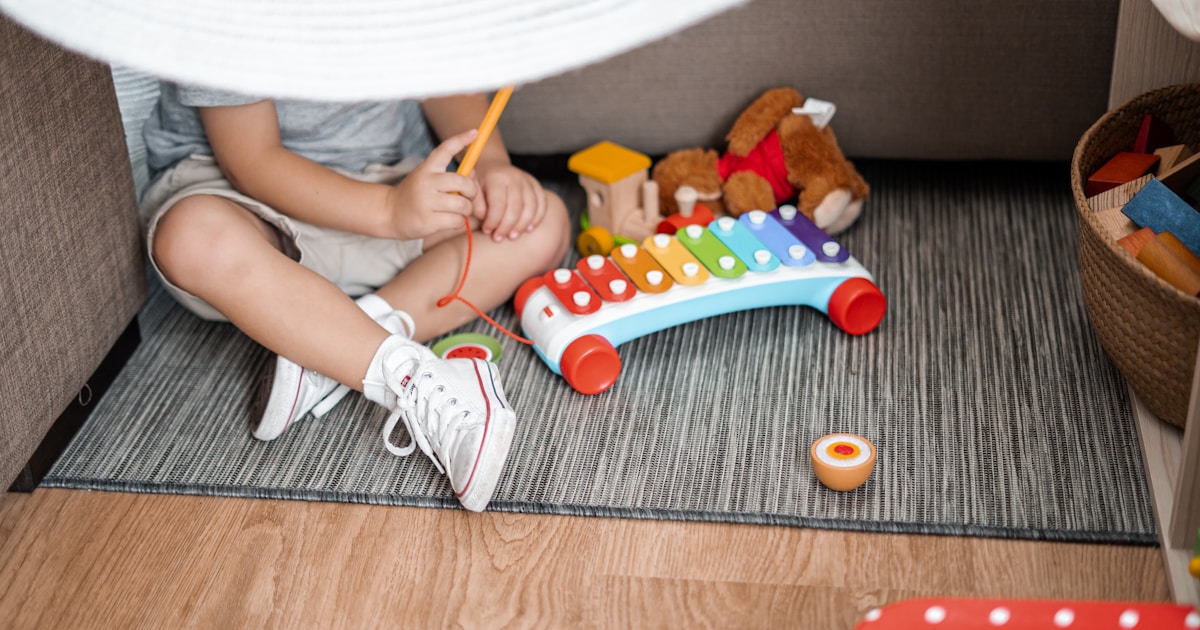
Simple musical instruments are wonderful now too. A maraca, a small drum, a xylophone. They do not need to be making music. They need to be experiencing the thrill of "I did that" every time they bash something and a sound comes out.
9-12 Months: Moving, Problem-Solving, and Getting Into Everything
By nine months, most babies are mobile in some form. Crawling, shuffling, pulling up to standing, cruising along furniture. Play becomes less about lying on a mat and more about movement, exploration, and figuring out how the world works.
Activity cubes and shape sorters come into their own here. Your baby is starting to understand that objects have properties. This shape fits there. This lid comes off. This drawer opens (and everything inside can be removed and scattered across the floor at impressive speed).
Push-along toys encourage those wobbly first steps. Nesting cups teach size relationships. Simple puzzles with chunky knobs develop fine motor skills. And empty cardboard boxes remain, inexplicably, more interesting than any toy you have ever purchased.
The best thing you can do at this stage is get down on the floor with them and follow their lead. If they are fascinated by opening and closing a cupboard door, that IS the activity. If they want to put a ball in a bowl and take it out again forty-seven times, that is building neural pathways. Your job is to narrate, encourage, and resist the urge to redirect them to the "proper" toy.
What You Can Skip Entirely
A quick word on what is not worth your money or your shelf space:
- Electronic toys that "teach" letters and numbers. Babies under one learn through sensory exploration and human interaction, not recorded voices. Save these for toddlerhood if you want them at all.
- Anything marketed as making your baby smarter. The research is clear: responsive parenting and free play are what build healthy brains. No toy can replicate that.
- Too many toys at once. Babies are easily overwhelmed. Three or four options at a time is plenty. Rotate toys in and out every few days to keep things fresh without buying more.
- Expensive "developmental" subscriptions. Your baby genuinely does not know the difference between a beautifully packaged wooden toy and a whisk from your kitchen drawer. Both are equally fascinating.
The Stuff That Actually Matters
Across every single stage from zero to twelve months, the things that genuinely support your baby's development are refreshingly low-tech:
- Floor time. Lots of it. On their tummy, on their back, sitting, crawling. The floor is where physical milestones happen.
- Your voice. Narrating what you are doing, reading books, singing badly. Language development starts here.
- Variety of textures. Smooth, crinkly, soft, rough, warm, cool. Sensory input builds brain connections.
- Freedom to explore safely. Baby-proofing one room properly beats hovering anxiously over every move.
- A few good-quality, open-ended toys. Things that can be used in multiple ways last longer and engage developing brains better than single-purpose gadgets.
You do not need to be an entertainer. You do not need to fill every moment with structured activity. Sometimes the best thing you can do is put your baby on a mat with a wooden spoon and a saucepan lid, sit nearby with your tea, and let them figure it out. That is not lazy parenting. That is exactly what their brain needs. ✨
Add a good play mat and a handful of simple, safe toys to your registry and you are genuinely set for the entire first year. Everything else is optional.
Ready to Create Your Baby Registry?
Start your free baby registry today and share it with friends and family.
Get Started Free