Baby-Proofing Your Home: A Room-by-Room Guide for When Crawling Starts
Your baby just worked out how to move. Here is every room in your house, the hazards hiding in plain sight, and what to do about them before anyone gets hurt.
The first time your baby crawls, you feel an enormous swell of pride. You grab your phone, you film it, you send it to every group chat you belong to. Then, roughly forty-five seconds later, you watch them head straight for the one thing in the entire room that could hurt them, and the pride is replaced by something closer to mild panic.
Babies have an uncanny gift for finding hazards you never even registered. The slightly loose radiator cover. The dog bowl tucked under the kitchen table. That one cupboard door you assumed was too stiff for tiny hands. Spoiler: it is not too stiff.
The good news? Baby-proofing does not have to mean turning your house into a padded cell. Most of it is common sense, a few well-placed locks, and about twenty minutes per room with a fresh pair of eyes. This guide walks you through every room so you can tick it off and stop hovering.
When Should You Start?
Most babies start crawling between six and ten months, but some skip crawling entirely and go straight to cruising along furniture. The best time to baby-proof is before they are mobile, ideally around five or six months, because once they are on the move you will not have time to order stair gates while simultaneously retrieving a shoe from someone's mouth.
If your little one is already crawling and you have not started, do not worry. Get down on your hands and knees in each room and look at the world from their height. You will spot things you have walked past a thousand times.
The Living Room
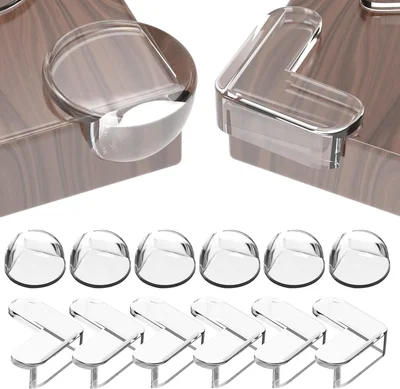
This is where most families spend the most time, which means it is also where most minor bumps happen. Coffee tables with sharp corners are the classic culprit. A set of stick-on corner protectors takes about three minutes to fit and saves a lot of tears.

Other things to check in here:
- Plug sockets - fit socket covers on any you are not using. Yes, even the one behind the sofa.
- TV and furniture - anchor your TV, bookshelf, and any freestanding furniture to the wall. Tip-overs are one of the most serious risks and one of the easiest to prevent with a simple anti-tip strap.
- Trailing cables - phone chargers, lamp leads, anything dangling at grab height. Tidy them behind furniture or use cable clips.
- Houseplants - some common ones are toxic if chewed. Move them up high or check whether yours are safe. (Peace lilies and pothos are not.)
The Kitchen
Kitchens are fascinating to babies and terrifying to parents, for exactly the same reasons. Everything is colourful, makes noise, and is potentially dangerous. The key move here is multi-use cupboard locks. One pack covers the lot: under-sink cleaning products, the cutlery drawer, the bin cupboard.
Beyond locks, keep an eye on:
- The oven and hob - a hob guard stops curious hands reaching up to hot pans. Turn pan handles inward every time you cook until it becomes muscle memory.
- The dishwasher - an open dishwasher door is an irresistible climbing frame. Close it the second the cycle ends.
- Fridge magnets - small magnets are a choking hazard. Swap decorative ones for large, flat versions.
- Pet bowls - babies will eat the cat food. They will also drink the water and tip it over themselves. Move bowls to a gated-off area or feed pets while baby is napping.
The Stairs and Hallway
A stair gate is probably the single most important piece of baby-proofing kit you will buy. You need one at the top and one at the bottom. Pressure-fit gates work brilliantly for most setups and do not require drilling into your walls, which is a relief if you are renting.
A few tips for choosing and fitting:
- Measure your doorway or stair opening before you order. Gaps wider than about 80cm may need extension panels.
- Always check the gate is properly locked after passing through. The number-one gate failure is a grown-up forgetting to click it shut.
- If you have an awkward-shaped opening (angled banisters, uneven walls), look for gates with adjustable fittings rather than forcing a standard one to fit.
The Bathroom
The simplest rule for bathrooms: keep the door shut. A closed door is the best baby-proofing there is. But since doors do get left open (especially by older siblings), it is worth covering the basics.
- Toilet - a toilet lock stops little hands lifting the lid. Drowning can happen in very shallow water, so this is not overkill.
- Medicine cabinet - move anything medicinal up high or into a locked cabinet. Paracetamol, vitamins, even cough syrup.
- Non-slip mat - one inside the bath and ideally one on the floor beside it.
- Hot water - check your boiler thermostat. Water should be no hotter than 48°C to prevent scalds.
The Nursery and Bedrooms
You might think the nursery is already safe since you set it up with a baby in mind. Worth double-checking a few things once they are mobile, though.
- Cot mattress height - lower it to the bottom setting once your baby can pull themselves up to standing. This is the one people forget until they walk in and find their baby grinning at them from the top rail.
- Blind cords - looped cords are a strangulation risk. Switch to cordless blinds or fit a cleat high up on the wall to wrap the cord around.
- Chest of drawers - anchor it to the wall, especially if drawers double as steps. (They will try.)
- Small items on shelves - coins, hair clips, button batteries. Anything smaller than a toilet roll tube is a choking hazard.
Create a Safe Play Zone
Even with every room ticked off, there will be moments when you need a guaranteed safe space, somewhere you can put your baby down, dash to the loo, and know they cannot reach anything dangerous. A playpen or room divider is genuinely useful for this, not as a permanent parking spot, but as a five-minute safety net.
Some parents feel guilty about playpens. Do not. A contained space with a few toys while you answer the door or make lunch is perfectly fine. Your baby does not know they are in a pen. They think they are in a very exciting toy zone.
The Bits Everyone Forgets
No checklist is truly complete, because babies are endlessly creative at finding new ways to give you heart palpitations. But here are a few commonly missed ones:
- Door hinges - finger traps. A foam door stopper wedged over the top of the door stops it closing fully on tiny fingers.
- Handbags and visitor bags - medications, keys, coins, lip balm. Ask guests to put bags up high.
- Shoe racks - laces, buckles, and the general deliciousness of chewing on a shoe. Move them out of reach or behind a closed door.
- Recycling bins - tin lids, broken glass, small plastic caps. Treat recycling like rubbish and keep it locked away.
You Do Not Have to Do It All at Once
If this list feels overwhelming, start with the room you use most and work outward. The living room and kitchen are the highest priority. Stairs come next. Bathrooms and bedrooms can follow once you have the basics covered.
And remember, baby-proofing is not a one-time job. As your little one grows taller, stronger, and more determined, you will need to re-check. What was out of reach at eight months is firmly within grabbing distance at fourteen months. Stay one step ahead, literally.
If you are building a registry and want to add safety essentials alongside the cute stuff, you can set one up at bubsnest.co. Because stair gates are not glamorous, but they are the gift that actually gets used every single day. 🛡️
Ready to Create Your Baby Registry?
Start your free baby registry today and share it with friends and family.
Get Started Free