Baby Registry for Small Spaces: The Compact Gear That Actually Fits Your Flat
Living in a small flat does not mean you need less for your baby. It means you need smarter choices. Here is the compact, foldable, multi-tasking gear that earns its place when square footage is tight.
There is a particular kind of panic that sets in around week 28 when you look at your one-bedroom flat, then look at a baby registry checklist, and wonder where exactly you are supposed to put all of it. The travel system alone seems bigger than your hallway. 😅
Here is the thing, though. Having less space does not mean your baby gets less. It means you get to be smarter about what comes through the door. Every item has to earn its spot, fold flat, serve more than one purpose, or ideally all three.
This guide is for the parents building a registry from a flat, a terrace house, or a bedroom that is already pulling double duty. No enormous nursery required. No guilt about not having a dedicated changing room. Just the gear that genuinely works when square footage is tight.
The Golden Rule of Small-Space Baby Gear
Before you add a single thing to your registry, ask this: can it fold, stack, or serve two purposes? If the answer is no, it needs to be really, truly essential to earn its place. A beautiful rocking chair is lovely. It is also a permanent resident of whatever corner it lands in. A feeding pillow that tucks into a drawer? That is small-space thinking.
The second question: where will this live when it is not in use? Pushchairs live in hallways. Baths need to go somewhere between uses. Highchairs lurk in kitchens. If you cannot picture its resting spot, think twice.
Sleep: The Cot That Disappears
In a small flat, a full-size cot is often the single biggest space commitment. It sits there 24 hours a day, taking up a chunk of your bedroom or living room, and your baby actually sleeps in it for maybe 12 of those hours.
A foldable travel cot used as a primary sleep space is one of the smartest small-flat moves going. Modern ones have proper mattresses, breathable mesh sides, and fold down to something you can slide behind a sofa or under a bed. You get the floor space back during the day, which in a small flat feels like actual magic.
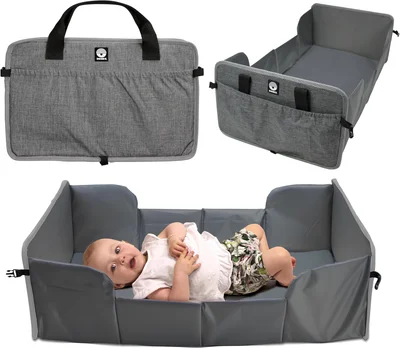

A bedside crib is another brilliant option if your baby sleeps in your room. It tucks against your bed, takes up almost no additional floor space, and makes night feeds infinitely easier because you barely have to move. When your baby outgrows it, it packs away completely.
Changing: Skip the Table, Keep the Mat
A dedicated changing table is one of those items that looks essential on every registry list but is genuinely one of the easiest things to skip in a small flat. It takes up the same space as a small chest of drawers and does exactly one thing.
Instead, a portable changing mat on top of your existing chest of drawers, bed, or sofa does the same job with zero additional footprint. Pair it with a nappy caddy (which you can carry room to room) and you have a changing station that exists only when you need it.
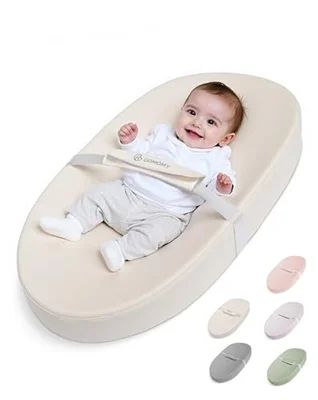
The waterproof, wipeable mats are particularly good for this. No fitted cover to wash, no frame to navigate around. Just unroll it, do the change, wipe it down, roll it up. Done. Your bedroom goes back to being a bedroom.
Bathing: The Fold-Flat Bath
Baby baths are bulky and oddly shaped, which makes them a storage nightmare in a small bathroom. A foldable bath solves this neatly. They collapse to a few centimetres thick and slot into the gap beside your washing machine or behind the bathroom door.
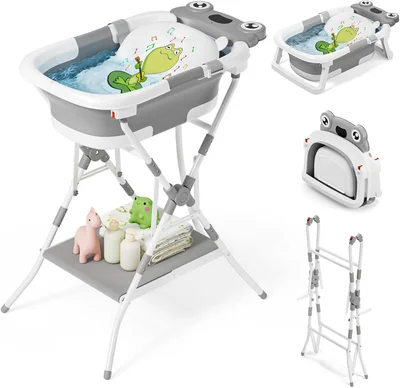
Some parents in really tiny flats skip the baby bath entirely and just use the kitchen sink for the first few months (it is actually a great height for your back). But when you want something purpose-built, foldable is the way. You get a proper bath with a newborn support, and it vanishes between uses.
Feeding: A Highchair That Folds Away
Highchairs are one of those items you do not need until around six months, but when you do need one, you need it for every single meal for the next couple of years. In a small kitchen, a full-size highchair is a permanent obstacle course.
A folding highchair gives you the stability and safety of a proper chair at mealtimes, then folds flat and slides against a wall or into a cupboard afterwards. Some fold so slim they are genuinely just a few centimetres deep when stored.
If your kitchen is truly tiny, a clip-on seat that attaches directly to your table is worth considering. No legs on the floor at all, no storage footprint. Just check your table edge is sturdy enough first.
Getting Out: The Compact Pushchair
The pushchair is often the biggest single item in any flat, and it lives in the most annoying spot: the hallway. A compact, lightweight stroller makes an enormous difference to daily life. Easier to wrestle through narrow doorways, lighter to carry up stairs, and it folds small enough to actually fit in a cupboard rather than blocking the front door.
If you are choosing between a travel system and a lightweight stroller, consider this: a travel system gives you the newborn carrycot and car seat compatibility, but it is significantly bigger when folded. A lightweight stroller works from around six months. Some parents start with a sling or carrier for the first few months and then move to a compact stroller, skipping the enormous travel system entirely. In a small flat, that is a genuinely clever strategy.
What You Can Safely Skip (or Borrow)
Not everything on a standard registry list needs to live in your flat permanently. Some things you only need for a few weeks, some you barely use at all, and some have simpler alternatives.
- Moses basket: Lovely, but your baby outgrows it in about eight weeks. Borrow one, or go straight to a bedside crib.
- Baby swing: Takes up a huge amount of floor space for something most babies use for a few months. A bouncer is smaller and lighter.
- Nappy bin: A regular pedal bin with a lid works just as well and does not need special refill cassettes.
- Bottle warmer: A jug of hot water does the same thing. One less gadget on your counter.
- Nursery wardrobe: A few hooks on the back of a door and a drawer in your own wardrobe is plenty for tiny clothes.
Storage Tricks That Actually Work
The secret to living with a baby in a small space is not having less stuff. It is having stuff that lives in smarter places.
- Over-door hooks: Hang your changing bag, muslins, and baby carrier on the back of the bedroom door. Instant storage, zero floor space.
- Under-bed storage: Flat boxes under your bed are perfect for outgrown clothes, spare bedding, and bulk nappy packs.
- Vertical shelving: A narrow bookshelf or floating shelves hold nappies, creams, and books without eating into your floor space.
- One-in-one-out rule: When a new size of clothes comes in, the outgrown ones go into a vacuum bag under the bed or straight to a friend.
Your Small-Space Registry Checklist
Here is a streamlined list for flat-dwelling parents. Everything on it is either compact, foldable, or multi-purpose.
- Foldable cot or bedside crib
- Portable changing mat and nappy caddy
- Foldable baby bath (or plan to use the sink)
- Compact pushchair or baby carrier
- Folding highchair (from six months)
- Bouncer (folds flat when not in use)
- Slim storage solutions (hooks, under-bed boxes, floating shelves)
- A good-quality changing bag that doubles as your everyday bag
That is genuinely it for the big stuff. Everything else, muslins, bottles, clothes, blankets, fits in drawers you already have. You do not need a nursery to have a brilliant setup. You just need a plan. 🏡
Start building your small-space registry at BubsNest, where you can add items from any shop and share your wishlist with family and friends.
Ready to Create Your Baby Registry?
Start your free baby registry today and share it with friends and family.
Get Started Free