Best Nappy Bins UK 2026: £15 vs £50 vs £76
Three nappy bins at three price points. We compare the Angelcare Classic XL, Magic HEKA Telescopic and Ubbi Stainless Steel to help you pick the right one for your budget and nursery.
BUYER’S GUIDE · NAPPY DISPOSAL
A nappy bin is one of those purchases you do not think much about until you are elbow-deep in a midnight change and the smell hits. The market ranges from a £15 plastic pail with refill cassettes to a £76 stainless steel unit that uses ordinary bin bags and promises to last well beyond the nappy years. The difference is not just price. It is a choice between ongoing cassette costs and standard bags, between compact capacity and room for seventy nappies, between recycled plastic and powder-coated steel.
We compared three bins covering the full UK price spectrum: the Angelcare Classic XL at roughly £15, the Magic HEKA Telescopic at £50 and the Ubbi Stainless Steel at £76. Each takes a fundamentally different approach to the same problem. Here is exactly what your money buys at each tier.
Quick picks
- Best premium bin (£76): Ubbi Stainless Steel – nine awards, stainless steel body that never absorbs odours, uses standard bin bags, childproof sliding lid, 55-nappy capacity, available in twelve colours
- Best mid-range bin (£50): Magic HEKA Telescopic – patented Drop & Turn odour seal, telescopic height adjustment, uses standard household bags, 100% recycled materials, converts to a bathroom bin after nappy years
- Best budget bin (£15): Angelcare Classic XL – largest capacity at 70 nappies, easy one-handed operation, octagonal cassettes using 7x less film, trusted brand with 25 years of heritage
Comparison at a Glance
| Ubbi Stainless Steel | Magic HEKA | Angelcare Classic XL | |
|---|---|---|---|
| Price | £76–100 | £50 | £15–30 |
| Capacity | 55 nappies | 30 nappies (expandable) | 70 nappies |
| Material | Powder-coated stainless steel | 100% recycled plastic | Plastic |
| Odour control | Steel body + rubber seal + sliding lid | Patented Drop & Turn wave-seal drum | Push-and-lock clamp + cassette film |
| Bags | Standard kitchen bin bags | Standard bags or Magic bags | Proprietary octagonal cassettes |
| Running cost (yearly) | £0 (standard bags) | £0 (standard bags) | ~£60 (cassette refills) |
| Childproof lock | Yes | No | No |
| Colours | 12+ | 7 | 1 (White) |
| Nest Score | 8.2 | 7.3 | 7.8 |
What We Looked For
Every bin was assessed against five criteria that matter most when you are dealing with a dozen or more nappy changes a day and want the nursery to smell like a nursery, not a landfill.
Odour control: The whole point of a dedicated nappy bin. We looked at the sealing mechanism, whether the body material absorbs smells over time and how well the bin performs after two or three days without emptying.
Capacity: How many nappies can the bin hold before it needs emptying? A larger capacity means fewer trips to the wheelie bin, which matters especially overnight or during winter months when you would rather not go outside.
Running costs: The upfront price tells only half the story. Cassette-based systems lock you into proprietary refills that can add £50–60 per year. Bins that accept standard bags cost virtually nothing to run. We calculated the total cost of ownership over 18 months.
Build quality and longevity: Will the bin survive a toddler knocking it over? Does it still look presentable after six months? Can it be repurposed once the nappy phase ends? We checked materials, design durability and long-term versatility.
Ease of use: Can you operate it one-handed while holding a wriggly baby? Is it easy to empty and clean? We prioritised bins that work in the real-world chaos of a nappy change rather than just looking good on a shelf.
Ubbi Stainless Steel Nappy Bin
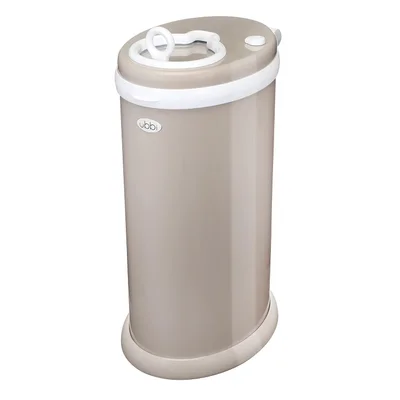

The Ubbi is the bin that parents buy once and keep for years. Its powder-coated stainless steel body is not just a design choice. Steel does not absorb odours the way plastic does, which means the bin smells no worse on day three hundred than it did on day one. A rubber seal around the rim and a smooth sliding lid work together to trap smells inside, and a childproof lock keeps curious toddler fingers out.
The real selling point is what you do not need to buy. The Ubbi works with any standard tall kitchen bin bag. No cassettes, no proprietary refills, no subscription. One reviewer calculated that cassette-based systems cost over £200 in refills across 18 to 24 months. The Ubbi pays for itself roughly a year in.
It holds 55 newborn nappies in its 59-litre interior and comes in over twelve finishes, from Sage Green to Chrome to Woodgrain. It has won nine awards including the Mumii Gold Award for Best Nappy Disposal System, and with nearly 25,000 reviews averaging 4.4 out of 5, the verdict from parents is consistently positive.
The trade-off is upfront cost and a small practical compromise. The sliding lid is manual rather than push-through, so it is not truly one-handed in the way cassette systems are. And when you do open it after a couple of days, the accumulated smell can be strong. It works best when emptied every two to three days.
One parent shared: “Expensive initially, but then you can just use normal bin liners – so much cheaper in the long run.”
Another noted: “After three years and two children, I do not see why it will not keep going for future kids – unlike the plastic ones friends have thrown out.”
Pros
- Stainless steel body never absorbs odours, unlike plastic alternatives
- Uses standard kitchen bin bags with zero ongoing refill costs
- Childproof sliding lid with locking switch for safety
- Available in 12+ colour finishes to match any nursery decor
Cons
- Highest upfront cost at £76–100, with a 12–18 month payback period
- Sliding lid is manual, not truly one-handed like push-through systems
- Bin liner can occasionally slip out of position inside the steel drum
Best for: Style-conscious parents happy to invest upfront for a premium, long-lasting bin with no ongoing refill costs and excellent durability.
Magic HEKA Telescopic Nappy Bin
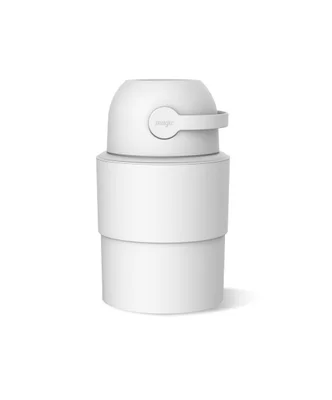
The Magic HEKA is the mid-range option that tries to give you the best of both worlds: cassette-free running costs with a clever odour-control mechanism that goes beyond what a standard pedal bin can manage. Made by Italian nursery brand Foppapedretti and sold through Mamas & Papas in the UK, it brings a distinctly European design sensibility to a product category dominated by functional plastic.
The standout feature is the patented Drop & Turn system. You drop the nappy through the top opening, turn the handle, and a wave-seal drum locks the smell inside. The bin is marketed as 100% odourless when closed, and parents who use it correctly generally agree. It accepts standard household bin bags or optional Magic-branded bags for enhanced protection, so ongoing costs stay near zero.
The telescopic design is genuinely clever. The bin starts compact and extends in height as it fills, then collapses back down once emptied. An optional bathroom lid lets you convert it into a regular waste bin after the nappy years, giving it a second life rather than heading for the recycling centre.
The compromise is capacity and track record. At around 30 newborn nappies, it fills up roughly twice as fast as the Angelcare and nearly twice as fast as the Ubbi. It is also relatively new to the UK market, so the depth of long-term parent reviews is thinner than for the established competitors. Some early users have reported that the odour seal can lose effectiveness after a few months, and standard bin bags may not sit as securely as the branded alternatives.
One parent shared: “Love that you do not need to purchase expensive refills – it just uses normal bags.”
Another noted: “The telescopic design is clever; it grows as you fill it and tucks away neatly when empty.”
Pros
- No proprietary cassettes – uses standard household bin bags, keeping running costs near zero
- Patented Drop & Turn odour seal effectively locks smells inside when used correctly
- Telescopic design expands as it fills and collapses for compact storage
- Made from 100% recycled materials and converts to a bathroom bin post-nappy phase
Cons
- Smallest capacity at 30 nappies, requiring more frequent emptying
- Limited UK review history makes long-term reliability harder to verify
- Some reports of the odour seal losing effectiveness after several months of use
Best for: Eco-minded parents who want to avoid cassette lock-in and prefer a stylish, Italian-designed bin that can be repurposed once the nappy phase ends.
Angelcare Classic XL Nappy Bin
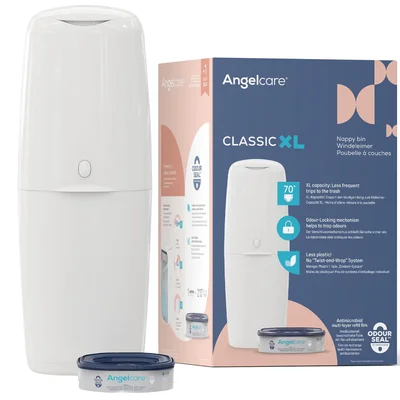
The Angelcare Classic XL is the bin you buy when the budget matters and you want something that simply works. At around £15, it is the cheapest branded nappy bin on the UK market, and it includes one octagonal refill cassette in the box to get you started immediately.
The XL earns its name with the largest capacity in this comparison: up to 70 size-1 nappies before it needs emptying. For parents with twins, or anyone whose outdoor bin involves a walk across a garden in the rain, that extra capacity is a genuine daily convenience. The push-and-lock clamp system lets you drop a nappy in one-handed without any twisting or fiddling, which makes it the easiest bin here to use during a frantic nappy change.
Angelcare redesigned the cassette system for the Classic XL. The octagonal refills use up to seven times less plastic film than older round cassettes, and each one holds up to 210 size-1 nappies, lasting several weeks of normal use. It is a meaningful improvement over the brand’s previous generation.
The catch is ongoing cost. A three-pack of refills costs roughly £15 and lasts about three months, working out to around £60 per year. Over 18 months, that turns a £15 bin into a £105 investment. Some parents also report that the plastic body can absorb odours over time, developing a lingering smell after several months of heavy use. And unlike the Ubbi or Magic HEKA, you cannot use standard bin bags – you are locked into the Angelcare refill ecosystem.
One parent shared: “Been amazing for the last six months – would definitely get one again.”
Another noted: “It is easy to clean, easy to change the cartridge, takes up hardly any room, and makes nappy changes generally better.”
Pros
- Lowest upfront cost at roughly £15 with one cassette included
- Largest capacity at 70 nappies, reducing trips to the outside bin
- Genuinely easy one-handed operation via push-and-lock clamp
- Octagonal cassettes use 7x less film than older round refills
Cons
- Ongoing cassette refills add roughly £60 per year to the total cost
- Plastic body can absorb odours over time, developing a lingering smell
- Locked into the Angelcare refill ecosystem – no standard bag option
Best for: Budget-conscious parents who want reliable, fuss-free odour control with the largest capacity at the lowest upfront price.
The Verdict: Which Should You Buy?
All three bins do the fundamental job: they contain nappy smells so your nursery does not reek. The difference is what you are willing to pay upfront, what you are willing to pay ongoing, and how long you want the bin to last.
If you want the best long-term value, the Ubbi Stainless Steel at £76 is the smartest investment. It costs nothing to run, the steel body never absorbs smells, and parents routinely report using the same bin across multiple children. The upfront price pays for itself in about a year compared to cassette systems, and you get a genuinely attractive piece of nursery furniture in the process.
If you want cassette-free convenience without the premium price, the Magic HEKA at £50 sits in an interesting middle ground. The telescopic design is clever, the running costs are near zero, and the eco credentials are strong. Just be aware of the smaller capacity and the thinner UK review history. It suits parents who empty regularly and want a bin that lives beyond the nappy phase.
If you want the lowest entry price and maximum capacity, the Angelcare Classic XL at £15 is the no-brainer starting point. It holds 70 nappies, works one-handed, and the improved octagonal cassettes are more efficient than the old design. Factor in the £60-per-year refill cost when budgeting, and know that the total 18-month cost sits around £105 – still less than the Ubbi upfront.
For most parents, the decision comes down to whether you prefer low upfront cost or low running cost. If you plan to have more than one child, the Ubbi is almost certainly the better deal over time. If this is your first baby and you are still working out what you need, the Angelcare gets you started for the price of a takeaway.
Add to Your Nest
Building your baby essentials list? Add any of these bins to your BubsNest registry and let family and friends know exactly which one you want. No more guessing games, no more unwanted gifts – just the nappy bin that suits your nursery, your budget and your nose.
Ready to Create Your Baby Registry?
Start your free baby registry today and share it with friends and family.
Get Started Free