Lansinoh Manual vs Medela Harmony: Which Manual Breast Pump Deserves a Spot in Your Changing Bag?
Two of the most popular manual breast pumps in the UK go head to head. We compare the Lansinoh Manual and Medela Harmony on comfort, portability, value, and real parent feedback to help you pick the right one.
COMPARISON · FEEDING
Choosing a manual breast pump feels like it should be simple, until you realise two of the most recommended options sit at almost the same price point and promise almost the same things. The Lansinoh Manual Breast Pump and the Medela Harmony are the two names that come up again and again in parent groups, antenatal class chats, and "what pump should I buy?" threads. Both are closed systems, both use two-phase expression technology, and both will fit inside a changing bag without taking up much room.
So which one actually deserves your money? We dug into the specs, handled both pumps, and gathered feedback from parents who have used them through the bleary-eyed reality of early feeding. Here is what we found.
Lil' Bubba's verdicts
- Best Overall: Lansinoh Manual Breast Pump · 7.5/10 - two flange sizes in the box, better tested expression rate, and strong value
- Best for Travel: Medela Harmony · 7.0/10 - lighter at 105 g, ultra-compact, and trusted brand with wide parts availability
Quick comparison
| Lansinoh Manual | Medela Harmony | |
|---|---|---|
| Price | ~£25 | ~£21 |
| Weight | ~136 g | 105 g |
| Flange sizes included | 2 (25 mm + 30.5 mm) | 1 (24 mm) |
| Additional sizes available | 21 mm | 21, 27, 30, 36 mm |
| Bottle capacity | 150 ml | 150 ml |
| Two-phase expression | Yes | Yes |
| Teat included | Yes (NaturalWave) | Yes (Calma, UK) |
| Dishwasher safe | Yes | Yes |
| Rating |
How we picked the two
We started with the manual breast pumps that parents on our platform add to their Nests most often. The Lansinoh Manual and Medela Harmony consistently appear in the top handful. Both sit at accessible price points, both are widely available from UK retailers with joined affiliate programmes, and both have enough real-world parent feedback for us to draw meaningful conclusions rather than just parroting spec sheets. We then cross-referenced independent lab data, parent reviews, and hands-on testing notes to build this comparison.
What to look for in a manual breast pump
Before you compare specific models, it helps to know what separates a good manual pump from a frustrating one.
Flange fit matters more than brand. The flange (or shield) is the funnel-shaped piece that sits over your nipple. If the diameter is wrong, pumping hurts and output drops. Some pumps include multiple sizes; others ship with one and sell extras separately. Getting the right fit is the single biggest factor in comfortable, effective pumping.
Two-phase expression mimics natural feeding. Most modern manual pumps offer a quick, light "let-down" mode and a slower, deeper "expression" mode. This encourages a stronger milk flow and reduces the time you spend pumping.
Portability is the whole point. You are choosing a manual pump precisely because you need something quiet, battery-free, and small enough to throw in a bag. Weight, assembled size, and the number of parts all matter when you are pumping in a car park, a guest bedroom, or a work toilet.
Cleaning and assembly should be simple. At 3 a.m. you do not want a pump with 20 tiny parts. Fewer components, dishwasher-safe materials, and a design that comes apart and goes back together without a manual are all worth paying for.
1. Lansinoh Manual Breast Pump
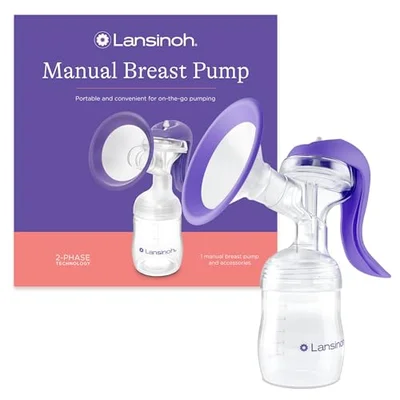
Lansinoh has been a trusted name in breastfeeding for decades, and their manual pump reflects that experience. The standout feature is what comes in the box: two ComfortFit flange sizes (25 mm and 30.5 mm), a NaturalWave teat, a storage bottle, and a cleaning brush. Most competitors give you one flange and charge extra for alternatives.
The ergonomic handle is designed to reduce hand fatigue during longer sessions, and the pump switches between a quick stimulation phase and a slower expression phase without any fiddly buttons. It is also one of the quieter manual pumps we have seen, which matters when you are expressing in a room next to a sleeping baby.
What parents love
- Comfortable even during longer sessions. One parent told us: "It is honestly all so lightweight and easy to squeeze that I thought nothing was happening at first, but when I looked down, milk was being expressed."
- Genuinely quiet and discreet. A parent shared: "The expressing action is silent so you can express discreetly. It is compact and light, meaning it is easy to carry in a changing bag."
- Simple to use and clean. We hear repeatedly from parents that: "It is easy to use, easy to clean and does not hurt. I would choose this over any other manual breast pump on the market."
- Two flange sizes included. Parents appreciate not having to guess their size or pay extra. The 25 mm and 30.5 mm options cover a wide range of fits out of the box.
What to know before you buy
- Hand fatigue with extended use. Like all manual pumps, longer sessions can tire your hand. Parents who pump for more than 15 minutes at a time may want to alternate hands.
- Slower than electric pumps. Manual pumps are inherently slower. This is not an exclusive-pumping solution, it is a backup or on-the-go companion.
- Narrow-necked bottles. The included bottle uses Lansinoh's own narrow neck, so you may need an adaptor if you want to pump directly into another brand's bottles.
Best for
- Occasional and backup pumpers who want a reliable manual option alongside an electric pump
- First-time pumpers who value simple assembly and intuitive operation
- Budget-conscious parents who want two flange sizes included without paying extra
- Travel and on-the-go parents who need something silent and battery-free

2. Medela Harmony
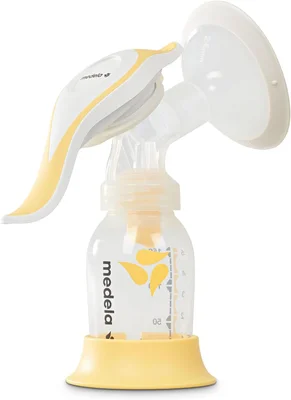
Medela is the brand you will find in hospital pumping rooms across the country, and the Harmony brings that clinical credibility into a pocket-sized manual pump. At just 105 g, it is noticeably lighter than the Lansinoh, and its PersonalFit Flex shield has an oval shape designed to move with your body rather than press rigidly against it.
The two-phase handle action is smooth and intuitive, switching between stimulation and expression with a change in your grip pressure. Medela also offers the widest range of replacement shield sizes (five in total, from 21 mm to 36 mm), which is a real advantage if the included 24 mm does not suit you.
What parents love
- Ultra-compact and featherlight. One parent told us: "I went to the cinema with friends and actually pumped out a full bottle without anyone noticing."
- Comfortable PersonalFit Flex shield. A parent shared: "I cannot believe the difference. It really feels like it is made with mums in mind to help make pumping feel comfortable and stress free."
- Built to last. We hear repeatedly from parents that: "I used mine for over five years and two babies. It is brilliant."
- Wide parts ecosystem. If you already own a Medela electric pump, the Harmony shares shields, valves, and membranes, so you only carry one set of spares.
What to know before you buy
- Only one flange size in the box. The 24 mm shield is a medium fit. If you need a different size, replacement shields cost around £15 each.
- Expression rate can be slower. Independent testing found the Harmony expressed milk at a lower rate per minute than the Lansinoh. For quick pump-and-go sessions this is rarely noticeable, but it adds up over longer sessions.
- Hand fatigue during extended use. As with any manual pump, sessions beyond 15 minutes can tire your hand. The handle is comfortable but not immune to physics.
Best for
- On-the-go and travelling parents who need an ultra-compact pump that fits in a handbag
- Parents already in the Medela ecosystem who want part compatibility across pumps
- Occasional pumpers who value brand trust and wide availability of replacement parts
- Parents who need a wide range of shield sizes (five options available)
What about the Philips Avent Manual?
The Philips Avent Manual Breast Pump is another popular choice at a slightly higher price point (~£30-35). Its soft silicone cushion moulds to the nipple during pumping, and it includes a Philips Avent feeding bottle with teat. Parents often praise its leak-resistant design and comfortable cushion. If you are already using Philips Avent bottles, the compatibility is seamless. We do not currently carry it through a joined programme in all configurations, but it is worth looking at if neither the Lansinoh nor the Medela feels right.
How to choose
Choose the Lansinoh Manual if you want the best value out of the box. Two flange sizes, a teat, and a cleaning brush all included at ~£25 means you are unlikely to need any extras on day one. It is also the better performer in independent expression-rate testing, so if efficiency matters to you, the Lansinoh edges ahead.
Choose the Medela Harmony if portability is your top priority. At 105 g it is genuinely handbag-friendly, and the PersonalFit Flex shield is one of the most comfortable on the market. If you already own Medela electric pump parts, the shared ecosystem saves money and bag space. Just budget for an extra shield if 24 mm is not your size.
Both pumps are honest, well-made tools for occasional and backup pumping. Neither replaces an electric pump for exclusive expressers, but that is not what they are for. They are for the cinema trip, the overnight stay at grandma's, and the 6 a.m. relief pump when the baby sleeps through for the first time.
Whichever you pick, add it to your free BubsNest registry so friends and family know exactly which one to buy.
Ready to Create Your Baby Registry?
Start your free baby registry today and share it with friends and family.
Get Started Free