
Love to Dream Swaddle Up vs ergoPouch Cocoon: Arms Up or Arms In?
Two award-winning swaddles, two very different design philosophies. We compare the arms-up Love to Dream against the arms-in ergoPouch Cocoon to help you pick the right one for your baby.
COMPARISON · NURSERY & SLEEP
The newborn swaddle decision feels small on your registry checklist, but it can make or break those bleary-eyed early weeks. Two products dominate nursery wishlists right now: the Love to Dream Swaddle Up, with its distinctive arms-up silhouette, and the ergoPouch Cocoon Swaddle Sack, with its arms-in-to-arms-out flexibility. They solve the same problem differently, and which one suits your baby comes down to one question: does your little one prefer sleeping with hands near their face, or tucked in snugly?
We compared specs, materials, real-world performance, and spoke to dozens of parents who swear by each. Both have won industry awards, both are recognised by the International Hip Dysplasia Institute, and both have enthusiastic followings. The differences, though, matter more than you might expect.
Lil’ Bubba’s verdicts
- Best Overall: Love to Dream Swaddle Up · 8.5/10 - natural arms-up position suits most newborns from day one
- Best for Transition: ergoPouch Cocoon Swaddle Sack · 8.0/10 - organic cotton 2-in-1 that grows from swaddle to sleep sack
- Worth a Look: Halo SleepSack Swaddle - 3-way adjustable wrap at the lowest price point
Quick comparison
| Feature | Love to Dream Swaddle Up | ergoPouch Cocoon |
|---|---|---|
| Price (from) | ~£24 | ~£32 |
| TOG options | 1.0 | 0.2, 1.0, 2.5, 3.5 |
| Material | Cotton/elastane jersey | 95% GOTS organic cotton |
| Arm position | Arms up (fixed) | Arms in or out (poppers) |
| Transition path | Separate Transition Bag | Built-in shoulder snaps |
| Hip-healthy | IHDI recognised | IHDI recognised |
| Rating |
How we picked these two
We started with BubsNest registry data: the Love to Dream Swaddle Up is one of the most-added sleep products on our platform, and the ergoPouch Cocoon consistently appears alongside it in wishlists. Both are widely stocked by UK retailers with active affiliate programmes, both have strong review histories, and both represent genuinely different design philosophies. Rather than testing every swaddle on the market, we zeroed in on the comparison parents actually face at 2am when their newborn will not settle.
What to look for in a swaddle
TOG rating tells you the thermal resistance of the fabric. A 1.0 TOG suits most UK nurseries kept between 20-24°C. If your home runs warmer, look for 0.2 TOG; colder rooms in winter need 2.5 or above. Getting this wrong is the most common reason babies sleep restlessly in an otherwise good swaddle.
Arm position is the biggest philosophical divide. Some babies naturally sleep with hands near their face and fight any attempt to pin their arms down. Others settle better with the snug, womb-like containment of arms tucked in. Watch how your baby falls asleep in your arms and that will tell you which camp they fall into.
Transition design matters because most babies outgrow swaddling between 3 and 5 months when they start to roll. A swaddle with a built-in transition path (zip-off arms, shoulder poppers) saves you buying a second product. One without may mean a rocky few nights re-adjusting.
Material and certification matter for sensitive newborn skin. GOTS-certified organic cotton is the gold standard. Look for breathability, stretch, and whether the product has been tested for harmful substances. Hip-healthy certification from the IHDI is a reassuring baseline for any swaddle you consider.
1. Love to Dream Swaddle Up

The Swaddle Up built its reputation on one insight: most newborns naturally sleep with their arms raised. Rather than fighting that instinct with a traditional wrap, Love to Dream designed a swaddle that keeps arms contained but in a natural upward position. The result is a product that often works from the very first night, with minimal fussing and no complicated folding technique to master.
The single-layer cotton-elastane jersey feels stretchy and breathable against skin, and the two-way zip means you can change a nappy without fully unwrapping your baby. At around £24, it is comfortably the more affordable option in this comparison, and the construction holds up well through repeated machine washes.
What parents love
- Instant acceptance. One parent told us: "Our baby took to it almost instantly, and it made a remarkable difference in her sleep patterns." The arms-up design means fewer escape attempts and less midnight re-wrapping.
- Dead-simple design. Legs in, arms in, zip up. Parents we hear from regularly say it takes seconds, even in the dark. No folding, no tucking, no watching tutorial videos at 3am.
- Self-soothing access. Babies can touch their face and suck their hands through the fabric, which helps them settle without a dummy. A parent shared: "My child looks extremely comfortable and likes being able to move her hands."
- Good value. At roughly £24 for the 1.0 TOG, it costs less than most competitors while delivering award-winning performance.
What to know before you buy
- Sizing runs snug. Several parents report needing to size up earlier than expected. If your baby is near the top of a weight range, go up.
- No built-in transition. When your baby starts rolling, you need the separate Love to Dream Transition Bag with zip-off wings, which is an additional purchase.
- Single TOG only. The Original comes in 1.0 TOG. You need the Lite (0.2 TOG) or Warm (2.5 TOG) versions separately if your nursery temperature varies seasonally.
Best for
- Babies who naturally sleep with hands near their face
- Parents who want the simplest possible bedtime routine
- Families on a tighter budget who want proven performance
- Newborns who fight traditional arms-down swaddling
2. ergoPouch Cocoon Swaddle Sack
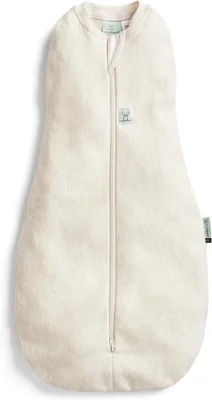
The ergoPouch Cocoon takes a different approach: a firm-yet-stretchy zip-up that cocoons your baby in GOTS-certified organic cotton, with clever shoulder poppers that let you switch from arms-in swaddling to arms-out sleeping as your baby grows. It is a genuine 2-in-1 product, which means you buy one item that carries you from the newborn swaddle stage right through to the sleep-sack stage.
The organic cotton and elastane blend feels noticeably premium against skin, and the bell-shaped bottom gives hips and legs room to move freely. At around £32, it costs more than the Love to Dream, but the built-in transition and wider TOG range (0.2 through 3.5 across the Cocoon line) make it a strong long-term investment.
What parents love
- Buttery-soft organic cotton. One parent told us: "It is really soft and comfortable for my baby and me when breastfeeding." The GOTS certification and Eczema Association approval give parents of sensitive-skinned babies real peace of mind.
- Built-in transition. The shoulder poppers mean you can pop one arm out, then both, without buying a separate product. Parents we hear from regularly say this made the swaddle-to-sleep-sack switch almost seamless.
- Four TOG ratings. From the ultra-light 0.2 TOG for summer to the cosy 3.5 TOG for cold winter nights, the Cocoon range covers every nursery temperature without needing a different brand.
- Proven results. A parent shared: "It has made such a great positive impact on our 16-week-old baby’s sleep." The snug fit calms the startle reflex effectively while still allowing natural chest expansion.
What to know before you buy
- Higher price point. At roughly £32 for the 1.0 TOG, it is about £8 more than the Love to Dream. The organic materials and transition design justify the premium, but it is worth noting if budget is tight.
- Arms-down only (without add-on). The standard Cocoon swaddles arms in. For an arms-up option, you need the separate Butterfly Cardi layered underneath, which adds cost and complexity.
- Can run short. Like many swaddles, longer babies may outgrow the length before they outgrow the weight range. Check measurements, not just weight, before buying.
Best for
- Parents who want one product from newborn through the sleep-sack stage
- Babies with sensitive or eczema-prone skin
- Families who value organic, sustainably produced materials
- Nurseries that vary in temperature across seasons
What about the Halo SleepSack Swaddle?
The Halo SleepSack Swaddle deserves a mention as the budget-friendly third option. At around £18, it is the most affordable swaddle in our catalogue with a 3-way adjustable wrap that lets you swaddle arms in, hands to face, or one arm out. It is used in over 1,700 hospitals and features the same IHDI-recognised hip-healthy design. The trade-off is that it uses hook-and-loop fasteners rather than a zip, which can be noisy during night feeds, and the cotton is not organic. If you are watching every pound on your registry, it is a reliable choice.



How to choose
Choose the Love to Dream Swaddle Up if your baby naturally gravitates towards sleeping with hands near their face. It is simpler, cheaper, and most babies accept it from night one. The arms-up design is genuinely unique and solves a problem that traditional swaddles cannot. You will need to budget for the Transition Bag separately when rolling starts, but the initial outlay is lower and the day-to-day experience is brilliantly straightforward.
Choose the ergoPouch Cocoon if you want a single investment that lasts from the newborn swaddle stage through to independent sleep-sack use. The organic cotton is noticeably softer, the TOG range means you are covered year-round, and the built-in transition saves you buying a second product. It is the better choice for eco-conscious parents and babies with sensitive skin.
Both are excellent swaddles. Neither is a wrong choice. The real deciding factor is your baby’s arms: up or in.
Add it to your Nest
Whichever swaddle catches your eye, you can add it straight to your free BubsNest registry and let friends and family know exactly which one you have chosen. One less decision to make at 2am.
Ready to Create Your Baby Registry?
Start your free baby registry today and share it with friends and family.
Get Started Free