Maxi-Cosi Minla Plus vs Stokke Tripp Trapp: Which Highchair Is Worth the Investment?
Two of the most popular grow-with-your-child highchairs compared side by side. One is feature-packed and folds flat; the other is solid beech wood built to last a lifetime. We break down which suits your family best.
COMPARISON · FEEDING & WEANING
Two highchairs dominate the conversation whenever parents start thinking about weaning. The Maxi-Cosi Minla Plus is the feature-packed all-rounder that reclines, pivots, folds, and rolls between rooms on lockable wheels. The Stokke Tripp Trapp is the Scandinavian design icon, a solid beech wood chair that has barely changed since 1972 and promises to carry your child from birth through to adulthood.
Both claim to grow with your child. Both have fiercely loyal fanbases. But they go about the job in completely different ways, and what suits one family may frustrate another. The Minla Plus packs every feature into one box at around £144; the Tripp Trapp starts at £199 for the base chair alone, then asks you to buy accessories on top.
We looked at parent feedback, tested specifications, and real-world usability to work out where each chair genuinely excels, where it falls short, and which one earns its price tag for different types of families.
Lil' Bubba's verdicts
- Best Overall: Stokke Tripp Trapp · 8.5/10 - unmatched build quality and a genuine 10+ year lifespan make the maths work
- Best for Versatility: Maxi-Cosi Minla Plus · 8.0/10 - from-birth recline, pivoting tray, and 9 height settings in one box
Quick comparison
| Feature | Maxi-Cosi Minla Plus | Stokke Tripp Trapp |
|---|---|---|
| UK price | ~£144 | ~£199 (chair only) |
| Rating | ||
| Chair weight | 12.5 kg | 7 kg |
| Age range | Birth to ~14 years | Birth to adult (with accessories) |
| Max user weight | 60 kg | 136 kg |
| Material | Plastic frame, steel legs, fabric seat | Solid European beech wood |
| Recline positions | 5 (including lie-flat) | None (upright only) |
| Height positions | 9 | Adjustable seat plate + footrest |
| Tray | Pivoting, one-hand, dishwasher-safe | Sold separately (~£60) |
| Folds flat | Yes | No |
| Wheels | Yes, lockable front casters | No |
| Harness | 5-point to 3-point convertible (included) | Sold separately (~£35) |
| Footrest | 2 positions | Fully adjustable plate |
| Warranty | 2 years | 7 years (extended) |
How we picked these two
We shortlisted highchairs that parents add to their BubsNest registries most often, then narrowed to two that represent genuinely different approaches in the £140-£200 range. The Minla Plus is the most-registered all-in-one adjustable highchair on our platform; the Tripp Trapp is the most-registered wooden highchair. Rather than ranking one above the other, we wanted to test whether the extra £55 buys you something meaningfully different, or just a wooden frame and a famous name.
We cross-referenced parent feedback from multiple independent sources, verified specifications against manufacturer data, and focused on what parents actually say after months of daily use rather than first-impression unboxings.
What to look for in a highchair
Before diving into the comparison, here are the factors that matter most, based on what parents consistently raise when choosing a highchair.
Cleaning ease tops every list. Weaning is messy. You want surfaces you can wipe down in seconds, trays that detach for the dishwasher, and minimal crevices where pureed carrot can hide. A chair that takes five minutes to clean after every meal will wear you down faster than you expect.
Longevity determines your cost per year. A £65 chair used for 18 months costs roughly the same per month as a £200 chair used for eight years. The question is whether your family will actually use a highchair that long, or whether your child will migrate to a regular dining chair by age three.
Footprint matters in UK kitchens, which tend to be compact. Does the chair tuck under the table when not in use? Does it fold flat? Can you move it between rooms easily?
Safety is non-negotiable: a stable base, a crotch post to prevent sliding, and a harness that holds a wriggling toddler. All chairs sold in the UK must meet EN 14988, but the quality of harnesses and the stability of the base vary.
Footrest support is increasingly emphasised by occupational therapists. A child whose feet dangle unsupported may fidget more and eat less comfortably. An adjustable footrest that keeps feet flat makes a real difference to posture and mealtime behaviour.
1. Maxi-Cosi Minla Plus
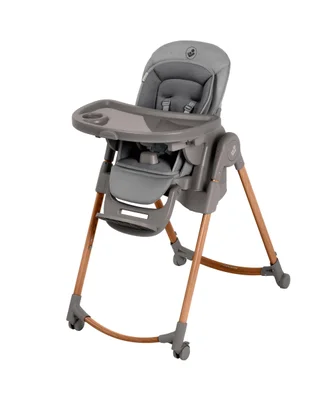
The Minla Plus is Maxi-Cosi's answer to the question "what if one chair did everything?" It works from birth (fully reclined with a padded newborn inlay) through to around 14 years as a youth stool. In between, it passes through five configurations: reclined newborn seat, upright highchair, booster with tray, booster without tray, and junior stool.
The standout feature is the pivoting tray. Instead of lifting it off entirely, you swing it open with one hand to get your child in and out. After six months of daily testing, parents consistently single this out as the detail that makes the biggest practical difference. One parent put it simply: "The hinged tray makes it much easier to get my son in and out. It is a simple feature, but one that makes a real difference when you are trying to strap in an impatient toddler."
Nine height positions let it work at dining tables, kitchen islands, and breakfast bars. Five recline angles mean younger babies can sit comfortably before they have full core strength. The lockable front wheels make it easy to roll between rooms, though at 12.5 kg it is noticeably heavier than the Tripp Trapp.
What parents love
- All-in-one versatility. Birth to 14 years in a single purchase, with no essential accessories to buy separately. The newborn inlay, harness, and tray are all included.
- Pivoting one-hand tray. Swing it open, lift your child in, swing it back. Parents we hear from repeatedly say this is the feature they would miss most if they switched chairs.
- Comfort and adjustability. We hear repeatedly from parents that babies sit contentedly in the Minla Plus for longer stretches, thanks to the padded seat and multiple recline options.
- Easy mobility. Lockable front casters let you roll it from kitchen to dining room without lifting. A parent shared: "The wheels are great to move her around the kitchen and the pivoting tray is very helpful."
What to know before you buy
- Pale fabric stains. The lighter colourways show food marks, and not all fabric sections are removable. If your child is a vigorous self-feeder, darker colourways are worth considering.
- Bulky even when folded. It folds to 124 cm tall and 33 cm deep, which is fine for room-to-room storage but not something you would take on holiday.
- Limited colour range. Currently available in just one or two colourways, which is disappointing at this price point.
Best for
- Parents who want one chair from birth through toddlerhood and beyond
- Families with varied table heights (dining table, breakfast bar, kitchen island)
- Parents who prioritise features and adjustability over raw materials
- Households where the highchair needs to move between rooms regularly



2. Stokke Tripp Trapp
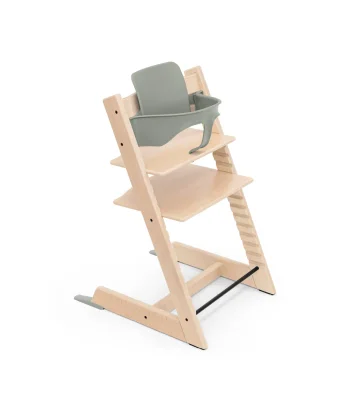
The Tripp Trapp has been in production since 1972. Designed by Peter Opsvik, it is built from solid European beech wood and looks more like a dining chair than baby equipment. That is by design: the philosophy is to bring your child to the table at the right height, as part of the family, rather than isolating them in a plastic pod.
The chair itself is simple. Two side panels, an adjustable seat plate, and an adjustable footrest. That is it. To use it from birth you add the Newborn Set (sold separately); from six months you add the Baby Set rails and a harness (both sold separately); and if you want a tray, that is another purchase. This accessory model is the Tripp Trapp's biggest source of criticism, because a fully kitted-out setup can push past £325.
But the build quality justifies the approach. At 7 kg it is lighter than the Minla Plus, it supports up to 136 kg (meaning adults can and do sit on it), and it comes with a 7-year extended warranty. One parent told us: "Compared with our previous chair, which could tip if my toddler leaned too far, this one does not move an inch."
What parents love
- Exceptional longevity. Parents report 10+ years of daily use across multiple children. The solid wood frame is described as "nigh-on indestructible" and holds its resale value remarkably well.
- Ergonomic footrest. The adjustable footplate keeps feet flat at every age, which occupational therapists recommend for comfortable, supported eating. Parents notice their children sit still longer.
- Space-efficient design. At just 49 cm deep, it pushes neatly under a standard dining table when not in use. No folding mechanism needed because it simply looks like a chair.
- Looks like furniture. Available in 14+ colours, it blends into dining rooms rather than dominating them. A parent shared: "I can see us using it for many years to come, we absolutely love it."
What to know before you buy
- Accessories add up. The chair at £199 is just the start. Baby Set (~£60), harness (~£35), tray (~£65), and cushion (~£45) can push the total past £325. You are buying an ecosystem, not a single product.
- No recline. The main chair is upright only. Recline is only available with the Newborn Set, which covers birth to about six months. From the Baby Set stage onwards, it is fully upright.
- Harder to clean than plastic. The wooden seat and the gap where the Baby Set meets the frame can trap food. Several parents note that it takes more effort to clean than a simple wipe-down plastic chair.
Best for
- Families who want a single chair from baby through to school age and beyond
- Parents who eat together at the dining table and want their child at the right height
- Style-conscious households that prefer wood over plastic
- Second-child families or those who value strong resale value
What about the IKEA Antilop?
It would be dishonest not to mention the elephant in the room. The IKEA Antilop costs around £15 and does the basic job perfectly well. It has no footrest, no recline, no padding, and no grow-with-your-child features, but it is absurdly easy to clean (you can literally hose it down) and light enough to carry one-handed. If your priority is a cheap, functional seat for the 12-18 months of active highchair use, neither the Minla Plus nor the Tripp Trapp can match its value for money. The trade-off is comfort, posture support, and longevity.
How to choose
Choose the Maxi-Cosi Minla Plus if you want everything in one box from day one. No extra accessories to research or buy, five recline positions for younger babies, a pivoting tray that genuinely saves time, and the ability to fold it away when you need the floor space. It is the better choice for families who need a chair that works from birth, moves between rooms, and adapts to different table heights. At £144 with everything included, it represents strong value against the Tripp Trapp's total cost of ownership.
Choose the Stokke Tripp Trapp if you are thinking in years rather than months. The solid wood construction, 136 kg weight capacity, and 7-year warranty mean this chair genuinely lasts from your first child's weaning through to your second child's homework years. The adjustable footrest is the best in the category for supported posture, the design disappears into your dining room, and the resale value is exceptional. The higher upfront cost, including accessories, is the price of buying something you will never need to replace.
Neither choice is wrong. The Minla Plus gives you more features per pound; the Tripp Trapp gives you more years per pound. The right answer depends on how your family eats, how long you plan to use a highchair, and whether you value convenience today or longevity tomorrow.
Add it to your Nest
Whichever highchair suits your family, you can add it to your free BubsNest registry alongside everything else on your list. Share one link with everyone, compare across retailers, and let your loved ones contribute to the bigger purchases.
Ready to Create Your Baby Registry?
Start your free baby registry today and share it with friends and family.
Get Started Free