The Dummy Debate: When to Give One, When to Ditch One, and Everything in Between
Will a dummy ruin your baby’s teeth? Interfere with breastfeeding? Here’s the honest, evidence-based guide to pacifiers that actually helps you decide.
Will a dummy ruin your baby's teeth? Will it mess up breastfeeding? Will you be prising it from their grip at age five while a dentist tuts in the background?
If you have typed any of those questions into a search engine at 2am, you are not alone. Dummies might be one of the most debated items in the entire baby universe, and the opinions come at you from every angle. Your midwife says one thing, your mum says another, and that parenting forum thread from 2019 has 47 pages of conflicting advice.
So here is the actual, evidence-based picture, minus the guilt trip. 🍼
The Science Bit: Do Dummies Actually Help?
Short answer: yes, in several measurable ways.
Research consistently shows that dummy use during sleep is associated with a reduced risk of sudden infant death syndrome (SIDS). The exact mechanism is not fully understood, but the correlation is strong enough that health organisations across the world acknowledge it. One widely cited meta-analysis found that dummy use during sleep reduced SIDS risk by up to 90% in some studies.
Beyond the safety angle, dummies are a genuine self-soothing tool. Babies are born with a strong sucking reflex, and not all of that need is about hunger. Non-nutritive sucking, the kind a dummy provides, can help regulate a baby's nervous system, reduce crying, and support settling between feeds. For premature babies, dummy use in neonatal units has been shown to improve feeding skills and shorten hospital stays.
None of this means every baby needs a dummy. Some babies refuse them entirely (and that is completely fine). But the idea that dummies are inherently harmful? The evidence does not support it.
When to Introduce a Dummy
Timing matters more than most people realise.
If you are breastfeeding, the general recommendation is to wait until feeding is well established before introducing a dummy, usually around four to six weeks. This is not about dummies causing "nipple confusion" (a term that sounds scarier than the evidence warrants), but about giving your baby enough time to develop a strong latch and a reliable feeding pattern before introducing a different sucking sensation.
If you are formula feeding or combination feeding, there is less reason to wait. Some parents introduce a dummy from the very first week without any issues.
A few practical tips for the introduction:
- Offer the dummy after a feed, not instead of one. A hungry baby does not want a soother, they want milk.
- If your baby spits it out, do not force it. Try again another day. Some babies take a few attempts before they accept one.
- Try dipping the teat in a tiny bit of expressed milk if your baby keeps rejecting it. Sometimes that familiar taste is all it takes.
Choosing the Right Dummy
Walk into any baby shop and you will find roughly four thousand dummy options staring back at you. Deep breath. Here is what actually matters.
Shape. There are three main teat shapes: cherry (round), orthodontic (flattened on one side), and symmetrical (flattened on both sides so it sits the same way regardless of how it goes in). Orthodontic and symmetrical shapes are generally recommended by dental professionals as they put less pressure on developing teeth and palate. That said, some babies will only accept a cherry shape, and a dummy your baby uses is more useful than a perfect dummy they reject.
Material. Silicone is the most popular choice these days, it is durable, easy to clean, and does not retain odours. Natural rubber latex is softer and some babies prefer the feel, but it wears out faster and can trigger allergies in rare cases. Both are safe.
Size. Dummies come in age-graded sizes, typically 0-6 months, 6-18 months, and 18+ months. Using the right size for your baby's age ensures the shield sits comfortably against their face without being too large or too small.


FRIGG pacifiers are a favourite among parents who want something that looks as good as it performs. Their symmetrical silicone teats are designed to support natural oral development, and the muted colour palette means they actually look intentional rather than garish.
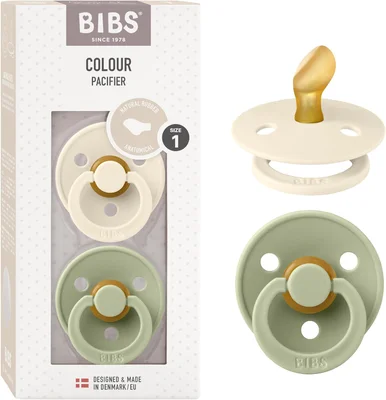
BIBS has been the default "stylish dummy" for years, and for good reason. The anatomical (orthodontic) nipple is designed to mimic the shape of a mother's breast, and the lightweight shield with ventilation holes keeps skin around the mouth comfortable. They come in an absurd number of colour options, which honestly makes collecting them slightly addictive. 🎨
Keeping Dummies Clean (and Attached to Your Baby)
Dummies spend an alarming amount of time on the floor. This is a universal truth of parenthood that no one warns you about. You will buy five, lose three, and find one behind the sofa six months later.
For the first few months, sterilise dummies before each use, the same way you would bottles. After six months, a thorough wash with hot soapy water is generally enough (your baby's immune system is stronger by then, and they are probably eating the carpet anyway).
Replace dummies regularly, especially if you notice any cracks, tears, or stickiness in the teat. Silicone dummies typically last longer than latex ones, but both should be swapped every four to eight weeks.
One thing that will genuinely improve your daily life: a decent dummy clip. It attaches the dummy to your baby's clothing so when they spit it out (and they will, constantly), it dangles safely instead of bouncing under the pushchair into a puddle.
The Elodie Details clip is one of those small purchases that earns its keep within about three hours of ownership. It clips securely to clothing and the design is subtle enough that it does not look like a medical device.
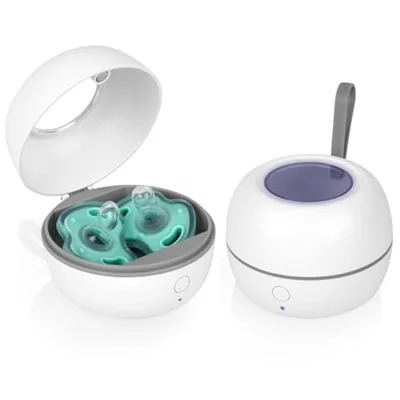
For sterilising on the go, a portable UV steriliser like the HOTUT is a game-changer. Pop the dummy in, press a button, and three minutes later it is sanitised. No water, no microwave, just UV-C light doing the work. Brilliant for days out, holidays, and those moments when the dummy hits the cafe floor for the fourth time in twenty minutes.
When to Ditch the Dummy
This is the part that keeps parents up at night (well, one of the things).
The general dental guidance is to aim for weaning off the dummy by around 12 months, and ideally no later than age two. Prolonged dummy use beyond this point can start to affect tooth alignment and jaw development. The risk increases the longer the habit continues, but occasional use is not the same as constant use. A child who uses a dummy only for sleep is in a very different position from one who has it in their mouth all day.
Some strategies that actually work:
- Gradual reduction. Start by limiting dummy use to sleep time only, then nap time only, then drop naps too. This works well for children who use the dummy mainly as a comfort object.
- The "dummy fairy." Similar to the tooth fairy concept, the dummy fairy visits, collects all the dummies, and leaves a small gift. This works surprisingly well for toddlers who respond to narrative and ritual.
- Cold turkey. Some parents find that ripping the plaster off is less painful for everyone than a drawn-out transition. A few rough nights, then done. This takes nerves of steel but plenty of families swear by it.
- Natural weaning. Some children simply lose interest on their own, usually between 18 months and three years. If your child is heading that direction, let them lead.
Whichever approach you choose, expect a few unsettled days. Your child has been using that dummy as a comfort tool, and removing it means they need to find a new way to self-soothe. Extra cuddles, a favourite teddy, and a consistent bedtime routine all help bridge the gap.
The Bottom Line
Dummies are not the villain some corners of the internet make them out to be. Used sensibly, introduced at the right time, and retired before they start causing dental issues, they are a perfectly reasonable tool in the parenting toolkit.
If your baby loves their dummy, brilliant. If they refuse one, also brilliant. There is no single right answer here, just the one that works for your family.
And if you are building your baby registry, a pack of dummies and a good clip are two of the cheapest, most-used items you will ever add. Pop them on your BubsNest wishlist and let someone else pick the colours. 💛
Ready to Create Your Baby Registry?
Start your free baby registry today and share it with friends and family.
Get Started Free