Tommee Tippee Closer to Nature vs Philips Avent Natural Response: Which Baby Bottle Suits Your Family?
Two of the UK’s most popular baby bottles go head to head. We compare teat design, anti-colic tech, cleaning, and value to help you pick the right one for your baby.
COMPARISON · FEEDING
Choosing your baby's first bottle feels like it should be straightforward, but anyone who has stood in the baby aisle staring at shelves of anti-colic claims, breast-like teats, and self-sterilising promises knows it is anything but. Two bottles dominate the UK market, and for good reason: the Tommee Tippee Closer to Nature and the Philips Avent Natural Response are the ones most parents try first, most midwives mention, and most registries default to.
The question is not really which is "better" - it is which suits your baby and your feeding routine. One prioritises simplicity and value. The other leans into science-led flow control and a more robust anti-colic system. We have pulled together spec sheets, pricing, and real parent feedback to help you decide without buying both and hoping for the best.
Lil' Bubba's verdicts
- Best Overall: Tommee Tippee Closer to Nature · 8.5/10 - Unbeatable simplicity and value for everyday feeding
- Best for Colic-Prone Babies: Philips Avent Natural Response · 8.0/10 - Baby-controlled flow and optional AirFree vent tackle wind head-on
Quick comparison
| Tommee Tippee CTN | Philips Avent NR | |
|---|---|---|
| Rating | ||
| Price per bottle | ~£5-7 | ~£8-10 |
| Sizes | 150ml, 260ml, 340ml | 125ml, 260ml, 330ml |
| Teat flow rates | 4 (slow, medium, fast, variable) | 6 (Flow 1 to Flow 6) |
| Anti-colic | Single valve in teat | Built-in valve + optional AirFree vent |
| Teat design | Breast-shaped, soft, stretchy | Natural Response valve, baby-controlled flow |
| Material | PP plastic (glass available) | PP plastic (glass available) |
| Parts to clean | 4 | 4 (valve built into teat) |
| BPA-free | Yes | Yes |
| Best for | Value, simplicity, first-timers | Colic, reflux, combination feeding |
How we picked these two
We started with the bottles UK parents add to their registries most often, then cross-referenced with real parent feedback across forums, review panels, and our own community. Both bottles have been tested by thousands of families and sit at the top of their respective categories for good reason. We scored each on five criteria: teat acceptance, anti-colic performance, ease of cleaning, value for money, and real-world durability.
What to look for in a baby bottle
Before you commit to a full set, a few things are worth understanding. Teat shape matters more than you might expect. Some babies will latch onto anything; others have a strong preference for a particular shape or material. If you are combination feeding, a breast-shaped teat often makes the transition smoother.
Anti-colic design varies hugely. A basic valve in the teat reduces vacuum pressure so your baby swallows less air. More advanced systems, like a vented base or a baby-controlled flow teat, go further by separating air from milk entirely. If your baby is already showing signs of colic or excessive wind, a more robust system is worth the extra cost.
Flow rate flexibility is easy to overlook. Newborns need a slow flow; by six months, most babies want something faster. Check how many teat sizes the brand offers and how easy they are to buy. There is nothing worse than discovering your bottle brand only sells two flow rates.
Cleaning is the unsexy reality of bottle feeding. Count the parts. Four is manageable; six or more with fiddly internal tubes will test your patience at midnight. A wide neck helps too, both for getting a brush in and for scooping formula without spilling.
1. Tommee Tippee Closer to Nature
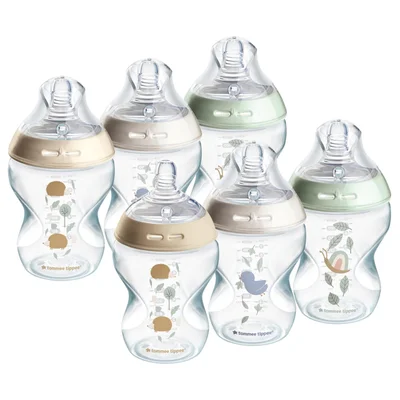
The Closer to Nature bottle has been a UK bestseller for over a decade, and it is easy to see why. The breast-shaped teat is designed to mimic the feel and flex of a real breast, making it one of the most natural-feeling bottles on the market. Parents overwhelmingly praise how quickly breastfed babies accept it, often on the very first attempt.
With just four parts (bottle, screw ring, teat, and cap), assembly and cleaning are as simple as it gets. The wide neck makes filling and brushing easy, and the hourglass shape is comfortable to hold during long night feeds. The integrated anti-colic valve sits in the teat, so there is no fiddly base to unscrew.
What parents love
- Effortless breast-to-bottle switch. One parent told us: "Our breastfed baby took the first Closer to Nature bottle without any fight at all. It felt like a small miracle after struggling with other brands."
- Dead-simple design. Four parts, wide neck, one-handed assembly. A parent shared: "I can put it together in the dark during night feeds, and the wide neck makes cleaning a doddle."
- Genuine value for money. At around £5-7 per bottle, ongoing costs stay low because only the teats need replacing every six to eight weeks.
- Grows with your baby. Four teat flow rates (slow, medium, fast, and variable) mean the same bottles work from newborn through to weaning.
What to know before you buy
- Basic anti-colic system. The single valve in the teat reduces air intake but is not a full vented system. Parents of babies with significant wind sometimes switch to a more robust option.
- Teats can collapse mid-feed. Loosening the screw ring slightly fixes this, but it can be disruptive while your baby is feeding.
- Bottles may cloud over time. After months of sterilising, the plastic can develop a cloudy appearance. It is cosmetic, not a safety concern.
Best for
- Combination-feeding families who need a smooth breast-to-bottle switch
- First-time parents wanting a reliable, no-fuss all-rounder
- Budget-conscious families - the lowest per-bottle cost of any premium brand
- Parents who value quick, easy cleaning with minimal parts

2. Philips Avent Natural Response
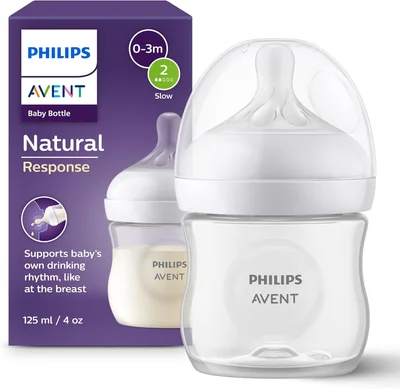
The Natural Response bottle takes a different approach to feeding. Its headline feature is a teat that only releases milk when your baby actively sucks, mimicking the natural rhythm of breastfeeding. Rather than gravity doing the work, your baby controls the pace, which means fewer gulps of air and a calmer feeding experience.
The anti-colic valve is built into the teat itself, so there are no extra parts to clean or lose. For babies who struggle with wind or reflux, Philips also sells an optional AirFree vent accessory that keeps the teat full of milk even when the bottle is held almost upright - a real benefit for refluxy little ones.
What parents love
- Baby controls the pace. A parent shared: "Feeding time has genuinely become easier since we switched. She is rarely gassy after feeds now, and the fact that she drinks at her own pace means less spit-up too."
- Effective colic and wind reduction. The dual approach (built-in valve plus optional AirFree vent) tackles air ingestion from two angles. Parents we hear from regularly say the difference is noticeable within days.
- Easy to clean with fewer fiddly parts. Because the valve is integrated into the teat, there is no separate internal tube or base disc to wash. The wide neck makes brushing quick.
- Six teat flow rates. More options than most competitors, so you can fine-tune the flow to your baby's drinking style as they grow.
What to know before you buy
- Assembly takes a bit of practice. The teat must be seated correctly in the screw ring, or the bottle can leak. Most parents find the knack within a few feeds.
- Some leaking reported with faster teats. A handful of parents notice dripping when moving to Flow 4 or above, regardless of how carefully they assemble.
- Higher price per bottle. At around £8-10 each, building a full set costs noticeably more than with Tommee Tippee.
Best for
- Babies with colic, reflux, or excessive wind, especially with the AirFree vent
- Combination-feeding families who want the closest mimic of breastfeeding rhythm
- Parents who prefer baby-led pacing over gravity-fed flow
- Families happy to invest more upfront for a system that grows through six teat stages
How to choose
Pick the Tommee Tippee Closer to Nature if you want a reliable, affordable bottle that practically every baby accepts. Its breast-shaped teat and four-part design make it the easiest bottle to live with day to day, and the accessory ecosystem (sterilisers, warmers, breast pumps) is the most extensive in the UK. If your baby does not have significant colic or reflux, there is very little reason to look elsewhere.
Pick the Philips Avent Natural Response if your baby struggles with wind, colic, or reflux, or if you are combination feeding and want a bottle that closely mirrors breastfeeding rhythm. The baby-controlled flow mechanism is genuinely different from a conventional teat, and the optional AirFree vent adds another layer of protection. The higher price per bottle is the main trade-off, but the six-stage teat system means you can use the same bottles well into the first year.
Not sure which to try first? Many parents buy a single bottle of each and let their baby decide. Both brands sell individual bottles, so you do not need to commit to a full set upfront.
Add it to your Nest
Whichever bottle you choose, add it to your free BubsNest registry so friends and family know exactly which one to buy. No more unwanted duplicates, no more gift-receipt awkwardness.
Ready to Create Your Baby Registry?
Start your free baby registry today and share it with friends and family.
Get Started Free