Tommee Tippee FlexiPen vs Braun Age Precision Thermometer: The Smarter Display Can't Be Read in the Dark
Two flexible-tip stick thermometers at around £10. The Braun reads your baby's age into its colour-coded fever guide; the Tommee Tippee keeps one simple red alarm you can see at 3am. Here's which suits your home.
COMPARISON · SAFE & SOUND
Ear thermometers and no-touch forehead guns get most of the attention, but the thermometer UK guidance actually points parents of under-fives towards is the humble digital stick, tucked under the arm. It is cheap, it does not need a probe cover, and it works on a newborn whose ear canal is still too small for most infrared models. Which is why almost every hospital bag list includes one, and why most homes end up with one in the medicine drawer whether they planned it or not.
The two we hear about most often cost about the same, look almost identical and both read in roughly eight seconds: the Tommee Tippee FlexiPen at around £11 and the Braun Age Precision at around £10. On paper there is nothing between them. In practice they make one very different design choice. The Braun changes what counts as a "fever" depending on your child's age and shows it as green, yellow or red. The Tommee Tippee uses a single fixed alarm and a red light you can actually see in a dark nursery.
That sounds like a small thing until you are taking a temperature at 3am with one hand while the other holds a hot, grizzly baby. So we looked hard at how each one behaves in real use, read through a large volume of parent feedback, and compared the specs line by line. Here is what we found.
Lil' Bubba's verdicts
- Best Overall: Braun Age Precision Digital Thermometer · 8.5/10 - age-based colour guide takes the guesswork out of "is this actually a fever?", and it handles oral, rectal and underarm use
- Best for Night Checks: Tommee Tippee FlexiPen Thermometer · 8.0/10 - one clear 37.6°C alarm with a red light you can read without switching on the big light
Quick comparison
| Tommee Tippee FlexiPen | Braun Age Precision | |
|---|---|---|
| Our rating | ||
| Typical price | £11 | £10 |
| Reading time | About 8 seconds | About 8 seconds (can stretch towards 14) |
| Where it goes | Underarm or under the tongue | Underarm, mouth or rectal |
| Fever alert | Red light and alarm at 37.6°C and above | Green, yellow or red display based on three age settings |
| Readable in the dark | Yes, red light flashes | No, plain LCD with no backlight |
| Memory | Last reading | Last reading |
| Tip | Soft, flexible | Soft, flexible |
| Extras | °C/°F switch, cover, CR2032 battery included | Storage cap, battery included |
How we picked these two
We started with the stick thermometers parents add to their Nests most often and narrowed it to models that are easy to buy in the UK, from established health brands, at under £15. Both of these came up again and again when we spoke to parents and read through hundreds of owner reviews. We then compared the published specifications, how the fever alerts are set, and the recurring praise and complaints. Neither brand paid to be included and neither saw this article before publication.
What to look for in a stick thermometer
Underarm first. For babies and children under five, an underarm reading with a digital stick is the method UK health guidance recommends at home. Never take an oral reading in a baby or young child, and only use the rectal setting if a health professional has shown you how. Both of these thermometers work underarm, so this is not the deciding factor, but it does mean the Braun's rectal and oral options are mostly useful for older children and adults in the house.
A flexible tip. Both have one. It makes it easier to tuck the tip into a small armpit without poking, and more comfortable if you have to hold it in place for a squirming toddler.
Speed. Eight seconds is the norm now. Older sticks took a full minute, which is long enough for a baby to wriggle free and give you a low, misleading reading. Faster is genuinely better here.
How it tells you there is a problem. This is where the two really split. A fixed alarm is simple. An age-adjusted colour guide is more nuanced, because a temperature that is mildly raised in a toddler can matter more in a young baby. Remember that for a baby under three months, a temperature of 38°C or above always needs a call to your GP or NHS 111 straight away, whatever colour the screen shows.
Night use. You will mostly take temperatures in the dark. A screen you cannot read without a torch is a real annoyance at 3am.
Memory. Both store the last reading, which helps when you are tracking a temperature before and after paracetamol or describing it to a doctor.
1. Tommee Tippee FlexiPen Thermometer
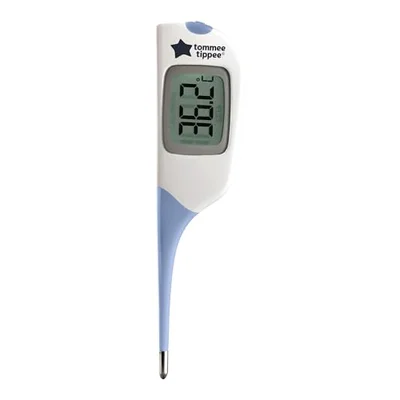
The FlexiPen is the no-fuss option. It is designed for use from birth, reads under the arm or under the tongue in around eight seconds, and has one job when it comes to warnings: if the reading is 37.6°C or higher, a red light flashes and an alarm sounds. That is it. There are no age settings to remember to change and no colour bands to interpret.
That simplicity is the point for a lot of parents. When your baby is unwell and you are half asleep, a light that is either red or not is easy to act on. It also comes with a protective cover, a replaceable CR2032 battery already fitted, and a button to switch between Celsius and Fahrenheit. It is splash-resistant rather than waterproof, so wipe it clean rather than rinsing it under the tap.
What parents love
- Visible at night. The red fever light is the feature we hear about most. One parent told us: 'I can see straight away if it's high without turning the lamp on and waking her fully.'
- Genuinely fast. Eight seconds underarm is short enough that most babies stay still for it.
- Nothing to set up. No age modes to switch between, so anyone in the house, grandparents included, can use it correctly first time.
- Soft, flexible tip. Comfortable to tuck into a small armpit and it bends rather than pokes.
What to know before you buy
- One threshold for every age. 37.6°C triggers the same alert for a newborn and a five-year-old, so you still need to know what the number means for your child's age.
- No rectal use. It is designed for underarm and under-the-tongue readings only.
- Toddlers still wriggle. A parent shared: 'Getting anything under the arm of a cross toddler is hard, even for eight seconds.' That is true of every stick thermometer, but worth knowing if you have an older child too.
Best for
- Parents who mostly check temperatures overnight
- Households where several carers share the job
- Anyone who wants one clear "high or not" signal
- Hospital bags and changing-bag first aid kits

2. Braun Age Precision Digital Thermometer
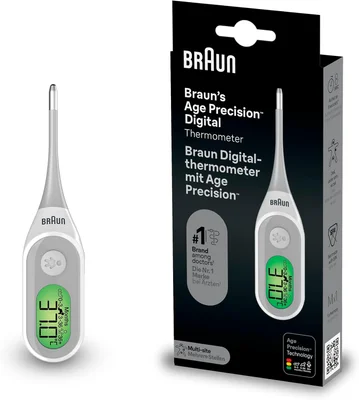
Braun's stick looks like any other, but it has a dedicated age button. You choose between three settings, 0 to 3 months, 3 to 36 months, or 3 years and over, and when you take an underarm reading the display turns green, yellow or red depending on what that number means for that age. The idea is that a reading which is only borderline for a toddler gets flagged sooner for a young baby, which is how clinicians think about fever anyway.
It reads in around eight seconds (Braun's own testing ranges from about 8 to 14), beeps when it is done, remembers the last reading and comes with a battery and storage cap. Unlike the FlexiPen it is also designed for oral and rectal use, so it doubles as the family thermometer once your baby is older. Our listing also includes Braun's closely related High Speed stick, sold by some retailers at a slightly higher price.
What parents love
- The colour guide. We hear repeatedly from parents that it removes the "is 37.8 bad?" panic. One parent put it best: 'Green, yellow or red is so much easier than trying to remember numbers at midnight.'
- Simple to use. One button to read, one to set the age. Several parents describe it as incredibly simple.
- Whole-family thermometer. Underarm for the baby, oral for older children and adults, all in one stick.
- Long battery life. Owners regularly say the battery lasts well through normal household use.
What to know before you buy
- No backlight. The colour display is clever, but the screen does not light up, so you will need a lamp or phone torch to read it at night.
- Colours only work underarm, at the right age. The colour coding is designed for underarm mode, and you have to remember to change the age setting as your baby grows. You also cannot switch Age Precision off completely.
- Loose cap, occasional odd reading. A parent shared that the cap 'doesn't stay on very well', and a few owners say they repeat a high reading to be sure, which is good practice with any stick thermometer.
Best for
- First-time parents who want help interpreting the number
- Families who want one thermometer for baby and adults
- Parents of young babies, where small differences matter most
- Anyone on a tight budget who still wants a trusted brand
What about an ear or forehead thermometer?
Infrared ear and no-touch models are quicker with a sleeping toddler, and many families end up owning one as well. But most ear thermometers are not designed for young babies, they need probe covers, and they cost three or four times as much. A stick thermometer is still the sensible first buy, and the one to keep as a back-up even if you add an infrared model later. We cover those in our other thermometer comparisons in the community.
How to choose
Choose the Braun Age Precision if you would like the thermometer to do some of the interpreting for you. The age-based colours are the most useful feature either of these has, especially in the first few months, and the oral and rectal options mean it will still be the family thermometer in five years. Keep a small torch or your phone nearby for night checks.
Choose the Tommee Tippee FlexiPen if most of your temperature checks happen in the dark, or if lots of different people will be using it. One alarm at 37.6°C and a red light you can see from across the room is hard to get wrong, and it costs only a pound or so more.
Whichever you pick, buy it before the baby arrives, put a fresh battery in the drawer next to it, and remember that the number is only part of the picture. If your baby is under three months and has a temperature of 38°C or above, or seems unusually floppy, drowsy or unwell at any temperature, get medical advice straight away.
Add it to your Nest
A thermometer is one of those things nobody thinks to buy until they need it at midnight. Add your pick to your free BubsNest registry so it is ticked off the list long before the first sniffle.
Ready to Create Your Baby Registry?
Start your free baby registry today and share it with friends and family.
Get Started Free