Baby Teethers by Budget: £5 vs £13 vs £14
Does a £14 teether actually soothe better than a £5 one? We compare the Nuby IcyBite Keys, Sophie la girafe So'Pure and Mushie Teething Ring to find the best option at every price point.
COMPARISON · PLAY & DEVELOPMENT
Teething is one of those milestones that parents anticipate with a mixture of excitement and dread. Your baby is growing, which is wonderful. Your baby is also waking at 2am with swollen gums, which is considerably less wonderful. At some point, every parent reaches for a teether, and the question becomes: does it matter which one?
The short answer is yes, but not in the way you might expect. A £14 teether is not automatically three times better than a £5 one. What changes is the material, the design philosophy and the type of soothing it provides. Ice-gel teethers offer cooling relief. Natural rubber teethers give a soft, skin-like chew. Silicone teethers are virtually indestructible and dishwasher-safe. Each approach suits different babies and different parents.
We tested three teethers across those categories, all available through UK retailers right now. Our mid-range pick, the Sophie la girafe So’Pure Multi Textured Teether (around £13), combines natural rubber with clever multi-textured design and takes our Best Overall spot. Our budget pick, the Nuby IcyBite Keys (around £5), brings ice-gel cooling technology at a price that makes replacement painless. And our design pick, the Mushie Teething Ring (around £14), pairs Scandinavian aesthetics with food-grade silicone that survives the dishwasher.
Each one does the job differently. Here is what actually matters when choosing between them.
Lil’ Bubba’s verdicts
- Best Overall: Sophie la girafe So’Pure Multi Textured Teether · 8.0/10 - Natural rubber with multiple textures and fine motor engagement
- Best Budget: Nuby IcyBite Keys · 7.5/10 - Ice-gel cooling at a supermarket-friendly price
- Best for Design: Mushie Teething Ring · 7.0/10 - Dishwasher-safe silicone with Scandi charm
| Nuby IcyBite Keys | Sophie So’Pure | Mushie Ring | |
|---|---|---|---|
| Price | ~£5 | ~£13 | ~£14 |
| Material | Silicone + PurICE gel | 100% natural rubber | 100% food-grade silicone |
| Age | 3 months+ | 3 months+ | 3 months+ |
| Cooling | Yes (fridge) | No | No (fridge-safe) |
| Sterilisable | No | No | Yes (dishwasher) |
| Made in | China | France | Denmark (designed) |
| Rating | 7.5/10 | 8.0/10 | 7.0/10 |
How we picked the three
We reviewed every teether available through UK retailers with an active partnership programme, which gave us over 30 options across a dozen brands. We filtered for products with genuine parent feedback, confirmed stock levels and descriptions detailed enough to compare specifications meaningfully. We then grouped by material type and price tier, selecting one teether per category that best represented what your money buys at that level.
We deliberately chose three different materials to highlight how the teething experience changes depending on what your baby is actually chewing on. The Nuby IcyBite Keys uses ice-gel technology for cooling relief. The Sophie la girafe So’Pure is made from 100% natural Hevea tree rubber, handcrafted in France. The Mushie Teething Ring uses food-grade silicone with a Scandinavian design sensibility. Each material has genuine advantages, and understanding those differences is more useful than simply spending more.
What to look for in a teether
Material safety. Look for products explicitly labelled BPA-free, phthalate-free and PVC-free. Food-grade silicone and natural rubber from the Hevea tree are the safest mainstream options. The NHS recommends teething rings as a first-line soothing method, but advises cooling them in the fridge only, never the freezer, as frozen teethers can damage delicate gums.
Textures. Different textures apply varying pressure to different parts of sore gums. Ridged, bumped and smooth sections on the same teether are more effective than a single flat surface. As teeth emerge in stages (front incisors around six months, molars around twelve months), a teether with multiple textures adapts to each phase.
Grip and weight. A teether your baby cannot hold is a teether that lives on the floor. Look for ring shapes or easy-grip handles, especially for younger babies whose fine motor skills are still developing. Weight matters more than you might expect: anything over 80-90 grams can be tiring for a four-month-old to hold for extended periods.
Cleaning method. This is where materials diverge sharply. Silicone teethers can typically go in the dishwasher or steam steriliser. Natural rubber cannot, it degrades with heat, so you are limited to warm soapy water. Ice-gel teethers usually cannot be sterilised at all. Consider how important easy cleaning is to you before choosing.
Size and safety. A good rule of thumb: if the entire teether can fit through a toilet roll tube, it is too small. Avoid teethers with detachable small parts, and always supervise use. The NHS specifically warns against tying teething rings around a baby’s neck due to choking risk.
1. Sophie la girafe So’Pure Multi Textured Teether
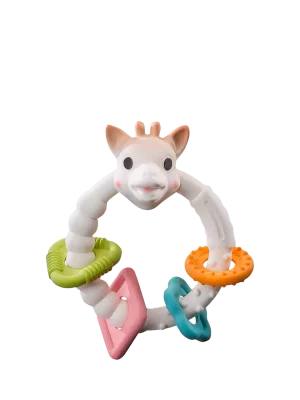
The So’Pure Multi Textured Teether is what happens when a 60-year-old French baby brand turns its attention to serious teething relief. Made from 100% natural rubber harvested from the Hevea tree, decorated with food-grade paint and handcrafted in France, this is the teether for parents who want to know exactly what their baby is chewing on.
The design is genuinely clever. Four brightly coloured geometric shapes slide around a central ring, giving babies something to grip, push and explore. The ring itself features multiple textures: rounded dots, ribbed surfaces and Sophie’s iconic ears and horns, each offering a different kind of gum relief. The variety means it adapts as teething progresses, from early front-tooth soreness through to back molars appearing months later.
At around 100 grams, it is light enough for small hands to manage from three months onwards. The ergonomic ring shape means babies can bring it to their mouth independently, which parents consistently highlight as a key advantage over bulkier teethers. One parent told us: “My baby has been through a variety of teethers and this one stacked up the best.”
The trade-off is cleaning. Natural rubber cannot be boiled, steam-sterilised or put in the dishwasher. You are limited to wiping with a damp cloth and mild soapy water. For some parents this is a dealbreaker; for others, the natural materials make it worthwhile. One parent summed up the divide: “Overpriced? Almost certainly. But it remains the only teether my son bothered with.”
What parents love
- Natural, non-toxic materials. 100% Hevea tree rubber with food-grade paint, no BPA, no phthalates, no synthetics. Part of Sophie la girafe’s eco-conscious So’Pure range with recyclable packaging.
- Multiple textures for different teething stages. Rounded dots, ribbed surfaces and Sophie’s ears and horns each provide different gum relief. Parents report it works from early soreness through to molars.
- Lightweight and easy to grip. The ergonomic ring design lets even young babies hold, manipulate and bring the teether to their mouth independently.
- Sensory engagement beyond teething. The four sliding geometric shapes provide fine motor stimulation and visual interest, making it a developmental toy as well as a teether.
What to know before you buy
- Cannot be sterilised. Natural rubber degrades with heat. No dishwasher, no steam steriliser, no boiling. Cleaning is limited to warm soapy water and a cloth.
- Premium price for a teether. At £13-15 from most retailers, it costs two to three times more than basic alternatives. The quality is evident, but not every family can justify it.
- Not universally loved. A minority of parents report their baby showed little interest. Given the price, this represents a real risk of wasted spend.
Best for
- Eco-conscious parents who prioritise natural, plant-based materials
- Babies in the active teething phase (3-12+ months) who benefit from varied textures
- Gift-givers looking for a premium, presentation-ready teether in a charming box
2. Nuby IcyBite Keys
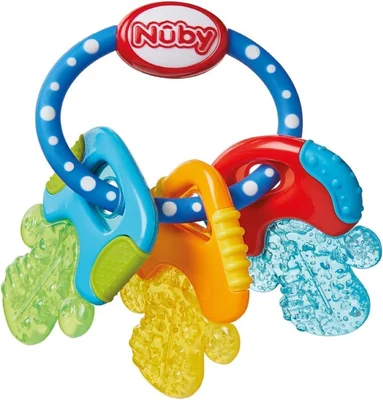
The IcyBite Keys is Nuby’s answer to a problem every teething parent faces: sore gums respond to cold, but most teethers warm up in minutes. Nuby’s proprietary PurICE gel technology stays cooler for longer than standard water-filled alternatives, and the three-key design means your baby can rotate between them as each one gradually warms.
Each key features different textured surfaces with offset bumps and ridges designed to massage gums and assist tooth eruption. The bright colours provide visual stimulation, and the key-ring shape is intuitive for small hands. At around £5 from most supermarkets, it is the kind of teether you can buy two of without thinking about it, keeping one in the fridge while the other is in use.
One parent shared: “My daughter can hold on to them really easily, which means I do not have to help her guide them to her mouth and she does not drop them as much as other teethers.” Another noted: “I could carry less teething toys when we were out and about. Very practical and durable.”
The limitations are real, though. At 96 grams, the keys are heavier than they look, and several parents of younger babies (three to four months) report their child struggled with the weight. More significantly, the IcyBite Keys cannot be steam-sterilised, UV-sterilised or frozen. Cleaning is limited to warm soapy water, which frustrates hygiene-conscious parents. One parent noted: “There were no instructions, and I had to search online to check if they should go in the fridge or freezer and how to clean them.”
What parents love
- PurICE gel cooling. Stays cooler longer than water-filled teethers. Multiple keys mean continuous relief as each one gradually warms.
- Multi-functional teether and toy. Three different key shapes with varied textures serve double duty, reducing the number of items needed in the nappy bag.
- Highly portable and durable. The compact key-ring design fits easily in a changing bag and survives being thrown on the floor repeatedly.
- Outstanding value. At under £6 from most UK retailers, this is one of the most affordable gel-filled teethers available. Easy to buy a spare.
What to know before you buy
- Too heavy for very young babies. At 96 grams, babies at the lower end of the 3-month age range often struggle to grip and manoeuvre all three keys. Works better from around five months.
- Cannot be sterilised or frozen. No steam steriliser, no UV steriliser, no dishwasher, no freezer. Warm soapy water only, which is the most common parent frustration.
- All-or-nothing design. The three keys are permanently attached. If one key gets punctured and the gel leaks, the entire teether must be discarded.
Best for
- Budget-conscious parents who want gel-cooling technology without spending £10+
- On-the-go families who need a portable, multi-purpose teething solution for the nappy bag
- Babies aged five to eight months who have developed enough grip strength to manage the weight

3. Mushie Teething Ring
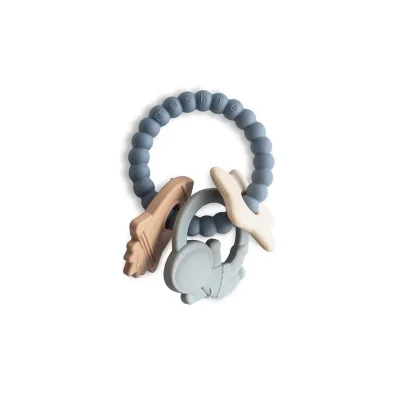
Mushie is the Scandinavian brand that made baby products Instagram-worthy, and the Teething Ring is a perfect example of their design philosophy: calming muted colours, clean lines and materials that quietly do their job. The Space design features playful planet and star charms attached to a central ring, all made from 100% food-grade silicone.
The practical advantage of silicone over natural rubber is significant. You can put this in the dishwasher. You can steam-sterilise it. You can boil it. The non-porous surface does not harbour bacteria, does not develop the sticky residue that rubber can, and does not degrade with repeated cleaning. For parents who prioritise hygiene, this is the strongest argument for the Mushie over the Sophie.
The charms serve a dual purpose: they give babies something to grip and slide, building fine motor skills, while also providing different chewing surfaces. The ring itself is lightweight and sized for small hands. One parent shared: “Gorgeous design and my baby loves sliding the little charms around. It looks lovely in photos too.”
The trade-off is that silicone is firmer than natural rubber. Babies who prefer a softer, squishier chew may find the Mushie less soothing. There is no cooling element either, so for acute teething pain where cold provides relief, the Nuby IcyBite will do more. And at £14, you are paying a premium that is partly for the design and brand rather than the teething functionality alone. One parent noted: “Beautiful product, but my baby reached for the cheap supermarket teether just as often.”
What parents love
- Fully sterilisable. Dishwasher-safe, steam steriliser-safe and boilable. The easiest teether to keep hygienically clean, no compromises.
- Beautiful Scandinavian design. Muted colours and clean lines that look as good on the nursery shelf as they do in your baby’s mouth. Available in multiple colourways.
- Fine motor development. The sliding charms give babies something to manipulate beyond just chewing, supporting hand-eye coordination alongside teething relief.
- Durable and long-lasting. Food-grade silicone does not crack, degrade or develop odours over time. Will last through multiple children if needed.
What to know before you buy
- Firmer chew than natural rubber. Silicone does not have the same soft, skin-like give. Babies who prefer a squishier texture may not take to it.
- No cooling function. Unlike the Nuby, there is no gel or water filling to chill. You can put the ring in the fridge, but solid silicone does not hold cold as effectively.
- Design premium. At £14, the price reflects the Mushie brand and aesthetic as much as the teething functionality. A basic silicone teether costs a third of this.
Best for
- Hygiene-focused parents who want a teether they can properly sterilise
- Design-conscious families who want baby products that match their aesthetic
- Parents planning to reuse for future children, since silicone outlasts rubber by years
How to choose
The honest answer is that most babies will happily chew on any of these three. The differences matter more to parents than to babies, and that is perfectly fine, because you are the one buying, cleaning and carrying it.
If your baby is actively teething and the gums are visibly swollen, the Nuby IcyBite Keys at around £5 will do more immediate good than either alternative. Cold soothes inflammation, and the PurICE gel delivers that effectively. Buy two and rotate them from the fridge. The cleaning limitations are manageable at this price point, because replacing the teether every few months is not a painful expense.
If you want a teether that covers the full teething journey with natural materials and genuine design thought, the Sophie la girafe So’Pure at around £13 is our pick. The multiple textures, the sliding shapes and the lightweight ring add up to a product that works at every stage. The inability to sterilise it is a real drawback, but the quality of the natural rubber and the Made in France craftsmanship justify the premium for many parents.
If easy cleaning is your top priority, or you want something that will last through multiple children, the Mushie Teething Ring at around £14 is the practical choice. Dishwasher-safe, virtually indestructible and genuinely beautiful. Just do not expect the cooling relief that the Nuby provides or the soft chew that natural rubber offers.
One final thought from the NHS: whichever teether you choose, cool it in the fridge, never the freezer. Frozen teethers can damage your baby’s gums. And never tie a teething ring around your baby’s neck. Beyond that, the best teether is the one your baby actually reaches for.
Add it to your Nest
Teethers make ideal registry items, whether you choose budget or premium. Add your pick to your free BubsNest registry and let friends and family help keep those sore gums soothed.
Ready to Create Your Baby Registry?
Start your free baby registry today and share it with friends and family.
Get Started Free