Best Baby Xylophones UK 2026: Only the £18 Chicco Needs Batteries, and the Jabadabado Waits Until Three
Four toy xylophones compared, from the £12 Little Dutch crocodile to the £25 Jabadabado. Starting ages run from 12 months to three years, and only one needs batteries.
COMPARISON · PLAY & LEARN
A toy xylophone is one of the few first-birthday presents that grows with a child rather than being outgrown by Christmas. At 12 months it is a thing to bash. By two it is a thing to bash in time with a song. By three or four, with the right instrument, it is where a child first works out that the long bar sounds low and the short bar sounds high. That arc is the whole reason to choose carefully, because the four xylophones we compared here are built for very different points along it.
The obvious split is electronic versus acoustic, and only one of the four needs batteries. The less obvious split is age. Read the boxes closely and the recommended starting ages run from 12 months to three years, a spread that matters a lot more than colour or price when you are buying for a one-year-old. A toy labelled 3+ is not a stricter version of a 12-month toy; it usually means small parts, a loose mallet or a design that has not been tested for babies who still put everything in their mouths.
We compared spec sheets, retailer listings and the feedback we hear from parents about each instrument, then looked at what actually changes day to day: whether the mallet goes missing, how the notes sound, how much space it takes on the shelf and whether it will still get played in a year. Prices are what our retailers listed at the time of writing, and several were discounted for the Black Friday run-up, so check the card before you buy.
Lil' Bubba's verdicts
- Best Overall: Little Dutch Crocodile Xylophone · 8.5/10 - seven bars on a slim wooden crocodile for about £12, the most instrument for the money
- Best for a First Birthday: Skip Hop Explore & More Fox Xylophone · 8.0/10 - eight notes and a mallet that clips under the fox so it never goes missing
- Best for Lights and Songs: Chicco Flashy the Xylophone · 7.5/10 - Follow the Light and Jukebox modes for toddlers who want the toy to lead
- Best for Preschoolers: Jabadabado Xylophone · 7.5/10 - metal keys in a flat, shelf-friendly frame, but labelled from three years
Quick comparison
| Xylophone | Price | From age | Notes | Batteries | Rating |
|---|---|---|---|---|---|
| Little Dutch Crocodile Xylophone | £11.95 | 18 months | 7 bars | None | |
| Skip Hop Explore & More Fox Xylophone | £19.99 | 12 months | 8 bars | None | |
| Chicco Flashy the Xylophone | £17.99 | Check box (12m to 3y listed) | 7 keys | 3 x AA | |
| Jabadabado Xylophone | £24.95 | 3 years | Metal bars | None |
How we picked the 4
We started with every xylophone in our catalogue that is in stock with a retailer we work with, then dropped multi-toy activity cubes where the xylophone is one face of five, and generic sellers with no track record. That left five instruments from five brands. One of them, the Speedy Monkey Xylo Bench, was showing as awaiting stock while we wrote this, so it is covered in prose further down rather than ranked.
For the remaining four we compared the published age grading, key count, power source, size and weight, then weighed them against what parents tell us matters after the first week: lost mallets, the noise level in a small flat, whether the notes are anything like in tune, and how long the toy holds a child's interest.
What to look for in a baby xylophone
The age on the box. This is the single most important number. A 12-month grading means the toy has been designed and tested for babies who mouth and throw things. A 3+ grading usually means a detachable mallet or small parts. If you are buying for a baby under two, stick to the lower gradings and check the label on the specific listing.
Mallet design. Loose mallets get lost, chewed and thrown. A tethered mallet solves the first two problems but introduces a cord, so supervise play and check the cord length. A chunky single mallet is easier for small hands to grip than a thin drumstick.
Acoustic or electronic. Acoustic xylophones are quieter than you might fear and never run flat. Electronic ones add lights, demo songs and guided modes that can hold a younger toddler's attention for longer, but they cost you batteries and tend to drown out the child's own playing.
Metal or wooden bars. Metal bars ring on and sound brighter; wooden bars give a softer knock. Toy instruments are rarely perfectly tuned, so treat any 'full scale' claim as approximate. What matters at this age is that each bar sounds clearly different from its neighbour.
Size and storage. A flat frame slides onto a bookshelf or into a toy basket. Chunkier designs with a character body take more space but are harder to knock over and easier to carry.
1. Little Dutch Crocodile Xylophone
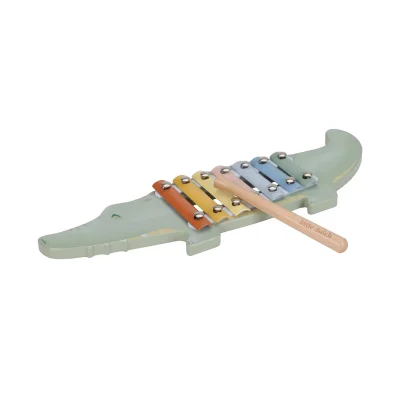
The Little Dutch Crocodile Xylophone is the cheapest of the four and, for most families, the best buy. It is a sage-green wooden crocodile 37.5cm long and just 2cm deep, with seven coloured bars that step down in size along its back and a small wooden mallet. At around 410g it is light enough for a toddler to carry to the sofa and slim enough to slide onto a shelf when play is over.
Little Dutch grades it from 18 months, which puts it after the Skip Hop and before the Jabadabado. That makes it a natural second-birthday present or a gift for an older one-year-old who has stopped mouthing everything. It was on offer at about £10 at the time of writing, against a usual £11.95.
What parents love
- Price. At under £12 it costs well under half the Jabadabado, and it is a proper bar-and-mallet instrument rather than a toy with a keyboard printed on it.
- Graduated bars. The seven bars shrink in length along the crocodile, so a child can see as well as hear that shorter bars sound higher.
- Slim and light. Two centimetres deep and roughly 410g, it stores flat and is easy for a toddler to move around.
- No batteries. Nothing to replace and no demo song to compete with the child.
What to know before you buy
- Loose mallet. The single wooden mallet is not tethered, so expect it to wander. Parents we hear from often keep it in a pot with the crayons.
- Not for young babies. The 18-month grading rules it out as a first-birthday present if you follow the label, which you should.
- Seven notes, not eight. You cannot play a full octave, so simple nursery tunes will sometimes run out of bar.
Best for
- Toddlers from 18 months
- Families who want a real instrument on a small budget
- Small homes where toys need to store flat
- Gift-givers who want something that looks lovely on a shelf

2. Skip Hop Explore & More Fox Xylophone

The Skip Hop Explore & More Fox Xylophone is the only one of the four that is clearly built for a one-year-old. The fox body holds eight colourful bars, which Skip Hop describes as a full scale of notes, and the mallet is attached so it stays with the toy. When play is done, the mallet tucks away under the fox's belly. The fox's head bobs as it is played, which is exactly the sort of payoff that keeps a 12-month-old coming back.
Retailers grade it from 12 months, and it does not need batteries. At £19.99 it costs more than the Little Dutch, and what that money buys is the younger age grading and the mallet that cannot go missing.
What parents love
- Mallet that stays put. The tethered mallet is the feature parents mention most. One parent told us: 'Every other xylophone we have owned, the stick was gone within a week. This one is still attached.'
- Ready at 12 months. The youngest age grading in this roundup, so it works as a first-birthday present.
- Eight notes. The extra bar over the Little Dutch and Chicco means simple tunes have room to finish.
- Built-in storage. The mallet clips under the belly, so the toy goes back in the basket as one piece.
What to know before you buy
- The cord. The tether is a cord, and we hear repeatedly from parents that it pays to supervise play and keep an eye on its condition. A few say the cord feels short for a toddler swinging the mallet.
- Toy-level tuning. Some parents find the notes slightly off key. For a one-year-old that will not matter; for a musical four-year-old it might.
- Bulkier shape. The character body takes more shelf space than the flat crocodile or Jabadabado.
Best for
- First birthdays
- Families tired of hunting for lost mallets
- New walkers who carry toys from room to room
- Toddlers who like a toy that reacts

3. Chicco Flashy the Xylophone

The Chicco Flashy the Xylophone is the electronic option. It has seven keys that light up, and on top of plain free play it offers a Follow the Light mode, where a key lights up and the child taps it, and a Jukebox mode that plays tunes. It runs on three AA batteries and weighs around 870g, making it the heaviest of the four.
Age grading is the thing to check here. Different listings for this toy show starting ages from 12 months to three years, so read the box on the version you buy. At £17.99 it sits between the Little Dutch and the Skip Hop on price.
What parents love
- Guided play. Follow the Light gives a toddler something to aim at, which can hold attention longer than free play at the youngest end.
- Lights as feedback. Each key lights up when hit, so the cause-and-effect payoff is visual as well as audible.
- Jukebox for downtime. It can play tunes on its own, handy when a toddler wants to dance rather than play.
What to know before you buy
- Batteries. Three AA cells, and a toy with lights and demo songs gets through them. Keep a screwdriver handy for the battery door.
- Electronic sound. This is not an acoustic instrument; the notes come from a speaker. If you want a child to learn how real bars sound, the other three do that better.
- Conflicting age labels. Listings disagree on the starting age, so check the packaging before giving it to a baby.
Best for
- Toddlers who love lights and buttons
- Parents who want guided play modes
- Grandparents looking for a bright, busy present
- Children who enjoy dancing to songs
4. Jabadabado Xylophone

The Jabadabado Xylophone is the design-led pick: a flat green frame measuring 29.7 x 13.6cm and only 2cm deep, with metal bars that give a clearer, ringing tone than plastic keys. It weighs about 0.5kg and looks more like a small music-room instrument than a baby toy, which is exactly its appeal for parents who curate the playroom.
It is graded from three years, the oldest in this roundup, so it is not a baby xylophone in the strict sense. Think of it as the instrument a child moves on to. At £24.95 it is the most expensive of the four, though it was reduced to around £16 at the time of writing. The listing does not state the number of bars or mallets, so check the product photos before you buy.
What parents love
- Metal bars. A brighter, longer-ringing note than the plastic keys of the electronic option.
- Flat and slim. At 2cm deep it stores on a bookshelf or in a drawer, a real plus in a shared bedroom.
- Looks good out. The muted green finish suits a neutral playroom and does not need hiding away.
What to know before you buy
- From three years. The grading rules it out for babies and young toddlers; buy one of the others for under-threes.
- Thin spec sheet. The key count and mallet details are not published on the listing, so you are partly buying on looks.
- Highest full price. At £24.95 full price it costs twice the Little Dutch.
Best for
- Three to five-year-olds
- Parents who want a nicer-looking instrument
- Toddlers moving on from a first xylophone
- A music corner alongside other instruments
What about the Speedy Monkey Xylo Bench?
The Speedy Monkey Xylo Bench is a clever crossover: a wooden pounding bench where the child hammers coloured balls down through the top and they roll across xylophone bars on the way out. It is made from FSC-certified wood with non-toxic paint and usually costs £25.95. It would have made this list, but our retailer was showing it as awaiting new stock while we wrote this, so we have not given it a card. If your toddler loves pound-a-ball toys, it is worth checking back for.
How to choose
Choose the Little Dutch Crocodile Xylophone if your child is 18 months or older and you want a real bar-and-mallet instrument for the least money. It is the best value here and stores flat.
Choose the Skip Hop Explore & More Fox Xylophone if it is for a first birthday. It is the only one graded from 12 months with a mallet that cannot get lost; just supervise play because of the tether cord.
Choose the Chicco Flashy the Xylophone if your toddler is drawn to lights and buttons and you are happy to buy batteries. Check the age on the box for the version you buy.
Choose the Jabadabado Xylophone for a child of three or more, or as the step up from a first xylophone. It is the best-looking and the slimmest, but it is not for babies.
Add it to your Nest
Building a first-birthday list or a Christmas wishlist? Add any of these xylophones to your free BubsNest registry so family can see exactly which one you want, and at which age it is meant for.
Ready to Create Your Baby Registry?
Start your free baby registry today and share it with friends and family.
Get Started Free