Best Toddler Scooters UK 2026: Deck Height Matters More Than Light-Up Wheels
We compared five toddler scooters from £49 to £115, from Micro, Globber, Scoot & Ride, Kinderkraft and Little Dutch. The low deck and lean-to-steer feel decide how fast a two-year-old gets going, not the light show.
COMPARISON · PLAY & LEARN
A first scooter is one of those purchases that looks simple until you are standing in front of twenty near-identical three-wheelers in four shades of pastel. They all have two wheels at the front, one at the back, a brake you stamp on and a handlebar that goes up and down. So why does one toddler zoom off within a week while another stands on the deck looking baffled for a month?
After going through the specs, the retailer listings and a lot of feedback from parents, the answer is less exciting than the marketing suggests. The things that actually decide whether a two-year-old gets going are how low the deck sits, how light the scooter is (because you will be carrying it home), and how forgiving the lean-to-steer feels. Light-up wheels are lovely, and almost every scooter here has them in some form, but they are not what separates a good first scooter from a frustrating one.
We have picked five toddler scooters across five brands, from a £49 budget option with a full light show to a £115 ride-on that converts into a scooter from 12 months. Every one is in stock with UK retailers we work with, and every one gets the same honest treatment below: what parents love, what to know before you buy and who it suits.
If you are buying for a second birthday or a Christmas stocking, the quick verdicts are just below. If you want to understand why the cheapest scooter here is not automatically the worst, keep reading.
Lil' Bubba's verdicts
- Best Overall: Micro Mini Deluxe ECO · 9.0/10 - the lightest, lowest and most forgiving first scooter, built to be passed down
- Best for Nervous Beginners: Globber Junior Foldable Lights · 8.5/10 - a steering lock keeps it rolling straight until your toddler is ready to lean
- Best from 12 Months: Scoot & Ride Highwaykick 1 · 8.0/10 - starts as a sit-on ride-on and becomes a stand-up scooter when they are ready
- Best Budget: Kinderkraft Raket · 7.5/10 - full light-up deck and a two-second fold for under £50
- Best for Style-Led Families: Little Dutch 3 Wheel Scooter · 7.0/10 - the prettiest of the five, for children aged three and up
Quick comparison
| Scooter | Price | Age from | Weight | Folds? | Rating |
|---|---|---|---|---|---|
| Micro Mini Deluxe ECO | £81 | 2 years | approx. 1.9kg | No (T-bar removes) | |
| Globber Junior Foldable Lights | £63 | 2 years | approx. 2.5kg | Yes | |
| Scoot & Ride Highwaykick 1 | £115 | 12 months (seat) | approx. 2.6kg | No | |
| Kinderkraft Raket | £49 | 2 years | approx. 3.2kg | Yes | |
| Little Dutch 3 Wheel Scooter | £54 | 3 years | approx. 2.1kg | No |
How we picked the 5
We started with the scooters parents ask us about most, then cross-checked them against the toddler scooters that come up again and again in UK buying guides and parent forums. From there we narrowed down to models that are genuinely designed for under-fives (not shrunk-down big-kid scooters), that use a three-wheel layout, and that are in stock with retailers in our partner network.
For each one we pulled the manufacturer specs (weight, age range, maximum load, handlebar adjustment), checked current UK prices, and read through parent reviews to find the patterns: what people praise after six months, not just on day one, and what makes them regret the purchase. We only included one scooter per brand so you are comparing genuinely different approaches rather than three colourways of the same thing.
What to look for in a toddler scooter
Lean-to-steer, not twist-to-steer. On a three-wheel toddler scooter the handlebar does not turn like a bike. Your child leans their body and the front wheels follow. It sounds odd, but it is far more intuitive for a two-year-old, because their natural reaction to wobbling is to lean, and on these scooters leaning simply makes them turn. All five here use some form of body-weight steering.
Deck height. The lower the deck, the less effort each push takes and the less dramatic a wobble feels. A low deck also means shorter legs can reach the ground comfortably for that first scoot. This is the single spec that most affects how quickly a younger toddler gets going, and it rarely appears on the box.
Weight. A scooter that weighs 2kg versus 3kg does not sound like much until you are carrying it, a tired toddler and a bag of shopping up a hill. Lighter scooters also tip less violently when your child steps off at an angle.
Handlebar range. Look for a handlebar that adjusts across several heights. A bar set too high makes a small child hang off it rather than balance; set too low, they hunch. The more range, the longer the scooter lasts.
Brake. All of these use a rear foot brake. A longer, wider brake is easier for little feet to find, but honestly, most toddlers stop by putting a foot down for the first few months anyway.
Folding. A fold is handy for car boots and buggy baskets, but it adds a hinge, a little weight and something else to check. If you mainly scoot from your front door, a non-folding scooter with a removable handlebar is often lighter and simpler.
Lights. Light-up wheels help visibility on dark winter afternoons and children adore them. Most good scooters now include them. Just do not pay extra for a light show at the expense of weight or deck height.
1. Micro Mini Deluxe ECO

The Mini Micro Deluxe is the scooter most other toddler three-wheelers are measured against, and the ECO version keeps everything that makes it work while swapping the standard deck for one made from recovered fishing nets. At around 1.9kg it is the lightest scooter in this roundup, the deck sits very close to the ground, and the lean-to-steer action is smooth enough that most two-year-olds get the hang of it on their first afternoon.
It is also the most expensive of the standalone scooters here at around £81, and it does not fold. What you are paying for is build quality and longevity: Micro sells almost every part separately, from wheels to grips to the brake, so a worn-out scooter can be repaired rather than replaced, and plenty of families pass the same one down two or three children.
What parents love
- Lightest of the five. At roughly 1.9kg it is easy for a toddler to manoeuvre and easy for you to carry home under one arm when legs give out halfway to the park.
- Very low deck. Short legs reach the ground comfortably, which makes those first pushes far less tiring. We hear repeatedly from parents that this is why younger two-year-olds take to it so quickly.
- Smooth, forgiving steering. The lean-to-steer mechanism responds gently, so a wobble turns into a curve rather than a tumble.
- Built to be repaired. Replaceable parts and a strong resale market mean it holds its value. One parent told us: 'Ours has done two children and still looks fine, we have only ever replaced the grips.'
What to know before you buy
- No fold. The T-bar pulls out for storage, but it does not fold flat with one click like the Globber or Kinderkraft. Fine for doorstep scooting, slightly fiddlier for car journeys.
- Premium price for a simple scooter. There are no gimmicks here, and some parents feel £80 is a lot for something this minimal. You are paying for longevity, not features.
- No steering lock. Unlike the Globber, there is no way to make it roll straight only. Nervous or very young riders may need a few sessions holding your hand.
Best for
- Two-year-olds who want to scoot straight away
- Families planning to pass it on to a younger sibling
- Anyone who walks to nursery or the park and will end up carrying it
- Parents who would rather pay once than replace a cheaper scooter

2. Globber Junior Foldable Lights

The Globber Junior is the Mini Micro's closest rival and, for some children, the better choice. Its trick is a patented steering lock: press a button and the front wheels stay straight, so a cautious toddler can practise pushing and balancing without the scooter veering off. When they are confident, you unlock it and they learn to lean.
It also folds, which the Micro does not, and the version we stock has a deck made with 60% recycled plastic and wheat straw plus battery-free light-up wheels powered by the motion of the scooter. At around 2.5kg it is a little heavier than the Micro, and the three-position handlebar has a narrower range, but at around £63 it undercuts it by nearly £20.
What parents love
- Steering lock for beginners. Lock the steering and your child can focus on pushing first. Parents of more hesitant toddlers say this is what finally got them scooting.
- Folds for the car. A tool-free fold makes it easy to throw in the boot or hang off a buggy handle.
- Long, wide rear brake. Globber gives it an extra-long brake that is easier for small feet to find than most.
- Feels quick. Some parents with both models report their children prefer the Globber because it feels faster once they are confident.
What to know before you buy
- Heavier than the Micro. Around 2.5kg is still light, but you will notice the difference on the walk home.
- Shorter handlebar range. The three-height T-bar tops out lower than some rivals, so taller four- and five-year-olds may outgrow it sooner.
- Busy colourways. The light-up, patterned versions are not to everyone's taste if you prefer something understated.
Best for
- Cautious toddlers who need to build confidence
- Families who drive to the park and need a fold
- Parents who want a quality brand without paying Micro prices
- Children aged two who are just starting out



3. Scoot & Ride Highwaykick 1

The Highwaykick 1 is a different idea: it starts life as a low sit-on ride-on from 12 months, then the seat comes off and it becomes a three-wheel stand-up scooter. Scoot & Ride says it has the lowest seat height on the market, and with a front storage box for toys and snacks, it doubles as a first birthday present that will still be in use at four.
At around £115 it is the priciest product here, and at 2.6kg it is not the lightest, but you are effectively buying a ride-on and a scooter in one. The seat and handlebar both adjust across three positions, and the weight-shift steering is the same lean-to-turn idea as the others, so the jump from sitting to standing feels natural.
What parents love
- Starts earlier than any other. Suitable from 12 months as a sit-on, years before most children are ready for a standing scooter. A parent shared: 'We bought this for my 16 month old and he absolutely loves it, the adjustable height and ability to go from sitting to standing is perfect as he grows.'
- Tool-free conversion. Switching from seat mode to scooter mode needs no tools, so you can try standing and go back to sitting on the same afternoon.
- Storage box. The front box is a genuine hit with toddlers who like to carry treasures, stones and snacks around.
- Feels well made. Parents consistently praise its stability and build quality, and reviews on UK retail sites are overwhelmingly positive.
What to know before you buy
- Highest price. Around £115 is a lot if your child is already two and ready to stand. In that case, a dedicated scooter is better value.
- Seat weight limit. The seat is rated to 20kg (the kickboard to 50kg), so it is very much a toddler ride-on rather than something a bigger child can sit on.
- Does not fold. It is compact, but there is no folding mechanism for car boots.
Best for
- First birthday presents
- Families who want one toy to cover ride-on and scooter stages
- Toddlers who love carrying things around
- Younger siblings who want to keep up with a scooting older child
4. Kinderkraft Raket

The Kinderkraft Raket is the scooter for the child who wants all the lights. The deck itself lights up with 20 colour modes and the wheels glow as they roll, and it folds in a couple of seconds with an automatic lock. At around £49, it is the cheapest scooter in this roundup.
It uses lean-to-steer like the others and the handlebar adjusts across three heights, from about 68cm to 78cm. The trade-off is weight: at around 3.2kg it is the heaviest scooter here, and that matters for a two-year-old trying to steer it and for the parent who ends up carrying it home.
What parents love
- The most lights for the money. A light-up deck plus glowing wheels makes it the most eye-catching scooter here, and helps visibility on dark afternoons.
- Quick fold. The automatic-lock fold takes seconds and makes it easy to stash in a boot or under the stairs.
- Grows with them. A 50kg maximum load and three handlebar heights mean it can last well beyond the toddler years.
What to know before you buy
- Heaviest of the five. At roughly 3.2kg, it is noticeably harder for a small two-year-old to manoeuvre and for you to carry.
- Lights do not make it easier to ride. We hear repeatedly from parents that their child loved the lights but took longer to get confident than friends on lighter scooters.
- More electronics. A light-up deck is one more thing that can stop working, and it will not be as easy to repair as a Micro.
Best for
- Budget-conscious families
- Children aged three and up who are already steady on their feet
- Kids who will be scooting on darker school-run afternoons
- Grandparents buying a showstopper gift
5. Little Dutch 3 Wheel Scooter
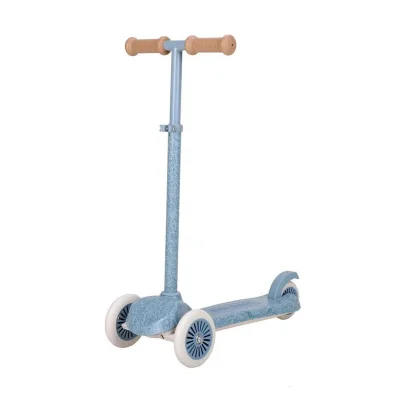
Little Dutch is better known for wooden toys and nursery accessories, and its 3 Wheel Scooter brings the same soft, muted look to a first scooter: pastel or off-white frames with warm brown handlebar grips, plus a matching helmet if you want the full set. It is light at around 2.1kg and steers by body balance like the others.
The catch is the age range. Little Dutch rates it from three years, a full year later than the Micro, Globber and Kinderkraft, so it is a better fit for a pre-schooler than a young toddler. At around £54 it sits in the middle of the price range, and it does not fold.
What parents love
- Genuinely lovely to look at. If the bright plastic of most scooters is not your thing, this is the one that will not clash with the rest of your hallway.
- Light and simple. At roughly 2.1kg with no fold mechanism, it is easy to carry and has very little to go wrong.
- Matching helmet available. Little Dutch sells a coordinating helmet, which makes it a popular gift set.
What to know before you buy
- From three years only. Younger two-year-olds are better served by the Micro or Globber, which are designed for them from the start.
- No fold, no lights. You get a simple scooter for the money, without the steering lock, fold or light-up wheels of rivals at a similar price.
- Less parent feedback. It is a newer, less widely reviewed scooter than the Micro or Globber, so there is less long-term evidence on durability.
Best for
- Pre-schoolers aged three to five
- Families who care about how toys look at home
- Gift buyers who want a matching scooter and helmet set
- Children upgrading from a balance bike or ride-on
What about the Micro Mini 3in1 or a balance bike?
You may have seen Micro's 3in1 and Mini2Grow models, which add a seat to a Mini Micro so it works from around 12 months. They are a good alternative to the Highwaykick 1 if you are set on the Micro platform, but we have kept this comparison to one scooter per brand so you can see five genuinely different approaches side by side.
And if your toddler is closer to three, it is worth asking whether a balance bike is the better first set of wheels. Scooters build confidence quickly and are easier on pavements; balance bikes teach the balance needed for a pedal bike later. Plenty of families end up with both. Our community guides cover balance bikes separately.
How to choose
Micro Mini Deluxe ECO: choose this if your child is around two, you will often carry the scooter, and you want something that lasts long enough to pass on. It is the safest bet in this roundup.
Globber Junior Foldable Lights: choose this if your toddler is cautious or very young and you want the option to lock the steering while they learn, or if you need a fold for the car.
Scoot & Ride Highwaykick 1: choose this if your child is between one and two, or you want a single present that covers the ride-on stage and the scooter stage.
Kinderkraft Raket: choose this if budget matters most and your child is already steady on their feet. The lights are a bonus, but be ready for the extra weight.
Little Dutch 3 Wheel Scooter: choose this if your child is three or older and you would like a scooter that looks as good in the hallway as it does in the park.
Add it to your Nest
Shortlisting a first scooter for a birthday or Christmas? Add your favourite to your free BubsNest registry so family and friends can see exactly which model and colour you have chosen, and nobody turns up with a duplicate.
Ready to Create Your Baby Registry?
Start your free baby registry today and share it with friends and family.
Get Started Free