Breast Pumps by Budget: £30 vs £140 vs £230
From a £30 silicone manual to a £230 hands-free wearable, we break down what each price tier actually buys you in the breast pump world.
COMPARISON · FEEDING
Choosing a breast pump feels like choosing a phone contract - there are too many options, the specs blur together, and you cannot really test one before you commit. The price spread does not help either: you can spend anywhere from £20 on a manual pump to £350 on a hospital-grade wearable, with dozens of options crammed into every price band in between.
The truth most guides skip: price does not always track with quality. A £30 silicone pump can be the perfect tool for one parent and completely wrong for another, regardless of how much they could afford to spend. What matters is matching the pump to how often you plan to use it, where you will be pumping, and whether you need hands-free operation or just occasional relief.
We picked one standout product at each of three distinct price points - budget, mid-range, and premium - and compared them on the metrics that actually matter to parents: comfort, output, portability, cleaning time, and noise. No lab conditions. Just real performance for real routines.
Lil' Bubba's verdicts
- Best Overall: Momcozy M5 Wearable Double · 8.0/10 - the sweet spot of hands-free convenience and value
- Best Value: Haakaa Manual + Ladybug Combo · 7.0/10 - captures milk you would otherwise lose, for the price of a takeaway
- Best for Power Pumpers: Momcozy M6 Double · 7.5/10 - strongest motor and largest capacity for exclusive pumpers
| Haakaa Combo | Momcozy M5 | Momcozy M6 | |
|---|---|---|---|
| Price | ~£32 | ~£140 | ~£230 |
| Type | Silicone manual + passive collector | Wearable electric double | Wearable electric double |
| Capacity | 100 ml (pump) / 75 ml (Ladybug) | 150 ml per cup | 180 ml per cup |
| Battery | None needed | ~120 min (3-4 sessions) | ~180 min (5-6 sessions) |
| Noise | Silent | <50 dB | <48 dB |
| Flange sizes | Universal (flexible silicone) | 17 / 19 / 21 / 24 mm | 17 / 19 / 21 / 24 mm |
| Modes | N/A (suction only) | 3 modes, 9 levels | 3 modes, 9 levels |
| Rating |
How we picked the 3
We started with the question parents actually ask: "How much do I need to spend on a breast pump?" Rather than ranking ten options in a single bracket, we chose one standout at each price tier so you can see exactly what your budget buys.
Each product had to meet three criteria: currently in stock from a UK-shipping joined retailer, from a brand with a track record in breastfeeding products, and genuinely popular among parents (not just algorithm-boosted). We cross-referenced parent community discussions, verified specs against manufacturer data, and weighted real-world output reports over lab claims.
What to look for in a breast pump
Manual vs electric vs wearable. Manual pumps (hand-operated or suction-based) are cheapest, quietest, and easiest to clean. Electric pumps offer adjustable suction and speed. Wearable pumps sit inside your bra and let you move freely, but cost more and have more parts to wash.
Flange fit matters more than price. The plastic or silicone funnel that sits against your breast needs to match your nipple diameter. Too large and you lose suction, too small and it hurts. Most wearable pumps now include multiple sizes. If you are unsure, measure before you buy - a correctly fitted £30 pump will outperform a poorly fitted £300 one.
Closed vs open system. Closed-system pumps have a barrier between the milk and the motor, making them more hygienic and resaleable. Open-system pumps (including silicone manuals) can technically allow moisture into the tubing. For personal use this rarely matters, but if you plan to resell or share, check which type you have.
Battery life vs sessions. Manufacturer battery claims assume short sessions. If you pump for 30 minutes per session (common for exclusive pumpers), divide the stated battery life by your session length to get real-world sessions between charges. USB-C charging is now standard on newer models.
Noise level. Anything under 50 dB is considered quiet enough to use during a work call or while a baby sleeps nearby. Silicone manuals are completely silent. If discretion matters to you, check real-user noise reports rather than manufacturer claims.
Cleaning time. Fewer parts means faster cleaning. A one-piece silicone pump takes 30 seconds to wash. A multi-part wearable pump can have 6-8 pieces per side. After the fourth pump of the day, this adds up.
1. Haakaa Manual Breast Pump + Ladybug Combo

The Haakaa is not really a pump in the traditional sense. It is a single piece of food-grade silicone that uses natural suction to draw out milk, and it comes paired with the Ladybug - a wearable collector that catches let-down from your other breast while you nurse. Together they cost less than a restaurant meal for two, and they require zero electricity, zero assembly, and about 20 seconds to clean.
For parents who are primarily breastfeeding and want to build a freezer stash without adding extra pumping sessions to their day, this combo is quietly brilliant. You attach the pump to one side during a feed, pop the Ladybug in your bra on the other, and let your natural let-down do the work. Many parents report collecting 60-90 ml per feed this way, enough to build a meaningful stash over a week without ever sitting down to "pump."
What parents love
- Effortless collection. One parent told us: "I used to lose milk during let-downs. Now I catch a few ounces a day, just by using it while nursing."
- Completely silent. No motor noise, no vibration - usable at 3am without waking anyone.
- One-piece cleaning. Pop both pieces in the dishwasher or rinse under a tap. No valves, no membranes, no tiny parts to lose.
- Truly portable. Weighs under 100g combined. No cords, no charging, no case needed.
What to know before you buy
- The Ladybug divides opinion. It works brilliantly for heavy leakers but collects very little for parents with a lighter let-down. Set expectations accordingly.
- Spill risk. Both pieces can detach if a baby kicks or you lean forward suddenly. Experienced users learn to move carefully.
- Passive only. This is not an active pump - it cannot replace an electric if you need regular, high-volume expression.
Best for
- Breastfeeding parents who leak heavily on the opposite side during feeds
- Building a freezer stash passively without extra pumping sessions
- Budget-conscious families wanting an affordable complement to direct nursing
- Night feeds where silence is non-negotiable

2. Momcozy M5 Wearable Double Breast Pump
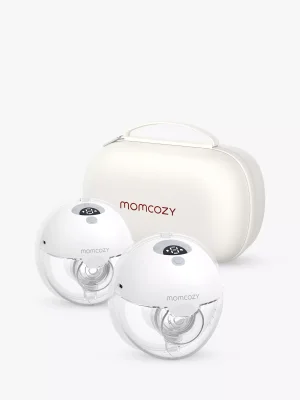
The M5 is where wearable pumping becomes genuinely accessible. It tucks inside a standard nursing bra, runs quietly enough to use on a work call, and delivers output that parents consistently compare to hospital-grade machines costing three times as much. At roughly £140 for the double, it undercuts the Elvie by over £100 while matching it on the specs that actually matter.
The 105-degree flange slope is designed to mimic a baby's natural latch angle, which Momcozy claims reduces discomfort during let-down. Four flange sizes ship in the box (17, 19, 21, and 24 mm), so you can find your fit without ordering extras. Three modes (stimulation, expression, and mixed) with nine intensity levels give enough flexibility for most routines.
What parents love
- Hospital-grade output. A parent shared: "I have been using a hospital-grade pump every day for six months and this gets equivalent milk volumes."
- Truly hands-free. Tucks into a bra with no tubes or cords. Parents cook, type, and commute while pumping.
- Quiet enough for shared spaces. Under 50 dB - comparable to a quiet conversation.
- All flange sizes included. Four sizes in the box means no guessing or buying extras.
What to know before you buy
- Bulkier than premium competitors. One parent noted: "It is bulky and very obvious when wearing." Not ideal under fitted clothing.
- Hand-wash only. The parts are not dishwasher safe, adding cleaning time to each session.
- Motor longevity. Some long-term users report reduced suction after several months of heavy daily use.
Best for
- Part-time pumpers who want flexibility without the Elvie price tag
- Working parents needing discreet, cord-free pumping during busy schedules
- Parents who prioritise comfort and value over ultra-slim aesthetics
- Anyone pumping 1-3 times daily at home or at a desk



3. Momcozy M6 Double Breast Pump

The M6 is Momcozy's flagship - a second-generation motor, larger 180 ml cups, and a more contoured shape designed to sit flatter against the body. It costs roughly £90 more than the M5, and the question every parent asks is: "Is it worth the upgrade?" The honest answer is yes, but only if you pump frequently enough to notice the differences.
The stronger motor (295 mmHg vs the M5's 285 mmHg) means slightly faster emptying. The larger cups mean fewer mid-session overflows for high-output parents. And the USB-C charging with a quoted 180 minutes of battery means fewer top-ups between sessions. It also stands upright on its own, which sounds trivial until you have tried balancing a pump on a bedside table at 4am.
What parents love
- Surprisingly efficient. We hear repeatedly from parents that output exceeds expectations. One parent put it best: "It has been much more efficient at collecting milk than I ever expected."
- Comfortable flange fit. Parents we hear from regularly praise the soft silicone edge seal and warmth of the flange against skin.
- Whisper-quiet motor. Under 48 dB - you can hold a normal conversation while pumping.
- Stands upright. The flat base prevents spills when you set it down between sessions.
What to know before you buy
- Leaks when you bend. The pour spout can let milk escape if you lean forward to pick up a baby or reach across a desk. The most-cited issue.
- Battery life overstated. Manufacturer claims 180 minutes, but parents report performance dropping well before that with regular use.
- Heavier than the M5. At 287g per cup (vs 230g), you notice the extra weight over a long session.
Best for
- Exclusive pumpers who need maximum output and capacity per session
- Parents returning to work who pump 4+ times daily at a desk
- Travellers who need long battery life and a compact carry case
- High-output parents who overflow smaller 150 ml cups
What about Elvie and Medela?
Two names come up in every breast pump conversation. The Elvie Stride and Elvie Pump are slimmer and more discreet than either Momcozy model, but they start at over £250 for a single pump and are not currently available through our joined-programme retailers. If aesthetics and profile are your top priority, they are worth researching separately.
Medela's Harmony manual pump (£20-25) is the traditional alternative to the Haakaa at the budget end. It uses a lever-action rather than suction, which some parents prefer for active expression. If you want a manual pump for deliberate pumping sessions rather than passive collection, the Harmony is worth considering - but it is a very different tool to the Haakaa's "set it and forget it" approach.
How to choose
Choose the Haakaa Combo if you are primarily breastfeeding, want to build a stash without extra sessions, and your budget is tight. It is also the perfect "first pump" if you are not sure how much you will pump long-term - at £32 there is almost no risk.
Choose the Momcozy M5 if you need regular hands-free pumping but do not want to spend £250+. It delivers the best balance of output, comfort, and price, and the included flange sizes mean most parents find their fit immediately. This is our top pick for the majority of pumping parents.
Choose the Momcozy M6 if you are an exclusive pumper, pump more than four times daily, or routinely produce more than 150 ml per side. The extra capacity and stronger motor justify the price for high-frequency users. For everyone else, the M5 does the same job for £90 less.
Add it to your Nest
Whichever pump fits your budget and routine, you can add it to your free BubsNest registry so family and friends know exactly which one to buy. No more guessing, no more duplicate gifts - just the gear you actually want, from the retailers you trust.
Ready to Create Your Baby Registry?
Start your free baby registry today and share it with friends and family.
Get Started Free