Breast Pumps by Budget: £25 vs £85 vs £150
Manual, single wearable or double electric? We compare breast pumps at three price points so you can pick the right one for your budget and routine.
COMPARISON · FEEDING & NURSING
Breast pumps sit on a spectrum that runs from a £20 manual squeeze to a £350 app-controlled wearable, and the gap between them can feel bewildering when you are sleep-deprived and browsing at midnight. The good news: spending more does not always mean pumping better. What matters is matching the pump to the way you actually plan to use it.
This guide breaks the market into three clear price brackets - budget (around £25), mid-range (around £85) and premium (around £150). At each level we picked the product that delivers the best combination of comfort, output and everyday practicality for its price, drawing on parent feedback, hands-on testing notes and real-world reviews.
Whether you need something small enough to slip into a changing bag or a double wearable that lets you pump while folding laundry, one of these three will fit. Read the verdicts for a quick answer, or scroll through the full sections to compare specs, pros, cons and who each pump suits best.
Lil' Bubba's verdicts
- Best Value: Philips Avent Manual · 7.5/10 - quiet, compact and brilliant for occasional expressing
- Best Mid-Range: Momcozy M5 Smart · 7.0/10 - genuine hands-free pumping at a price that will not sting
- Best Premium: Tommee Tippee Double Wearable · 6.5/10 - double pumping with app tracking and free replacement parts for life
| Philips Avent Manual | Momcozy M5 Smart | Tommee Tippee Double | |
|---|---|---|---|
| Price tier | Budget | Mid-range | Premium |
| Typical price | ~£25 | ~£85 | ~£149 |
| Type | Manual | Wearable electric (single) | Wearable electric (double) |
| Rating | |||
| Weight | 371 g | 232 g | 567 g (pair) |
| Best for | Occasional expressing, travel | Everyday hands-free, return to work | Double pumping at home, existing TT families |
How we picked the three
We looked at every breast pump in our catalogue with at least two registry additions and an active retail listing, then grouped them by price. From each bracket we chose the product with the strongest combination of parent ratings, brand track record and practical everyday features. We cross-referenced parent feedback, product test panels and specialist lactation resources, anonymising all quotes. No brand paid for placement.
What to look for in a breast pump
Manual vs electric. A manual pump has no motor, no battery and no noise. You control the rhythm with your hand, which is comfortable for short sessions but tiring over repeated use. An electric pump does the work for you, freeing your hands (especially in wearable designs) but adding weight, charging cycles and a higher price tag.
Single vs double. A single pump expresses from one breast at a time. A double pump expresses from both simultaneously, roughly halving session time. If you plan to pump several times a day, a double will save you hours over a week.
Wearable vs traditional. Traditional electric pumps sit on a table and connect via tubing. Wearable pumps fit inside your bra with no external parts, letting you walk around, hold your baby or work during a session. The trade-off is usually a bulkier profile under clothing and a higher price.
Flange fit. The flange is the funnel that sits against your breast. A poor fit causes pain, reduces output and can damage tissue. Most pumps ship with a 24 mm flange, but many parents need a smaller or larger size. Look for brands that include multiple inserts or offer free sizing kits.
Suction and modes. Adjustable suction matters more than maximum suction. A good pump offers a stimulation mode (fast, light pulses to trigger letdown) and an expression mode (slower, deeper pulls to draw milk). More levels give you finer control over comfort.
Closed system. In a closed-system pump, milk never contacts the motor or tubing, making cleaning easier and preventing mould growth. All three pumps in this guide use closed systems.
1. Philips Avent Manual Single Breast Pump
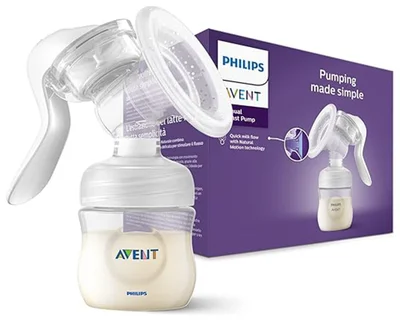
At around £25, the Philips Avent Manual is the entry point most healthcare professionals quietly recommend. It uses Natural Motion Technology with a soft silicone cushion that fits 99.98% of nipple sizes, so you can pump sitting upright instead of hunching forward. No batteries, no charging cable, no app to pair - just squeeze and go.
One parent put it best: "It is compact and easy to use. It is also SO much quieter than using an electric pump." That simplicity is the whole selling point. The pump packs down to barely larger than a single Avent bottle, making it genuinely pocketable for days out. Parents who breastfeed primarily and only need the odd expressed bottle will struggle to find a better return on £25.
What parents love
- Upright pumping position. The cushion design means you sit back naturally instead of leaning over. A parent shared: "I could sit back while I was pumping and did not end up with milk running down my front."
- Dead-silent operation. No motor noise at all, so it works in a quiet nursery, on a train or during a night feed without waking anyone.
- Simple assembly. Minimal parts snap together in seconds. The bottle doubles as a feeding bottle, reducing washing up.
- Strong value. At roughly £25, it undercuts most branded manuals and includes a bottle, teat and two disposable breast pads in the box.
What to know before you buy
- Hand fatigue. The handle is stiff enough that extended or repeated sessions cause forearm ache. This is not a primary pump for exclusive expressing.
- Small valve is fiddly. The tiny white valve is easy to misplace and slightly awkward to refit, especially when you are tired.
- Learning curve. Getting the rhythm right for maximum flow takes a few sessions. First-time pumpers should not judge output by the first attempt.
Best for
- Occasional expressers who breastfeed primarily
- Travel and on-the-go pumping
- Budget-conscious parents wanting a trusted brand
- Combination feeders needing a gentle backup

2. Momcozy M5 Smart Wearable Breast Pump

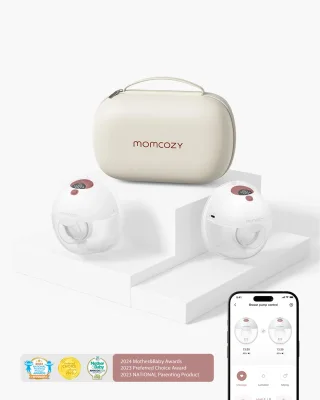
The Momcozy M5 Smart is where hands-free pumping becomes affordable. At around £85 for a single unit, it sits comfortably between the manual world and the £200+ premium wearables, and it earns its place. The pump slips into your bra with no external tubes, weighs just 232 g and connects to a companion app for remote control and session tracking. Its patented 105-degree flange angle mimics a natural latch, and the box includes inserts for 17, 19, 21 and 24 mm sizing.
We hear repeatedly from parents that this pump punches above its price. One parent told us: "I have been using a hospital grade pump everyday for 6 months and the Momcozy gets equivalent milk volumes." That said, it is not invisible under fitted clothing, and lactation professionals flag it as a secondary pump rather than a sole primary for exclusive expressing. For parents who pump one to four times a day and value freedom of movement, the M5 Smart hits a sweet spot.
What parents love
- Genuinely hands-free. No tubes, no cords. The motor sits flush with the pump body, letting you hold your baby, cook or work during a session.
- Strong output for the price. Multiple parents report volumes comparable to mains-powered pumps, thanks to the 285 mmHg suction and three-mode system (stimulation, expression, mixed).
- App control. Adjust modes and levels from your phone instead of reaching into your top. Session logs track supply trends over weeks.
- Multiple flange sizes included. Four insert sizes in the box means most parents can find a comfortable fit without buying extras.
What to know before you buy
- Visible under clothing. One parent shared: "It is bulky and very obvious when wearing, but this did not bother me." Not discreet enough for all workplace settings.
- Not ideal as a sole primary pump. Lactation professionals note the micro-vibration technology may not fully maintain supply signals for exclusive pumpers over months.
- Battery limits heavy use. At 150 to 180 minutes total, the battery covers five to six sessions before recharging. Parents pumping eight or more times daily may need to charge mid-day.
Best for
- Parents wanting wearable tech without the premium price tag
- Return-to-work parents needing a portable secondary pump
- Low-to-moderate frequency pumpers (one to four times daily)
- Tech-comfortable parents who value app-based tracking
3. Tommee Tippee Made for Me Double Wearable Breast Pump

The Tommee Tippee Made for Me Double is the premium pick in this guide, and its biggest selling point is not the tech but the economics. Tommee Tippee ships replacement membranes, valves and seals at no charge for the life of the pump. Competitors in this bracket can cost £40 to £100 per month in consumables, so the lifetime saving is substantial. Add double pumping (both breasts simultaneously), app connectivity and a nipple alignment light for dark-room night feeds, and you have a feature-rich package from a trusted brand.
The catch is size. This is a bulky pump by wearable standards, and parents consistently flag its visible silhouette under clothing. One parent told us: "Having used a hand held, and several different electric breast pumps in the past I have to say this in-bra pump is seriously a game changer!" But another noted the app "did not correctly measure how much I had collected and always said I was pumping on the wrong breast." If you pump mainly at home and want double-side speed, it delivers. If discretion outside the house is essential, look at the Momcozy M5 or a slimmer premium competitor.
What parents love
- Free replacement parts. Membranes, valves and seals are shipped at no charge. Over six months of pumping, this can save over £200 compared to competitors with proprietary consumables.
- Double pumping halves session time. Expressing from both breasts simultaneously is a genuine time-saver for parents pumping several times a day.
- Nipple alignment light. A small LED helps you position the flange correctly in the dark, making 3 a.m. sessions easier without a bedside lamp.
- Closer to Nature compatibility. Collector bottles accept Tommee Tippee teats directly, so you can express and feed from the same bottle.
What to know before you buy
- Bulkiest wearable in its class. The pump units are noticeably larger than competitors. Bra extenders are included, but fitted clothing is still a challenge.
- App reliability. Bluetooth pairing can be glitchy, and the milk volume sensor occasionally misreads output or identifies the wrong breast.
- Mixed output reviews. Some parents report lower yield and longer session times compared to their traditional plug-in pump. The constant-suction mechanism has a learning curve.
Best for
- Home-based multitaskers who pump while managing older children or household tasks
- Budget-conscious parents who want wearable tech without ongoing consumable costs
- Existing Tommee Tippee households wanting a seamless express-to-feed workflow
- Night-pumping parents who value the alignment light

What about the Elvie Stride?
Elvie is the name you will hear most often when researching wearable pumps. We do not currently carry Elvie in our affiliate channels, so we cannot offer a direct shop link. If you are comparing, the Elvie Stride sits at around £249 for a single and £299 for a double. Reviews praise its slimmer profile and quieter motor, but parents consistently flag the ongoing cost of proprietary containers and the higher price of replacement parts. For many families, the Momcozy M5 delivers most of the Elvie experience at a third of the price.
How to choose
Go budget if you breastfeed primarily and only want to express the occasional bottle. The Philips Avent Manual is silent, packs flat for travel and costs less than a round of coffees. Its only limitation is hand fatigue during longer sessions.
Go mid-range if you want hands-free convenience without the premium price tag. The Momcozy M5 Smart lets you pump while holding your baby, working or doing chores. It works best as a secondary pump or for parents pumping up to four times a day.
Go premium if you pump frequently and want double-side speed with free lifetime replacement parts. The Tommee Tippee Double Wearable shines as a home pump for families already using the Closer to Nature bottle system. Just be aware it is not the most discreet option outside the house.
Whichever pump suits your routine, add it to your free BubsNest registry so friends and family know exactly what to get.
Ready to Create Your Baby Registry?
Start your free baby registry today and share it with friends and family.
Get Started Free