Cybex Amya vs BabyBjörn Move 3D Mesh: Both Breathe in Summer, Only One Lasts Past 12kg
Two £110-ish mesh carriers that both fit from birth. The Cybex Amya adds a back carry and keeps going to 15kg; the BabyBjörn Move is the quicker on-off but stops at 12kg, around 15 months.
COMPARISON · ON THE GO
Put the Cybex Amya and the BabyBjörn Move 3D Mesh side by side in a shop and they look like the same answer to the same question. Both are soft-structured carriers built around breathable 3D mesh. Both take a newborn from 3.2kg with no separate insert. Both sit at roughly £110 to £116 in our channels, and both let your baby face in or face out on your front.
The difference only shows up when you read the small print on the tag. The Move is rated to 12kg, which BabyBjörn puts at around 15 months, and it only carries on your front. The Amya is rated to 15kg, around three years, and adds a back carry from about six months. So the real question is not which one is comfier on day one. It is whether you want a carrier for the baby you have now, or one for the toddler you will have next autumn.
That is not automatically a win for the Amya. Plenty of families use a carrier hard for the first year and then hand over to the pushchair, a hip seat or legs. For them the Move's simpler design, quick on-off and well-proven back support are worth more than months they will never use. We hear repeatedly from parents that the carrier they actually reach for is the one they can buckle on half asleep at 6am, not the one with the longest spec sheet.
To compare them we went through the published specs from both brands and retailers, checked live UK prices and stock across our retail partners, and pulled together what parents tell us about mesh carriers in everyday use: school runs, summer walks, and the lift-out-without-waking test.
Lil' Bubba's verdicts
- Best Overall: CYBEX Amya Baby Carrier · 8.5/10 - four positions including a back carry, rated to 15kg, so one carrier can see you from newborn to toddler
- Best for the First Year: BabyBjörn Baby Carrier Move 3D Mesh · 8.0/10 - the easiest of the two to get on and off, with firm built-in back support, but it stops at 12kg
Quick comparison
| CYBEX Amya | BabyBjörn Move 3D Mesh | |
|---|---|---|
| Our rating | 8.5/10 | 8.0/10 |
| Price in our channels | From £109 | From £116 (up to £150 at some retailers) |
| Child weight | 3.2kg to 15kg | 3.2kg to 12kg |
| Rough age range | Birth to about 3 years | Birth to about 15 months |
| Positions | Front inward, front outward, back | Front inward, front outward |
| Back carry | Yes, from about 6 months | No |
| Newborn set-up | Self-adjusting stretch panel, fold-in neck support, leg loops | Adjustable head support and seat, extra leg clips for 3.2 to 4.5kg |
| Feeding in the carrier | Possible by loosening the straps | Not really designed for it |
| Washing | Machine wash 30°C | Machine wash 40°C, dries quickly |
| Carrier weight | 0.76kg | Not published in UK listings |
How we picked the 2
Both carriers came from our own catalogue: in stock with UK retail partners we work with, from brands with a long track record in babywearing, and neither had been compared on BabyBjörn's or Cybex's own terms before. We kept the field to two because these are the mesh carriers parents most often shortlist at this price, and the trade-off between them is unusually clean. We checked weight limits, carry positions and newborn set-up against each brand's own instructions, then cross-checked prices across retailers on the day of writing. Parent feedback is anonymised.
What to look for in a mesh baby carrier
The weight limit, not the age on the box. Age ranges are a guide; the kilogram limit is the rule. A long, heavy baby can hit 12kg well before 15 months, and once they do, a carrier rated to 12kg is finished. If your family tends towards big babies, that matters more than any other spec here.
How it handles a newborn. The two common approaches are a separate insert, which neither of these needs, or an adjustable seat and panel. Look for a way to narrow the seat so a tiny baby's knees sit higher than their bottom in the "M" position, and some form of neck or head support that can be folded away later.
Which positions you will actually use. Front inward is the everyday position. Front outward is fun for short bursts once your baby has good head control, but most guidance suggests limiting the time. A back carry is the position that keeps a carrier useful into toddlerhood, because a 12kg child on your front starts to block your view and pull on your shoulders.
Breathability is about more than the label. "3D mesh" helps on warm days and in heated shops, but the waist belt and strap padding hold heat too. Both of these use mesh across the main panel, which is where it counts most.
Safety basics. Whatever you buy, follow the TICKS rule: tight, in view at all times, close enough to kiss, keep chin off the chest, supported back. A carrier that is easy to adjust makes all five easier to get right.
1. CYBEX Amya Baby Carrier

The Amya is Cybex's everyday carrier, sitting below the travel-focused Coya in the range. Its party trick is a stretch back panel that adjusts itself to your child's size, so there is no insert to lose and no seat-width dial to fiddle with. For a newborn you roll the cushioned neck support inside to brace their head; as they grow it folds outwards and buttons down. Leg loops narrow the openings for very small babies.
Where it pulls ahead of the Move is reach. It is rated from 3.2kg to 15kg, around three years, and adds a back carry from roughly six months alongside front inward and front outward (from about four to six months, for short stretches). At 0.76kg it is light for a carrier that goes this far, and the mesh runs across the back panel, waist belt and shoulder straps. It is a newer model, so the pool of long-term UK owner feedback is still small.
What parents love
- One carrier, three years. The 15kg limit and back carry mean you are not buying a second carrier at the one-year mark. We hear repeatedly from parents that the switch to back carrying is what keeps a carrier in use once a toddler wants to see everything.
- No insert, no fiddling. The self-adjusting panel means the same set-up works on a 4kg newborn and a 10kg one, with just the neck support and leg loops to change.
- Feeding is possible. Loosening the shoulder straps lowers your baby enough to feed in the carrier, which the Move is not really designed for.
- Light and cool. At 0.76kg with mesh on the panel, belt and straps, it suits warm days and long walks.
What to know before you buy
- Buckles, not magnets. The Click-&-Go buckles have safety buttons and are secure, but they are fiddlier one-handed than the magnetic buckle on Cybex's own Coya.
- Back carrying takes practice. Getting a baby on your back safely is a skill. Practise over a bed with a second adult the first few times.
- Lower wash temperature. It is a 30°C wash, and the outer fabric mixes cotton and polyester, so it dries more slowly than an all-mesh carrier.
Best for
- Families who want one carrier from newborn to toddler
- Parents of bigger babies likely to pass 12kg early
- Anyone who wants to breastfeed or bottle-feed on the move
- Walkers and hikers who will want a back carry later
2. BabyBjörn Baby Carrier Move 3D Mesh
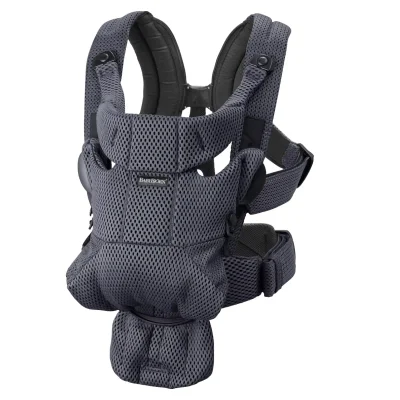
The Move is BabyBjörn's answer to parents who wanted the brand's famously easy front carrier with proper long-wear comfort. It adds built-in back support and a waist belt to take weight off your shoulders, plus wide padded straps. The 3D mesh is soft and airy, and the whole carrier goes in the washing machine at 40°C and dries quickly.
The catch is written on the label: 3.2kg to 12kg, roughly birth to 15 months, and front carrying only. Your baby faces in from birth and can face out from about five months once their head is steady. For small babies between 3.2kg and 4.5kg you use the extra leg clips to close up the leg openings. There is no back carry and no hip carry, so once your baby outgrows it, you will need something else.
What parents love
- On and off in seconds. One parent told us: "It's incredibly easy to put on." The front buckles also let you lift a sleeping baby out without the full unstrap.
- Back and shoulder support. A parent shared: "It provides a lot of support. I don't get shoulder or back aches after use."
- Easy to keep clean. A 40°C machine wash and fast-drying mesh suit the reflux and nappy-leak months.
- Built to last. One parent put it best: "It looks like it will last forever." Hand-me-down value is strong.
What to know before you buy
- Stops at 12kg. Around 15 months for an average baby, sooner for a big one. Budget for a toddler carrier or hip seat afterwards.
- Bulky to pack. The back support that makes it comfortable also means it does not squash into a changing bag.
- Not one for feeding. Parents tell us it does not loosen easily enough to feed in, and facing in, the strap can block your baby's view.
Best for
- Parents who want the simplest possible on-off
- Families planning to carry mainly in the first year
- Anyone with a sore back who needs firm lumbar support
- Second-time parents who want a reliable carrier to pass on


What about the Cybex Coya or Ergobaby Omni Breeze?
If the Amya appeals but you travel a lot, its sibling the Cybex Coya folds smaller and has a magnetic buckle, at a higher price. We compared it with the Ergobaby Aerloom in Ergobaby Aerloom vs Cybex Coya. If you want a back carry and hip carry from a brand parents trust for long walks, the Ergobaby Omni Breeze is the other mesh carrier we hear about most, covered in Momcozy vs Ergobaby Omni Breeze. And if your baby is already heading past the first birthday, our best toddler carriers roundup picks up where the Move stops.
How to choose
Choose the CYBEX Amya if you want to buy once. The 15kg limit, back carry from about six months and the option to feed in the carrier make it the better value over three years, and at £109 it is slightly cheaper than the Move in our channels. Allow a little practice time for the back carry and accept that buckles are slower than magnets.
Choose the BabyBjörn Move 3D Mesh if you mostly plan to carry in the first year, value the quickest possible on and off, and want firm back support for longer walks. Just be honest about your baby's growth curve: if they are tracking above average, 12kg can arrive well before 15 months.
If you are torn, ask yourself where you will be carrying at 18 months. If the answer is "on a hill" or "at the zoo", the Amya. If it is "probably not at all", the Move.
Add it to your Nest
Still deciding? Add both to your free BubsNest registry and let family see the options. Your Nest keeps prices from every retailer we work with in one place, so whoever buys it gets the best deal on the day.
Ready to Create Your Baby Registry?
Start your free baby registry today and share it with friends and family.
Get Started Free