Fred Clear Acrylic vs Safety 1st Flat Step: £162 of Style or £44 of Sense at the Bottom of the Stairs?
A see-through acrylic stair gate at around £162 against a £44 metal gate with an almost flat step-over bar. Here's which pressure gate is easier to live with, and why neither belongs at the top of the stairs.
COMPARISON · SAFE & SOUND
Stair gates are one of those purchases nobody gets excited about until the day a crawler makes a beeline for the bottom step. Then the gate becomes the most-used piece of kit in the house, opened and closed dozens of times a day, usually with a baby on one hip and a cup of tea in the other hand.
This head-to-head pits two pressure-fit gates that tackle that job in very different ways. The Fred Pressure Fit Stairgate swaps metal bars for a clear acrylic panel and costs around £162 with our retailers. The Safety 1st SecurTech Flat Step is a plain white metal gate at roughly £44 whose big idea is an almost flat step-over bar. One is designed to disappear into your hallway, the other is designed so you don't trip over it at 3am.
The non-obvious bit: here, the extra money buys looks and a slicker latch, not extra safety. Both meet the same European gate standard, and both are pressure-fit gates with a bar across the floor, which matters a lot for where you can put them. We pulled together spec sheets, retailer listings and what parents tell us after months of daily use to work out which one deserves a place in your home.
Lil' Bubba's verdicts
- Best Overall: Safety 1st Flat Step · 8.5/10 - the lowest trip risk we have seen on a pressure gate, at around a quarter of the price
- Best for Open-Plan Style: Fred Clear Acrylic · 8.0/10 - a see-through panel that keeps hallways bright and sight lines open
Quick comparison
| Feature | Fred Clear Acrylic | Safety 1st Flat Step |
|---|---|---|
| Price (our retailers) | Around £162 | Around £44 |
| Panel | Clear acrylic, dark grey fittings | White metal bars |
| Fitting | Pressure fit, wall cups with adhesive or 4 screws | 4-point pressure fit, no drilling |
| Opening width | 76-96cm, up to 124cm with extensions (2 included) | 73-80cm, up to 136cm with extensions (sold separately) |
| Height | 77cm | 72cm |
| Bar across the floor | Standard rail with glow-in-the-dark strip | Ultra-flat step-over bar, around 1cm |
| Latch | 2-way magnetic, press and lift, colour alert | SecurTech colour indicators, slam shut, optional second lock |
| Age range | Up to 24 months | 6 to 24 months |
| Our rating |
How we picked these two
We started with the safety gates parents add to their Nests most often, then narrowed it to pressure-fit gates that are in stock with our retail partners and take a genuinely different approach. We read the manufacturer spec sheets and retailer listings, then weighed the long-term feedback parents share with us and in public reviews, giving most weight to families who had used a gate for six months or more.
Both gates were judged on the same five things: how easily they fit, how they feel to use every day, trip risk, how well they hold up and value for money. Nobody pays us for a rating.
What to look for in a stair gate
Pressure fit or screw fit. Pressure gates wedge between two walls or a door frame using adjustable spindles, so there's no drilling and they're easy to move. The trade-off is a bar across the floor. Screw-fit gates bolt to the wall and swing open with nothing underfoot. The widely shared safety advice is to use a screw-fit gate at the top of the stairs, because a bar there is a trip hazard exactly where a fall would be worst. Pressure gates come into their own at the bottom of the stairs, in kitchen doorways and across hallways.
Measure twice. Every gate has a base width range plus optional extensions. Measure the opening at floor level and at gate height, skirting boards included, and check whether extensions come in the box or cost extra.
One-handed use. You will open this gate while holding a baby, a laundry basket or both. A latch you can work with one hand, which also closes itself when you push it to, is worth more than any finish.
Fit and lock indicators. Pressure gates loosen slightly over time as walls flex and little ones shake them. Indicators that show when the gate is properly tensioned or properly latched turn a weekly guess into a quick glance.
Standards. Look for EN 1930 on the box. Both gates here meet it.
1. Fred Pressure Fit Stairgate (Clear Acrylic)
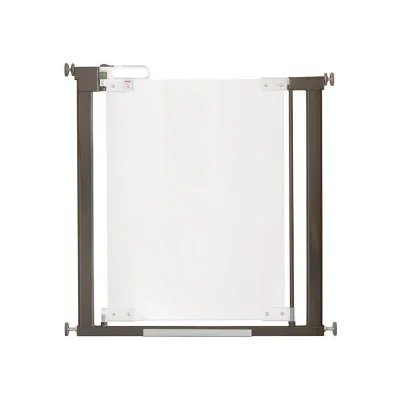
Fred's gate looks nothing like the white metal gates most of us grew up with. The panel is a single sheet of professional-grade clear acrylic in a dark grey frame, so you can see straight through it and light carries down the hallway as if it isn't there. It stands 77cm tall, fits openings of 76 to 96cm out of the box and stretches to 124cm with extensions, two of which are included.
The clever bits are practical rather than cosmetic. Accu-Fit indicators disappear once the gate is tensioned correctly, a glow-in-the-dark strip on the bottom rail shows you where to step at night, and the magnetic latch swings both ways and closes on its own. Instead of screwing wall cups into painted wood, you can use Fred's SecureHold adhesive, which renters in particular appreciate. The catch is the price: around £162 with our retailers, close to four times the Safety 1st.
What parents love
- Genuinely good looking. One parent told us: 'It's really stylish and amazing quality, it looks so good in our house and it functions perfectly.'
- Open sight lines. You can see a crawler on the other side without leaning over, and toddlers can see you, which cuts down on gate-rattling protests.
- Quick, reassuring install. Parents tell us fitting takes around ten minutes, and the Accu-Fit indicator takes the guesswork out of 'is it tight enough?'
- Smooth one-handed latch. The press-and-lift handle and magnetic close feel more premium than budget gates, and a colour alert shows if it's been left unlatched.
What to know before you buy
- Fingerprints. Clear acrylic shows every sticky hand and nose print. A parent shared that the only real downside is 'cleaning fingerprints off it constantly'.
- Not for the top of the stairs. Fred does not recommend the pressure-fit version at the top of a staircase because of the bottom rail. You'd need the pricier screw-fit model there.
- Fussy on awkward openings. A few parents with banisters or tight newel posts find the gate binds when fully tensioned, so measure carefully. Older siblings can also struggle with the two-action latch.
Best for
- Open-plan homes and hallways where a metal gate would feel like a cage
- Families who want a gate that blends in for the full two years
- Renters who would rather not drill into wooden frames
- Kitchen doorways and the bottom of the stairs

2. Safety 1st SecurTech Flat Step Metal Gate
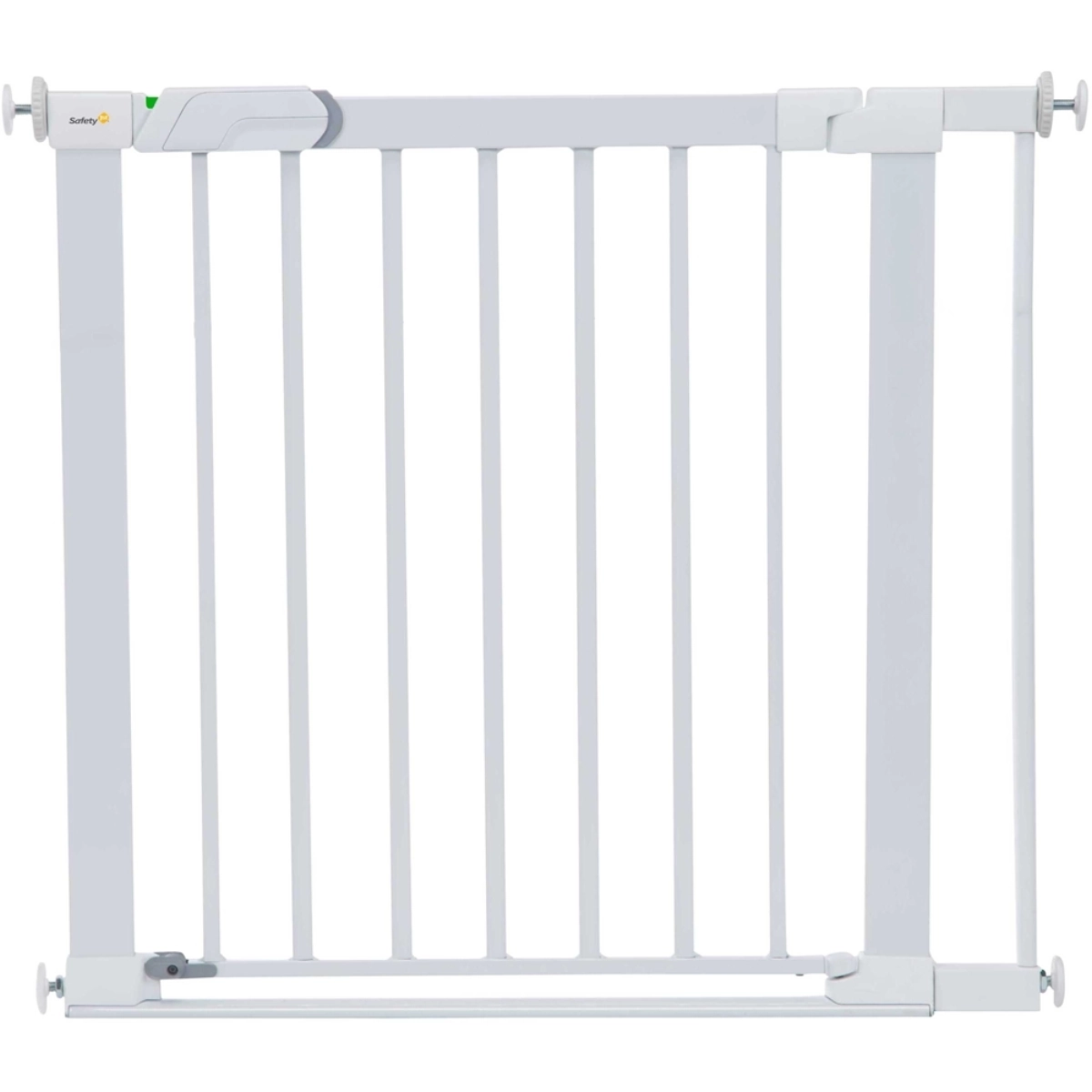
The Flat Step makes the opposite pitch: a no-nonsense white metal gate at around £44 whose headline feature sits underneath it. Where most pressure gates have a chunky U-shaped frame across the floor, this one has an ultra-flat step-over bar of roughly a centimetre. It's the single most-mentioned detail in parent feedback, and for good reason.
Out of the box it fits openings of 73 to 80cm, which covers many standard doorways, and extends to 136cm with 7, 14 and 28cm extensions sold separately. It's 72cm tall and uses four-point pressure with built-in cogs, so you can tighten the spindles without a spanner. Safety 1st's SecurTech indicators show when the spindles are at the right length and when the gate is properly locked. You can set it to open one way or both, and there's an optional second lock.
What parents love
- The flat step. We hear repeatedly from parents that this is the first pressure gate they've stopped tripping over. One parent put it best: 'It's not totally flat, but it's flat enough you wouldn't trip on it.'
- Sturdy for the money. Families using it for a year or more tell us it stays solid with regular re-checks, and the colour indicators make those checks quick.
- Simple one-handed use. Lift the handle to open, push it to and it closes itself. Parents carrying a baby rate this highly.
- Price. At around £44 you could buy one for the stairs and another for the kitchen and still spend about half of what the Fred costs.
What to know before you buy
- Narrow base width. 73 to 80cm out of the box means wider hallways need extensions, which add cost and a little flex.
- Plain looks. It's a white metal gate and looks like one. If style matters to you, this won't win you over.
- Lower than some. At 72cm it's shorter than the Fred and well below extra-tall gates, so determined climbers approaching two may test it.
Best for
- Parents who want the lowest trip risk on a pressure-fit gate
- Standard doorways and the bottom of the stairs
- Kitting out two or three openings on a sensible budget
- Night feeds when you are walking through half asleep


What about the top of the stairs?
Neither of these is the gate we'd put at the top of a staircase. Fred says so plainly for its pressure-fit model, and while the Flat Step's slim bar is a real improvement on a standard frame, the general safety advice for the top of the stairs is a screw-fit gate with nothing underfoot that opens away from the drop. Always follow the manual for your specific gate and stair layout.
Fred makes a screw-fit Clear-View version at a higher price, and most big gate brands offer a screw-fit option. Plenty of families end up with a screw-fit gate at the top and a pressure gate like one of these at the bottom, and that's the setup we'd recommend.
How to choose
Choose the Safety 1st Flat Step if you want the gate that's easiest to live with every day. The almost-flat bar, colour indicators and one-handed close do the important jobs well, and at around £44 it leaves budget for a second gate or a proper screw-fit gate for the top of the stairs. For most families, this is the one.
Choose the Fred Clear Acrylic if the gate is going somewhere you'll look at it all day, like an open-plan kitchen or a bright hallway, and you'd rather it disappeared. It's beautifully made and easy to fit, but you're paying for the look and the slick latch rather than extra safety, and you'll want a cloth handy.
Whichever you pick, measure the opening first, re-check the tension every week or two, and stop using any gate once your child can climb over it or passes the maximum age on the label.
Add it to your Nest
Shortlisting gates for the whole house? Add them to your free BubsNest registry so family and friends can chip in, and keep track of which gate is going where.
Ready to Create Your Baby Registry?
Start your free baby registry today and share it with friends and family.
Get Started Free