Kit & Kin vs Huggies Extra Care Newborn Nappies: 15p Buys a Wetness Line, 23p Buys a Plant-Based Liner
Two size 1 nappies for the first weeks. Huggies Extra Care costs about 15p a nappy and has a wetness indicator plus a back pocket for runny poo. Kit & Kin costs about 23p, skips the indicator on purpose and puts plant-based layers against newborn skin. Here is who each one suits.
COMPARISON · NAPPIES & CHANGING
Most parents buy their first pack of size 1 nappies before the baby arrives, usually on brand recognition alone, and then go through eight to ten a day for the next couple of months. That makes the newborn nappy one of the few baby purchases where a few pence per unit genuinely adds up. It is also the one where parents of babies with dry or eczema-prone skin start asking what is actually touching their baby all day.
Kit & Kin and Huggies Extra Care are two of the size 1 nappies parents ask us about most, and they come at the job from opposite ends. Huggies Extra Care is the mainstream supermarket-shelf nappy, priced at roughly 15p a nappy in its larger packs, with a colour-change wetness line and a back pocket built to catch runny newborn poo. Kit & Kin is the plant-based, fragrance-free, paper-packed option at roughly 23p a nappy, and it deliberately leaves out the wetness indicator because the brand does not want the chemistry behind it near baby skin.
So this is not really a question of which nappy holds more. Both are built for the 2-5kg stage and both will do the job for most babies. The real trade-off is between a cheaper nappy that tells you when it is wet and a pricier one that tells you exactly what it is made of. We looked at current UK pricing in our retailer channels, the published materials and specs for both, and what parents report back after the first few weeks of use, to work out who should pick which.
Lil' Bubba's verdicts
- Best Overall: Huggies Extra Care Newborn Nappies · 8.5/10 - the cheapest per nappy of the two, with a wetness line and a runny poo pocket that earn their keep in the newborn fog
- Best for Sensitive Skin: Kit & Kin Premium Nappies · 8.0/10 - plant-based layers on the skin, no fragrance, lotion or chlorine processing, and an umbilical cut-out on size 1
Quick comparison
| Huggies Extra Care Newborn | Kit & Kin Premium | |
|---|---|---|
| Rating | ||
| Size 1 weight range | 2-5kg | 2-5kg |
| Pack sizes we list | 40 (£6.49) or 160 (£23.50) | 152 (£35.99) or 304 (£69.99) |
| Approx. price per nappy | 15-16p | 23-24p |
| Wetness indicator | Yes, colour-change line | No, by design |
| Poo containment | Back pocket for runny poo | Channel core, snug size 1 fit |
| Skin-contact materials | Soft, breathable layers, dermatologically tested | Plant-based layers, no fragrance, lotion or chlorine processing |
| Umbilical cut-out on size 1 | Not something we could confirm | Yes |
| Packaging | Plastic | Recyclable paper |
| Best for | Value, first-time parents, runny newborn poo | Eczema-prone or sensitive skin, lower-impact buying |
How we picked the 2
Both nappies are size 1, both are in stock with our UK retail partners right now, and both turn up again and again when parents compare newborn nappies. We deliberately kept this to two because they represent the two main ways parents shop for nappies: on price and convenience, or on materials and skin. We compared pack pricing per nappy at today's prices, the published construction and materials for each, and the patterns that keep coming up in the feedback parents share with us after the first month. We did not take payment from either brand for placement.
What to look for in a newborn nappy
Cost per nappy, not cost per pack. Pack sizes vary wildly, from 40 to over 300, so the shelf price tells you very little. Divide by the count. In the first eight weeks a baby can easily get through 500 or more nappies, so a 7-8p difference per nappy can mean £40-50 over the newborn stage alone.
Fit at the waist and legs. Most newborn leaks come from gaps, not from the core running out of capacity. A snug waistband and double leg cuffs matter more than an absorbency claim on the box. Run a finger around the leg cuffs after fastening and make sure they are pulled out, not tucked in.
The umbilical stump. Until the cord stump falls off, the waistband should sit below it so it can stay dry. Some size 1 nappies have a cut-out or a lower front; with others, parents simply fold the front down.
Runny poo. Milk-fed newborn poo is loose, and it goes up the back as often as it goes out the legs. A back pocket or a well-elasticated rear waistband makes a noticeable difference.
What touches the skin. If your baby has dry patches, eczema in the family or reacts to fragrance, look at the materials list as well as the "hypoallergenic" label. Fragrance, lotion and chlorine bleaching are the three things sensitive-skin parents most often want to avoid.
A wetness indicator. It sounds minor, but in the first fortnight, when you are tracking wet nappies to check feeding is going well, a line that changes colour is genuinely useful. If you go without one, you check by feel.
1. Huggies Extra Care Newborn Nappies
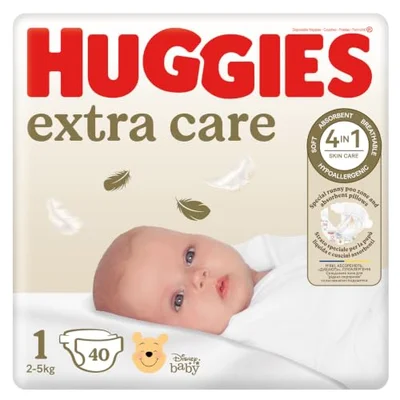
Huggies Extra Care is the nappy a lot of parents end up on after trying a hospital-bag pack of something else. The size 1 covers 2-5kg, and the larger 160-nappy pack works out at roughly 15p a nappy at current prices, with the 40-pack at about 16p. That is the cheapest of the two here by a clear margin.
The design is aimed squarely at the newborn stage: soft, breathable layers, absorbent zones that spread wetness along channels to stop the nappy sagging, a spacious back pocket for runny poo, and a colour-change wetness indicator on the front. It is dermatologically tested and sold as hypoallergenic, though it is a conventional nappy rather than a plant-based one.
What parents love
- The wetness line. In the early days, when you are counting wet nappies, it saves a lot of guesswork. One parent told us: 'At 3am I don't want to be squeezing a nappy to see if it needs changing. The line just tells me.'
- Price per nappy. At around 15p in the bigger pack, it is noticeably cheaper over the newborn months, and the 40-pack is an easy, low-risk first buy.
- The back pocket. Parents we hear from regularly credit it with stopping the up-the-back explosions that are so common with milk-fed poo.
- Easy to find. It is widely stocked, so running out is rarely a crisis.
What to know before you buy
- Not a plant-based nappy. If you are specifically trying to avoid conventional materials or plastic packaging, this is not that product.
- Occasional leaks with heavy wetters. A parent shared: 'Mostly great, but we had the odd leak overnight once she started feeding more. Sizing up early sorted it.'
- No obvious stump cut-out. We could not confirm one on the size 1, so you may need to fold the front down until the cord falls off.
Best for
- Parents who want the lowest cost per nappy without dropping to an unknown brand
- First-time parents tracking wet nappies in the first fortnight
- Babies with frequent runny, up-the-back poo
- Stocking up a changing caddy and a nappy bag at the same time

2. Kit & Kin Premium Nappies
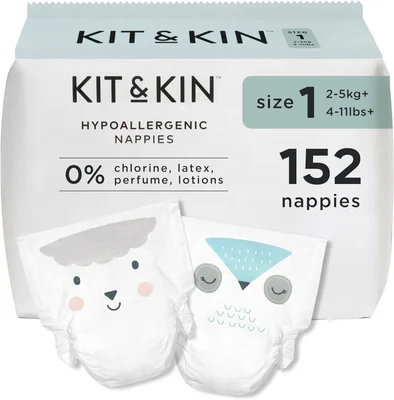
Kit & Kin is the nappy parents tend to move to when they want to know exactly what is against their baby's skin. The inner and outer layers are plant-based, the core is chlorine-free, and the brand leaves out fragrance, lotion, latex and optical brighteners. The size 1 has a snug fit with a cut-out for the umbilical stump, the print uses water-based inks, and the nappies arrive in recyclable paper packaging rather than plastic.
The trade-off is cost and one missing feature. In the 152 and 304 packs we list, it works out at roughly 23-24p a nappy, around 8p more than Huggies. And there is no wetness indicator: Kit & Kin says the chemicals used in those lines do not belong near baby skin, and suggests checking by feel instead, changing when the nappy feels heavy or bulky.
What parents love
- Gentle on reactive skin. This is the most common reason parents give for switching. We hear repeatedly from parents that: 'Her nappy rash calmed down within a week of changing over, and we had tried everything else.'
- A clear materials list. No fragrance, no lotion and no chlorine processing makes it an easy call for families with eczema or allergies.
- The umbilical cut-out. It keeps the waistband off the cord stump without folding, which is one less fiddly job in the first fortnight.
- Paper packaging and big packs. The 152 and 304 packs mean fewer top-ups, and there is no plastic wrap to bin.
What to know before you buy
- No wetness indicator. It is a deliberate choice, but in the first weeks it means checking by hand. One parent put it best: 'I love them, but I did miss the little line for the first month.'
- Mixed reports on sudden leaks. Most parents report few leaks, but some find a big, sudden wee can escape at the sides or waist, and the size 1 can come up a touch small.
- Higher cost per nappy. Around 8p more per nappy adds up to roughly £40-50 more over the first eight weeks than Huggies.
Best for
- Babies with eczema-prone, dry or reactive skin
- Families avoiding fragrance, lotion and chlorine-bleached materials
- Parents who want lower-impact packaging and fewer shop runs
- Anyone happy to check a nappy by feel rather than by a colour line
What about supermarket own-brand nappies?
Own-brand size 1 nappies from the big supermarkets and discounters can come in under 10p a nappy, and many parents are perfectly happy with them. They are not in this comparison because we wanted two nappies that are easy to buy in bulk through our retail partners and that represent the two clearest buying priorities: price with convenience features, or materials first. If budget is the deciding factor, an own-brand pack is worth trying alongside either of these, and it costs very little to find out whether it fits your baby.
How to choose
Choose Huggies Extra Care if you want the better-value nappy and the reassurance of a wetness line while you are tracking feeds. It is the easier everyday buy, it handles runny newborn poo well, and it costs roughly a third less per nappy than Kit & Kin.
Choose Kit & Kin if your baby has sensitive or eczema-prone skin, if you would rather avoid fragrance, lotion and chlorine processing, or if paper packaging matters to you. Accept that you will pay more and check by feel.
A lot of families do both: a small Huggies pack for the hospital bag and the first chaotic fortnight, then Kit & Kin once they know how their baby's skin reacts. Because newborns outgrow size 1 quickly, avoid buying huge boxes of either until you know the fit works.
Add it to your Nest
Nappies are one of the most useful things friends and family can buy, and one of the easiest to over-stock. Add your chosen size 1 pack, plus a size 2 for later, to your free BubsNest registry so gift-givers buy what you actually use.
Ready to Create Your Baby Registry?
Start your free baby registry today and share it with friends and family.
Get Started Free