Lansinoh vs Philips Avent Glass Baby Bottle: Which Does Your Newborn Actually Need?
Two of the UK's most popular glass baby bottles go head to head. We compare the Lansinoh NaturalWave and Philips Avent Natural Response on specs, price, anti-colic performance, and real parent feedback.
COMPARISON · FEEDING
Glass baby bottles are having a moment, and for good reason. With growing concern about microplastics leaching from heated plastic, more parents than ever are making the switch to glass for their newborn's feeds. The research is clear enough to have shifted buying habits: glass does not degrade, does not absorb odours, and does not leach chemicals when warmed. But once you have decided glass is the way forward, the next question arrives fast: which one?
Two bottles dominate the UK glass market right now, and they approach the problem differently. The Lansinoh NaturalWave Glass Bottle was designed for breastfeeding families, with a clinically tested teat that reduces nipple confusion and direct compatibility with Lansinoh breast pumps. The Philips Avent Natural Response Glass Bottle takes a broader view, offering a teat that only releases milk when baby actively drinks, plus six flow-rate options to grow with your child from newborn to nine months and beyond.
We have compared prices, specs, durability, anti-colic performance, and real parent feedback to help you decide which glass bottle belongs on your worktop. Neither is a bad choice, but one may suit your feeding setup far better than the other.
Lil' Bubba's verdicts
- Best Overall: Lansinoh NaturalWave Glass · 8.0/10 - clinically proven teat for breast-to-bottle transition, direct pump compatibility, and a lower price point
- Best for Flexibility: Philips Avent Natural Response Glass · 7.5/10 - six teat flow options, pace-controlled feeding, and a wider ecosystem of accessories
Quick comparison
| Lansinoh NaturalWave Glass | Philips Avent Natural Response Glass | |
|---|---|---|
| Rating | ||
| Price (single) | From ~£9.99 | From ~£11.99 |
| Sizes | 160ml, 240ml | 120ml, 240ml |
| Glass type | Borosilicate | Borosilicate |
| Anti-colic | AVS air vent in teat | Valve integrated in teat |
| Teat flow options | 4 (XS, S, M, L) | 6 (Flow 1-6) |
| Pump compatible | All Lansinoh pumps | No direct pump fit |
| Parts count | 4 | 5 |
| Best for | Breastfeeding families | Combination feeders |
How we picked the 2
We shortlisted the two most-added glass baby bottles from our registry data, cross-referenced with parent reviews across forums and retailer sites. Both are borosilicate glass, both have anti-colic systems, and both are widely available in the UK. We focused on real-world feedback from parents who have used them daily, not lab tests or brand claims alone.
What to look for in a glass baby bottle
Glass type matters. Borosilicate glass (the same material used in laboratory equipment) withstands thermal shock far better than soda-lime glass. Both bottles here use borosilicate, which means you can move them from fridge to bottle warmer without cracking. If a glass bottle does not specify borosilicate, it is worth asking the manufacturer directly.
Teat compatibility with breastfeeding. If you are combination-feeding or expressing, the teat shape and flow rate make or break whether baby will switch between breast and bottle without fuss. A wide-based, gradually sloped teat tends to work best. Both bottles here are designed for breast-to-bottle transition, but they take very different approaches.
Anti-colic systems. All glass bottles on the market claim to reduce colic, but the mechanism varies. Some use internal vent systems (tubes inside the bottle), while others integrate the valve directly into the teat. Teat-integrated valves mean fewer parts to clean, which is the approach both Lansinoh and Philips Avent have chosen.
Weight and grip. Glass is heavier than plastic, full stop. A 240ml glass bottle filled with milk can weigh over 400g. Look for a bottle with a shape that is easy to grip when you are feeding at 3am with one hand. A silicone sleeve (sold separately for both brands) adds grip and drop protection.
Number of parts. At 3am, the fewer pieces you need to assemble, the better. Four parts is the minimum for a functional anti-colic bottle. More parts means more to wash and more places for milk residue to hide.
1. Lansinoh NaturalWave Glass Bottle
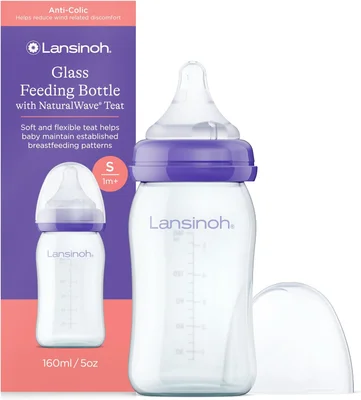
The Lansinoh NaturalWave Glass Bottle was built for one specific scenario, and it nails it: getting a breastfed baby to take a bottle without the dreaded nipple confusion. The NaturalWave teat is clinically proven to support natural sucking patterns, which means baby uses the same tongue and jaw movements as breastfeeding. For parents who express and need a bottle that will not derail their breastfeeding journey, this is the gold standard.
Available in 160ml (with a slow flow teat) and 240ml (with a medium flow teat), both sizes screw directly onto any Lansinoh breast pump. That pump-to-bottle compatibility is genuinely useful: express, cap, refrigerate, warm, and feed, all without transferring milk between containers. The borosilicate glass is scratch-resistant and can handle thermal shock from fridge to warmer without issue.
What parents love
- Breastfed baby acceptance. This is the standout. A parent shared: "My baby struggled to take a bottle for two weeks until we found these. Definitely recommend if you are breastfeeding."
- Pump compatibility. Express directly into the bottle with any Lansinoh pump, no decanting required. A genuine time-saver during those early morning feeds.
- Easy to clean. Only four parts, wide neck, dishwasher-safe. No fiddly internal tubes or hard-to-reach crevices.
- Chemical-free peace of mind. Borosilicate glass does not leach chemicals when heated, which matters when you are warming expressed milk several times a day.
What to know before you buy
- Glass weight. Noticeably heavier than plastic, which makes on-the-go feeding and eventually self-feeding harder for baby.
- Durability concerns. We hear from some parents that bottles can chip within weeks. A silicone sleeve is worth buying alongside.
- Teat placement. The NaturalWave teat can be fiddly to seat correctly on the collar ring until you get the knack.
Best for
- Breastfeeding parents who need a bottle baby will accept
- Parents who express with a Lansinoh pump and want a seamless workflow
- Families who prioritise chemical-free, plastic-free feeding
- Colic-prone babies (AVS anti-colic vent system)

2. Philips Avent Natural Response Glass Bottle
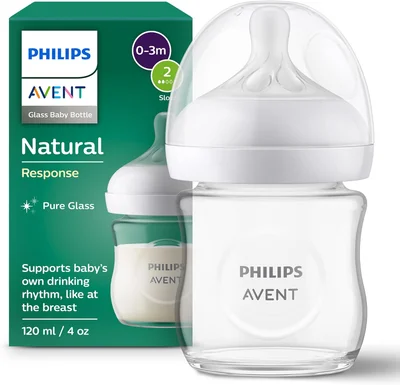
The Philips Avent Natural Response Glass Bottle takes a different approach to the breast-to-bottle problem. Its headline feature is a teat that only releases milk when baby actively sucks, mimicking the natural flow of breastfeeding. Baby controls the pace, which means less overfeeding, less wind, and a more relaxed feed. It is a clever bit of engineering that works well in practice.
Where Avent really pulls ahead is flexibility. Six teat flow rates (from newborn Flow 1 right up to Flow 6 for older babies) mean this bottle grows with your child far longer than most competitors. The wide neck makes filling and cleaning straightforward, and the borosilicate glass gives you the same chemical-free durability as the Lansinoh. At around £11.99 for the 120ml and £13.99 for the 240ml, it costs a touch more, but the wider accessory ecosystem may justify the premium for some families.
What parents love
- Pace-controlled feeding. The teat only releases milk when baby actively sucks, reducing overfeeding and wind. Parents we hear from regularly say feeds feel calmer and more natural.
- Durability. Borosilicate glass that parents report surviving counter-height drops without cracking. Built to last through multiple children.
- Easy to clean. Wide neck, minimal parts, and dishwasher-safe throughout. No internal tubes to scrub.
- Teat range. Six flow options mean you buy the bottle once and just swap teats as baby grows. One parent told us: "The glass is a nice feature, and it has minimal leaking compared to other brands."
What to know before you buy
- Weight. Glass bottles are heavy, and the Avent is no exception. One parent put it best: "The heaviness might be a problem when baby is trying to learn how to hold the bottle on their own."
- Occasional breakage. A small number of parents report cracked bottles, though this seems batch-dependent. A silicone sleeve is recommended.
- Teat flow inconsistency. Some parents find certain teats release milk too slowly or unevenly. Worth testing a couple of flow rates to find the right one for your baby.
Best for
- Combination-feeding families (breast and bottle)
- Parents who want maximum teat-flow flexibility as baby grows
- Eco-conscious parents looking for a long-lasting, recyclable bottle
- Parents who prioritise easy sterilisation and dishwasher-safe materials
What about the MAM Feel Good Glass and Dr. Brown's Options+ Glass?
Both are excellent glass bottles that come up constantly in parent recommendations. The MAM Feel Good Glass has a self-sterilising feature and claims a high baby acceptance rate for its SkinSoft teat. The Dr. Brown's Options+ Glass uses an internal vent system (rather than a teat-integrated valve) which some parents swear by for severe colic. We were not able to include either in our full comparison because they are not currently available through our joined retail partners, but both are worth considering if you are shopping around.
How to choose
Choose the Lansinoh NaturalWave Glass if you are primarily breastfeeding and need a bottle that will not cause nipple confusion. The clinically tested NaturalWave teat and direct Lansinoh pump compatibility make it the obvious pick for an express-and-feed workflow. It is also the cheaper option, which adds up when you are buying several bottles.
Choose the Philips Avent Natural Response Glass if you want one bottle system that grows with your baby from newborn to nine months plus. Six teat flow rates, pace-controlled feeding, and a wide accessory ecosystem give you flexibility that the Lansinoh cannot match. The slight price premium buys you a longer runway.
Add it to your Nest
Whichever glass bottle you choose, add it to your free BubsNest registry so friends and family know exactly which one to buy. No guessing, no duplicates, no returns.
Ready to Create Your Baby Registry?
Start your free baby registry today and share it with friends and family.
Get Started Free