Mamas & Papas Esna vs Gaia Baby Eos: The Cheaper Dresser Is the Solid Wood One
The £389 Mamas & Papas Esna has the rattan look everyone wants. The £349.95 Gaia Baby Eos is solid pine with ultra-low emissions. We compare changing height, drawer space, materials and lead times to find the dresser changer worth the nursery wall.
COMPARISON · NURSERY & SLEEP
A dresser changer is the hardest-working piece of furniture in the nursery and, oddly, the one most parents choose on looks alone. You will stand at it eight, ten, twelve times a day for the first year, and then it quietly becomes the chest of drawers that holds school jumpers. The questions that matter are less about the product photo and more about height, drawer space, what it is actually made of and how long it takes to arrive.
That is why this head-to-head is more interesting than it first looks. The Mamas & Papas Esna Dresser Changer costs £389 and wears the most talked-about finish on the high street right now: warm wood tones, a backed rattan-effect front and soft mid-century curves. The Gaia Baby Eos Dresser costs £349.95 and looks quieter, a two-tone chest with rounded edges and no sharp corners. On price alone you might assume the Esna is the more substantial piece. It is the other way round. The Eos is solid New Zealand pine with no MDF, chipboard or veneer anywhere, while the Esna is built from MDF and particle board.
That does not make the Esna a bad buy. It is taller, its drawers are deeper, it belongs to a full matching range, and for a lot of parents the look is the whole point. But it does mean the cheaper dresser is the one more likely to still feel solid in a ten-year-old's bedroom.
We compared the two on published specs from both brands and their UK stockists, current prices and delivery times from the retailers we work with, and what parents tell us after living with nursery furniture for a year or more. We weighed changing height, usable drawer space, materials and emissions, how cleanly each converts to a plain chest of drawers, and the small print (wall fixing, changing pads, lead times) that catches people out.
Lil' Bubba's verdicts
- Best Overall: Gaia Baby Eos Dresser · 8.5/10 - solid pine, ultra-low emissions and £39 cheaper, as long as you budget for a changing pad
- Best for a Statement Nursery: Mamas & Papas Esna Dresser Changer · 7.5/10 - the rattan look, a taller changing height and a full matching range
Quick comparison
| Mamas & Papas Esna | Gaia Baby Eos | |
|---|---|---|
| Price | £389 | £349.95 |
| Our rating | ||
| Construction | MDF and particle board, wood and rattan-effect finish | Solid A-grade New Zealand pine and real-wood ply |
| Height | 95.4cm with changer rails, 86.8cm without | 82.2cm |
| Footprint | Around 89cm wide | 88.2cm wide, 53.6cm deep |
| Drawers | 3 deep drawers, soft close | 3 drawers, soft close, 12cm listed drawer depth |
| Changing top | Removable, birth to 11kg | Removable, takes an 82 x 47cm pad (sold separately) |
| Finishes | Rattan with warm wood | Natural Ash or Soft White frame, six lower-panel colours |
| Delivery right now | Low stock, pre-order with delivery from late October | Roughly one to two weeks, direct from supplier |
How we picked the 2
Both dressers sit in the same £350 to £390 bracket, both have three soft-close drawers and a removable changing top, and both are designed to be the centrepiece of a matching room set (each brand sells a cot bed to go with it). That makes it a genuinely like-for-like choice, where the differences come down to materials, height and style rather than features. We left out sub-£200 dressers and the £500-plus designer pieces on purpose: if you are shopping at either end, our nursery dressers by budget guide is a better starting point.
What to look for in a nursery dresser changer
Changing height. This is the one most people forget. A changing surface that sits around your hip bone saves your back hundreds of times a week. Taller parents (and anyone recovering from a caesarean) should favour a taller unit; shorter parents can find a high changer awkward. Measure from the floor to your hip before you buy, and remember the changing pad adds a few centimetres.
Wall fixing. A chest of drawers with a baby on top, and later a toddler climbing the open drawers, is a toppling risk. Any dresser changer should be anchored to the wall, whatever the instructions say. Check you have a solid wall where you plan to put it, not a stud partition you cannot fix into.
Drawer depth, not just drawer count. Three drawers sounds generous, but shallow drawers fill quickly with sleepsuits, muslins and nappies. Deep drawers are more forgiving once clothes get bigger.
Materials and emissions. MDF and particle board are cheaper to shape and finish beautifully, but they are heavier on glues and less tolerant of being moved, dismantled and rebuilt. Solid wood is heavier on the wallet up front, lighter on emissions if finished with water-based paint, and survives house moves better.
The removable top. Both of these convert into a plain chest of drawers. Look at how cleanly the top comes off and whether it leaves visible fixings, because this is how the piece will live for most of its life.
What is in the box. Some dressers include a changing pad, many do not. Check the pad size the top is designed for, as an ill-fitting pad that slides is the last thing you want.
Lead time. Nursery furniture is often made to order or shipped from the supplier. If baby is due in a few weeks, delivery dates matter as much as specs.
1. Mamas & Papas Esna Dresser Changer

The Esna is Mamas & Papas leaning hard into the rattan trend, and it does it well. Warm wood tones, a backed rattan-effect front and curved mid-century detailing make it the dresser people photograph for the nursery reveal. Behind the fronts are three deep soft-close drawers, and on top is a changing surround rated from birth to 11kg (roughly 12 months) that lifts off when you are done changing nappies.
The trade-off is in the build. The Esna is made from MDF and particle board rather than solid timber, and the unit must be fixed to the wall to be used safely. At £389 it is also the pricier of the two, and right now it is low in stock, with new orders on pre-order for delivery from late October. If baby is due before November, check the date at checkout.
What parents love
- The look. Rattan and warm wood with soft curves is the most requested nursery style we hear about, and the Esna nails it without looking twee. Parents we hear from regularly say it is the piece that pulls the whole room together.
- A taller changing height. At 95.4cm with the changer rails fitted, it puts the changing surface higher than most dressers, which is kinder to the backs of taller parents.
- Deep drawers. Three deep, soft-close drawers swallow bulky items like sleeping bags and spare bedding, and they close quietly when baby has just gone down.
- A full matching range. There is an Esna cot bed and wardrobe, plus two- and three-piece room sets, so you can furnish the room in one go.
What to know before you buy
- MDF and particle board. It is not solid wood, and that shows in the feel. One parent put it best: "the design is lovely but it isn't sturdy or solid enough." If you plan to move house or pass it down, this matters.
- Lead time. Current stock is low and new orders are on pre-order for delivery from late October.
- Short changing life. The changing top is rated to 11kg, so you will likely be changing on the floor or a mat before your toddler is out of nappies.
Best for
- Parents who want the rattan, mid-century look as the centrepiece of the nursery
- Taller parents who want a higher changing surface
- Families buying a matching cot bed and wardrobe from the same range
- Anyone staying put in their home for the next few years

2. Gaia Baby Eos Dresser
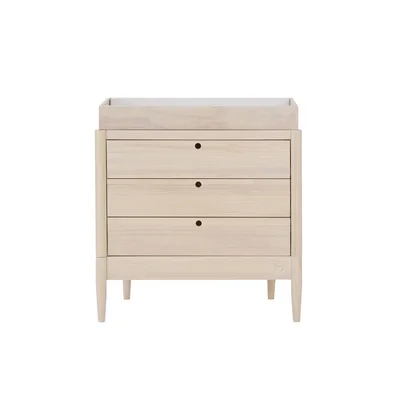
Gaia Baby builds everything from sustainably sourced A-grade New Zealand pine and real-wood ply, with no MDF, chipboard, composites or veneers, finished in non-toxic water-based paint. The Eos is certified to formaldehyde emissions below 0.2ppm, well under the strict limits it is tested against, and it meets the UK and European changing unit and toppling furniture standards. At 30kg it is a properly substantial piece of furniture for £349.95.
It is also more customisable than it first appears. You choose a Natural Ash or Soft White frame, then a lower panel colour from six options (including Desert Sage, Powder Blush and Primrose Yellow), so it can be as neutral or as playful as you like. The catch: the changing top is designed for an 82 x 47cm pad that is sold separately, so add roughly £20 to £40 to the price. It is also shorter at 82.2cm, which suits some parents and not others.
What parents love
- Solid wood you can feel. No particle board means it feels reassuringly heavy and survives being taken apart and rebuilt. A parent shared, about the brand's furniture: "the quality of everything is incredible. It's all very sturdy."
- Ultra-low emissions. Water-based paint and a sub-0.2ppm formaldehyde rating are a real draw for parents setting up a nursery in a small, newly decorated room.
- Soft, rounded edges. No sharp corners at toddler head height, which you will appreciate once they are cruising around the furniture.
- Grows up gracefully. Lift off the changing top and it is a simple two-tone chest of drawers that looks at home in a child's room or a guest room.
What to know before you buy
- Changing pad not included. You need a separate 82 x 47cm pad, which narrows the price gap with the Esna.
- Shallower drawers and a lower top. The listed drawer depth is 12cm, and the overall height is 82.2cm, so taller parents may find themselves stooping slightly.
- Assembly is a two-person job. Allow about an hour. We hear repeatedly from parents that the build itself is fine, but one was blunt about the paperwork: "the instructions are very unreliable... several diagrams are simply wrong." Lay every piece out first.
Best for
- Parents who want solid wood and low emissions without paying designer prices
- Families likely to move house in the next few years
- Anyone who wants a colour accent rather than a full statement finish
- Average-height or shorter parents

What about cheaper dressers?
If £350 to £390 is more than you want to spend on one piece, you do not have to give up a soft-close dresser with a removable changer. Our nursery dressers by budget guide compares options from around £160 upwards. And if you are furnishing the whole room at once, a matching room set often works out cheaper than buying the cot bed and dresser separately; our room set head-to-head is worth a read.
How to choose
Choose the Gaia Baby Eos if you care about what the furniture is made of. It is solid wood, it is the lower-emission choice, it is cheaper even after you buy a changing pad, and it will cope with house moves and a second child far better than particle board. It is our pick for most families, provided you are not especially tall.
Choose the Mamas & Papas Esna if the look is what sold you on it, if you want the higher changing height, or if you are buying the matching Esna cot bed and wardrobe. Fix it firmly to the wall, check the delivery date against your due date, and it will make a beautiful nursery.
Add it to your Nest
Nursery furniture is one of the best things to put on a gift list, because family members often want to club together on something lasting. Add your favourite to your free BubsNest registry and let your Nest do the organising.
Ready to Create Your Baby Registry?
Start your free baby registry today and share it with friends and family.
Get Started Free