Philips Avent Natural Response vs MAM Easy Start Anti-Colic
The UK’s two most popular anti-colic bottles go head to head. We compare the Philips Avent Natural Response and MAM Easy Start on colic relief, teat design, cleaning, and value.
COMPARISON · FEEDING TIME
Few first-year purchases spark as much debate as baby bottles. Get it right and feeds are calm, winding is minimal, and the transition from breast to bottle feels seamless. Get it wrong and you are up at 3am cycling through yet another brand while your baby screams into a half-finished feed.
Two bottles dominate the UK market: the Philips Avent Natural Response, built around a teat that only releases milk when baby actively sucks, and the MAM Easy Start Anti-Colic, designed around a vented base that keeps air out of every feed. They sit at similar price points, they target the same newborn-to-six-month window, and they both claim to reduce colic. Yet their engineering could not be more different.
We gathered real feedback from parents who have used both, compared specs and pricing, and put together this head-to-head to help you pick the right bottle for your baby.
Lil' Bubba's verdicts
- Best Overall: MAM Easy Start Anti-Colic · 8.5/10 - Built-in vented base and self-sterilising convenience make it the standout
- Best for Breast-to-Bottle: Philips Avent Natural Response · 8.0/10 - Breast-shaped teat and fewer parts ease the transition
At a Glance
| Philips Avent Natural Response | MAM Easy Start Anti-Colic | |
|---|---|---|
| Price (from) | £7.95 | £13.00 (3-pack) |
| Anti-colic | AirFree vent (add-on) | Built-in vented base |
| Parts to clean | 3 | 4 |
| Self-sterilising | No | Yes (3 min microwave) |
| Teat design | Breast-shaped, spiral texture | Flat, SkinSoft silicone |
| Sizes | 125ml, 260ml | 130ml, 160ml, 260ml |
| Glass option | Yes | No |
| Breast pump fit | Philips pumps | N/A |
| Rating |
How We Picked the Two
We track which bottles UK parents add to their registries, wishlists, and shopping lists. The Philips Avent Natural Response and MAM Easy Start Anti-Colic consistently rank among the top three most-added bottles on BubsNest. We then cross-referenced real-world parent feedback, focusing on colic relief, ease of cleaning, teat acceptance, and value for money. These two bottles represent genuinely different approaches to the same problem, making them ideal for a direct comparison.
What to Look for in an Anti-Colic Baby Bottle
Colic affects roughly one in five newborns, and while no bottle can cure it, the right design can make a real difference. Here is what matters most when choosing.
Anti-colic mechanism. The goal is to stop your baby swallowing air during feeds. Some bottles vent air through the base, others through an internal straw system, and others rely on a collapsing teat that controls air entry. Built-in systems work from the first feed. Add-on vents offer flexibility but cost extra.
Teat shape and flow. Breast-shaped teats (wide, rounded) help babies who move between breast and bottle. Flatter teats can work in any orientation, which some parents find easier during night feeds. Flow rate matters too: a too-fast flow overwhelms a newborn, while a too-slow flow frustrates a hungry three-month-old. Look for brands that offer graduated flow options you can step up as baby grows.
Parts count. Every extra part adds time to each wash and increases the chance of losing a tiny valve behind the sofa. Three-part bottles are the simplest. Four-part designs with a separate base vent offer better anti-colic performance but demand more assembly.
Compatibility. If you express milk, check whether the bottle fits your breast pump directly. A bottle that screws straight onto your pump body means one fewer transfer and one less thing to sterilise.
Material. Standard polypropylene (PP) is lightweight, shatterproof, and affordable. Glass is heavier but avoids plastic concerns and lasts longer. Both are safe and BPA-free across all major UK brands.
1. Philips Avent Natural Response
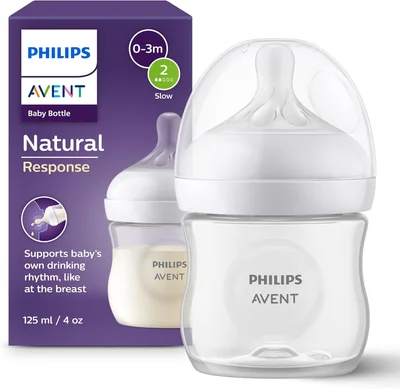
The Natural Response is Avent's flagship bottle, and its signature trick is a teat that only releases milk when your baby actively sucks. Pause to breathe, and the flow stops. It sounds simple, but it mimics the natural rhythm of breastfeeding in a way that few competitors manage. The wide, breast-shaped teat with its spiral texture encourages a deep latch, making it a strong choice for babies who are moving between breast and bottle.
With just three parts (bottle, teat, screw ring), cleaning is as straightforward as bottles get. The wide neck makes filling easy, and the bottles are dishwasher safe on the top rack. Parents who use a Philips breast pump get a bonus: the bottle screws directly onto the pump body, cutting out a messy transfer step. A glass version is available for those who prefer to avoid plastic entirely.
What parents love
- Natural feeding rhythm. The teat's flow-on-demand design lets baby control the pace. One parent told us: "She drinks and pauses just like she does on the breast, no gulping or spluttering."
- Easy cleaning. Three parts and a wide neck mean less time at the sink and fewer crevices for milk residue to hide.
- Breast pump compatibility. Screws directly onto Philips pumps, saving time and reducing spills for expressing parents.
- Glass option. The only major UK bottle brand offering a glass version in the same design, appreciated by parents who want to avoid plastic.
What to know before you buy
- Anti-colic is an add-on. The base bottle does not include an anti-colic vent. You need the separate AirFree vent accessory, which adds roughly £8 per bottle.
- Teat noise. A parent shared: "The anti-colic teat makes a high-pitched squeal while she sucks, which can be a bit unsettling at first."
- Fewer size options. Only two sizes (125ml and 260ml) compared to MAM's three, which can mean jumping from the small to the large with nothing in between.
Best for
- Parents combining breast and bottle feeding
- Families using a Philips breast pump
- Anyone who wants fewer parts to wash
- Parents who prefer a glass bottle option

2. MAM Easy Start Anti-Colic
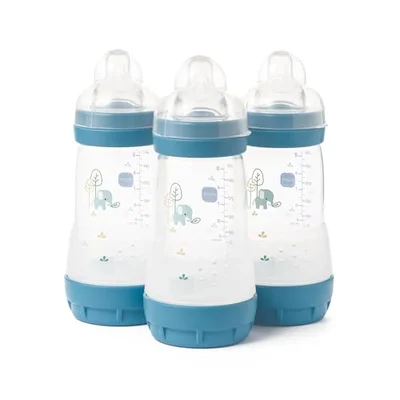
The MAM Easy Start takes colic seriously. Its anti-colic system lives in the base of the bottle: a vented plate that lets air enter from the bottom rather than through the teat, so your baby drinks milk while air flows harmlessly behind it. Research shows 80% of babies tested experienced reduced colic symptoms, and parents we hear from regularly back that up.
The other headline feature is self-sterilising. Disassemble the bottle, add 20ml of water to the base, pop it in the microwave for three minutes, and you are done. No separate steriliser needed. The SkinSoft silicone teat has a slightly textured surface designed to feel familiar, and 94% of babies accept it. Three sizes (130ml, 160ml, 260ml) cover newborns through to older babies without a gap.
What parents love
- Genuine colic relief. We hear repeatedly from parents that these bottles made a noticeable difference. One parent put it best: "These were the only bottles that helped with his colic. He was more settled during feeds and burped so much more easily afterwards."
- Self-sterilising. A parent shared: "As someone who visits friends and family a lot, being able to sterilise in any microwave in three minutes is a lifesaver."
- High teat acceptance. The flat, symmetric SkinSoft teat works in any orientation, and parents consistently report that babies take to it quickly after the breast.
- Sustainable materials. Bottle body is made from polypropylene linked to bio-circular feedstocks (ISCC PLUS certified), appealing to eco-conscious families.
What to know before you buy
- Four parts to clean. The vented base adds an extra piece to wash, dry, and reassemble at every feed. At 3am, that extra step feels longer than it is.
- Measurement markings start at 60ml. If you are making up small feeds for a newborn (30ml or 45ml), you will need to estimate or use a separate measure.
Best for
- Babies with colic or excessive wind
- Parents who want built-in anti-colic from day one
- Families on the go who need quick sterilising anywhere
- Eco-conscious parents looking for sustainable materials



What About Dr Brown's?
Dr Brown's Options+ is another popular anti-colic bottle in the UK, using an internal vent system that channels air through a thin tube running down the centre of the bottle. It is effective at reducing colic, and parents appreciate the wide-neck design. However, the internal vent adds even more parts to clean than the MAM, and the tube can be fiddly to scrub. If neither the Avent nor the MAM suits your baby, Dr Brown's is worth trying, but start with the two above as they cover the broadest range of feeding styles.
How to Choose
If your baby is moving between breast and bottle and you want the smoothest possible transition, the Philips Avent Natural Response is the stronger pick. Its breast-shaped teat encourages a natural latch, fewer parts keep things simple, and direct compatibility with Philips breast pumps saves time for expressing parents. Budget for the AirFree vent add-on if colic is a concern.
If colic relief is your top priority, or you want a bottle that can sterilise itself in any microwave, the MAM Easy Start Anti-Colic earns its spot as our overall pick. The vented base works from the first feed with no add-ons, the self-sterilising feature is genuinely useful for travel, and three size options give you room to grow without switching brands.
Both bottles are excellent. Your baby's preference will be the final deciding factor, so if budget allows, buying a single bottle of each to trial before committing to a full set is the smartest approach.
Add It to Your Nest
Whichever bottle suits your baby, add it to your free BubsNest registry so friends and family know exactly what to buy. You can always swap it later if your little one has other ideas.
Ready to Create Your Baby Registry?
Start your free baby registry today and share it with friends and family.
Get Started Free