Philips Avent Natural Response vs NUK Perfect Match: Which Bottle Wins the Latch Test?
Two of the most popular anti-colic baby bottles go head to head. We compare the Philips Avent Natural Response and NUK Perfect Match on latch, flow control, cleaning ease, and value.
COMPARISON · FEEDING
You have probably spent longer than you would ever admit scrolling through baby bottle reviews at two in the morning. Every brand promises a "natural latch", every label says "anti-colic", and every photo shows an impossibly serene baby taking the bottle on the first try. The truth is simpler and more frustrating: the right bottle is the one your baby actually accepts, and finding it often means trying two or three before something clicks.
The Philips Avent Natural Response and the NUK Perfect Match are two of the most-recommended first bottles in the UK right now, but they take very different approaches to the same problem. Avent focuses on flow control, letting your baby set the pace the way they would at the breast. NUK focuses on fit, with an ultra-soft teat that moulds to your baby's palate. Both have anti-colic venting. Both are BPA-free. But which one suits your baby, and your daily routine, better?
We gathered parent feedback from retailer reviews and BubsNest families, then cross-referenced with manufacturer specs and real-world durability reports to give you a practical, honest comparison.
Lil' Bubba's verdicts
- Best Overall: Philips Avent Natural Response · 8.5/10 - Superior flow control for combination feeding
- Best for Fussy Feeders: NUK Perfect Match · 8.0/10 - Ultra-soft teat that 98% of babies accept
| Philips Avent Natural Response | NUK Perfect Match | |
|---|---|---|
| Rating | ||
| Price from | ~£8 (single bottle) | ~£21 (4-pack) |
| Capacity | 125 ml / 260 ml | 150 ml / 260 ml |
| Anti-colic | Vent valve | Air system vent |
| Teat type | Breast-shaped, flow on demand | Orthodontic, palate-moulding |
| Flow options | 5 sizes (Flow 1-5) | 3 sizes (S, M, L) |
| Temp indicator | No | Yes (SafeTemp) |
| Material | Plastic (BPA-free) | Plastic (BPA-free) |
| Best for | Combination feeders | Fussy feeders |
How we picked these two
Both bottles appear repeatedly on BubsNest registries and come up in parent conversations whenever someone asks "which bottle for a breastfed baby?" Rather than comparing five options superficially, we wanted to go deep on the two that most often end up as the final shortlist. We focused on latch acceptance, anti-colic effectiveness, cleaning ease, and long-term value.
What to look for in a baby bottle
Before diving into the specifics, here are the five things worth paying attention to.
Teat shape and softness. Some teats are rounded and breast-shaped (like Avent's), designed to feel familiar to breastfed babies. Others are orthodontic (like NUK's), shaped to support your baby's jaw and palate development. Neither approach is objectively better - it comes down to what your baby prefers.
Flow control. A newborn needs a slow flow teat. Too fast and they will splutter, gag, or develop a preference for the easy bottle flow over the breast. Look for bottles with multiple flow-rate options so you can step up as your baby grows, and teats that let your baby control the pace rather than gravity doing the work.
Anti-colic venting. All modern bottles claim to be "anti-colic", but the mechanism matters. Some vent air through the teat, some through the base, some through an internal straw system. The goal is the same: keep air out of the milk so your baby swallows less of it. No bottle eliminates wind entirely, but good venting makes a noticeable difference.
Ease of cleaning. You will wash these bottles several times a day, every day, for months. Wide-neck bottles are easier to scrub. Fewer parts mean less fiddling at midnight. If a bottle has six components and a narrow neck, you will quietly resent it by week three.
Compatibility. If you are pumping, check whether the bottle fits your breast pump directly. Being able to pump into the same bottle you feed from saves time, reduces waste, and means fewer things to sterilise.
1. Philips Avent Natural Response
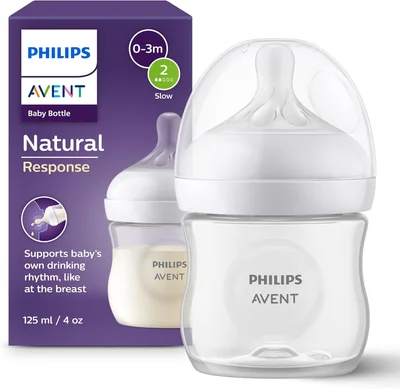
The Avent Natural Response is built around one clever idea: the teat only releases milk when your baby actively sucks. Turn the bottle upside down and nothing drips out. This mimics how breastfeeding works - your baby controls the pace, pausing to breathe and swallow naturally, rather than racing to keep up with gravity-fed milk.
It is the go-to recommendation for combination feeding families, and with good reason. The wide, breast-shaped teat helps babies switch between breast and bottle without developing a preference for one over the other. Philips offers five flow rates (Flow 1 through 5) so you can match the speed to your baby's age and appetite, and the wide-neck design makes cleaning straightforward even at 3am.
What parents love
- Flow-on-demand teat. The standout feature. One parent told us: 'The milk only comes out when she sucks, so she can pause to breathe without choking. It is the closest thing to breastfeeding we have found.'
- Simple to clean. Three parts, wide neck, no fiddly internal straw. Parents we hear from regularly say this is the bottle they do not dread washing.
- Flexible flow system. Five teat sizes means you can start on Flow 1 for a newborn and work up gradually. No need to switch bottle brands as your baby grows.
- No-drip design. A parent shared: 'I can throw it in the bag upside down and nothing leaks. Real time-saver for getting out the door.'
What to know before you buy
- Initial adjustment period. Some babies used to faster-flowing bottles find the Natural Response teat slow at first. It typically takes a feed or two for them to learn the active-sucking technique.
- Sold individually. Unlike multi-packs from other brands, you buy Avent bottles one at a time, which can feel expensive when you are building a full rotation of six.
- Not directly compatible with all pumps. While Avent bottles work with Philips breast pumps, you will need an adaptor for other brands.
Best for
- Parents combination feeding (breast and bottle)
- Families who want precise flow-rate control from newborn to 6 months
- Anyone who values a simple, easy-to-clean bottle design
- Babies transitioning from exclusive breastfeeding to occasional bottles

2. NUK Perfect Match
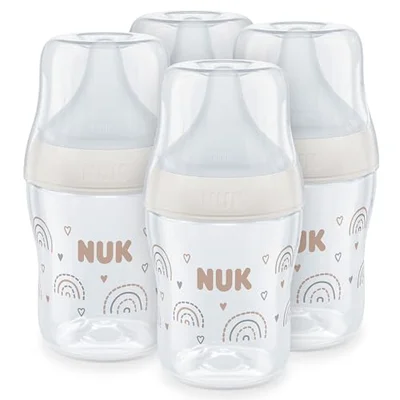
NUK's approach is fundamentally different. Where Avent replicates how milk flows from the breast, NUK replicates how the breast feels inside your baby's mouth. The Perfect Match teat is made from ultra-soft silicone - NUK claims it is twice as soft as competing teats - and its orthodontic shape moulds to your baby's palate rather than sitting on top of it.
The result, according to independent research, is a 98% baby acceptance rate. That statistic alone makes these bottles worth trying if your baby has refused everything else. The built-in SafeTemp indicator is a genuine safety bonus, changing colour when the milk is too hot. And the 4-pack format means you get a full day's rotation in one box.
What parents love
- Exceptionally high acceptance rate. We hear repeatedly from parents that the Perfect Match was the bottle their baby finally took after rejecting two or three others. One parent put it best: 'We tried four different brands. This was the only one she did not scream at.'
- Built-in temperature indicator. The SafeTemp stripe on the side changes colour when milk is above 37 degrees. Parents appreciate the peace of mind, especially during night feeds when judgement is foggy.
- Ultra-soft teat. The silicone genuinely feels softer than most competitors. Parents who have compared teats side by side consistently note the difference.
- Leak-proof lid. A parent shared: 'I keep one in the cool bag all morning and it has never leaked a drop.'
What to know before you buy
- Teat durability questions. Some parents report the ultra-soft silicone showing wear after eight to ten weeks of heavy use. You may need to replace teats more frequently than with firmer-silicone bottles.
- Orthodontic shape is polarising. The teat has a flat, curved shape rather than a symmetrical round one. Babies used to rounded teats may need time to adjust, and you need to position the bottle correctly so the teat sits right.
- Fewer flow options. Three teat sizes (S, M, L) compared to Avent's five. Fine for most babies, but less granular control if your baby is between stages.
Best for
- Babies who have refused other bottle brands
- Parents who want built-in temperature safety for night feeds
- Families looking for a complete 4-bottle starter set in one purchase
- Parents who prioritise orthodontic teat design for jaw development
How to choose
If you are combination feeding and want your baby to move seamlessly between breast and bottle, the Philips Avent Natural Response is the stronger pick. Its flow-on-demand teat genuinely replicates the pace of breastfeeding, and the five flow rates give you room to grow without switching brands. The trade-off is buying bottles individually and needing a feed or two for your baby to learn the active-sucking technique.
If your baby has been refusing bottles or you want the reassurance of a temperature indicator during those bleary 3am feeds, the NUK Perfect Match is hard to beat. The 98% acceptance rate is not just marketing - parents consistently tell us it is the bottle that finally worked. Just be prepared to replace the ultra-soft teats a little more often.
Whichever you choose, buy the smallest size first and test before committing to a full set. Babies are opinionated, and no amount of research replaces the five-minute trial where your baby either takes the bottle or launches it across the room.
Add it to your Nest
Found your winner? Add it to your free BubsNest registry so family and friends know exactly which bottle to buy - no more duplicate gifts or wrong-brand teats.
Ready to Create Your Baby Registry?
Start your free baby registry today and share it with friends and family.
Get Started Free