Safety Gates Buyer's Guide 2026: Hinge, Screw or Clamp? Match the Fitting to Your Stairs Before the Price
A £20 screw-fit, a £50 clamp-fit and a £70 three-panel hinged gate compared. The fitting style decides which one belongs at the top of your stairs, so measure first and buy once.
COMPARISON · SAFE & SOUND
Most parents shop for a stair gate the way they shop for a kettle: pick a price, pick a colour, click buy. Then the box arrives, and the real question turns up. Will it actually fit the top of your stairs, the one with the banister on one side, the skirting board on the other and a landing that is wider than any doorway in the house?
The fitting method decides almost everything about a safety gate. A hinged, hardware-mounted gate can wrap round an angled landing. A screw-fit gate with no bottom bar is the safe default for the top of a staircase. A clamp or pressure-fit gate goes up in ten minutes with no drill, which is brilliant for a doorway or a rented flat, and the wrong choice at the top of the stairs. Price follows the fitting, not the other way round.
So rather than ranking three gates from cheapest to dearest, this guide takes one gate from each fitting style and each price tier: a £20 screw-fit, a £50 clamp-fit and a £70 three-panel hinged gate. We read the spec sheets line by line, compared the fitting widths against typical UK hallways and landings, and pulled together what parents tell us after living with each one. If you measure first and read this second, you should only have to buy one gate per opening.
Lil' Bubba's verdicts
- Best for awkward landings: Dreambaby Newport 3-Panel Adapta Gate · 8.5/10 - three hinged panels span 85.5cm to 2m and bend round angles a straight gate cannot.
- Best value for the top of the stairs: Safety 1st Wall Fix Extending Metal Gate · 8.0/10 - screw-fixed, no bottom bar and 62cm to 102cm with no extensions, for about £20.
- Best no-drill gate: Hauck Open n Stop + 21cm Extension · 7.5/10 - clamps into a 96cm to 101cm opening with no holes in the wall, ideal for doorways and rentals.
Quick comparison
| Gate | Price | Fitting | Width | Top of stairs? | Rating |
|---|---|---|---|---|---|
| Dreambaby Newport 3-Panel Adapta Gate | £70 | Hardware-mounted, 3 hinged panels | 85.5cm to 200cm | Yes, set to open one way | |
| Safety 1st Wall Fix Extending Metal Gate | £20 | Screw-fit, no bottom bar | 62cm to 102cm | Yes | |
| Hauck Open n Stop + 21cm Extension | £50 | Clamp / pressure-fit, no drilling | 96cm to 101cm, up to 122cm | No, doorways and bottom of stairs |
How we picked the 3
We started with every safety gate in our catalogue that is in stock with a UK retailer we work with, then removed extension kits, pet-only gates and anything that had already featured in our recent gate comparisons. From what was left we wanted one gate per fitting style, from three different brands, landing roughly in the bottom, middle and top third of the price range. We checked each gate's fitting widths, opening mechanism and age guidance against the manufacturer's own descriptions, and leaned on the feedback parents share with us about installing and living with gates day to day. No brand paid to be included, and no brand saw this guide before it went live.
What to look for in a safety gate
Measure the opening, not the doorway. Measure between the surfaces the gate will actually touch: skirting to skirting, newel post to wall, or banister to wall. Then check that number sits comfortably inside the gate's range. A gate that only just reaches is a gate that will wobble.
Top of the stairs needs no trip bar. Pressure and clamp-fit gates usually sit in a frame that runs across the floor. At the bottom of the stairs or in a doorway that is fine. At the top, a bar underfoot while you carry a baby is a fall waiting to happen, which is why safety advice is consistent: use a screw-fixed gate at the top, and make sure it cannot swing out over the drop.
One-way swing for the top. A gate that opens towards the stairs can push a toddler, or you, over the edge. Look for a gate that swings back onto the landing, or one that lets you lock the swing to one direction.
Banisters change the maths. Spindles and newel posts often need a banister kit or Y-shaped spindles so the fittings grip without damaging the wood. Factor that into the price.
Height and climbing. Most gates stand at around 72cm to 76cm. That is plenty for a crawler. A determined climber of two or three may need something taller, or a gate with no horizontal footholds.
Rented or owned? Screw fittings leave holes. If you cannot drill, a clamp-fit gate in a doorway or at the bottom of the stairs, combined with keeping the top landing door shut, may be your safest workable option. Ask your landlord before assuming drilling is off the table, as many will agree for a safety gate.
1. Dreambaby Newport 3-Panel Metal Adapta Gate

The Newport Adapta Gate solves a problem that defeats most stair gates: the opening that is not a straight line. Instead of one rigid panel, you get three hinged panels with a walk-through gate, so you can run it straight across a wide hallway, angle it round the corner of a landing, or wrap it round the top of a staircase that opens out on two sides. The range is 85.5cm to 2m, which covers far more than any extending pressure gate.
It is hardware-mounted, so it screws into the wall or post at each end. That is more work than a pressure gate, but it is the right kind of work for the top of the stairs, and the gate lets you limit the swing to one direction so it can only open back onto the landing. Day to day, it opens one-handed, closes itself with an easy-close action, and has a stay-open setting for when you are carrying laundry up and down. An indicator shows you when it is properly latched.
What parents love
- It fits where nothing else will. The hinged panels handle angled and irregular openings. One parent told us: 'Our landing is basically a triangle. This was the only gate that didn't need a second gate bolted onto it.'
- Stay-open plus easy-close. You can leave it open during the day and let it swing shut behind you when it matters.
- Sturdy once fitted. We hear repeatedly from parents that it feels solid, with no rattling, and that installation is easier than they expected for a gate this size.
- Doubles as a room divider. Opened out, the panels can fence off a fireplace or split a through-lounge.
What to know before you buy
- You will be drilling. Hardware mounting is non-negotiable, so it is not one for renters who cannot make holes.
- Standard height. At 74cm it is tall enough for crawlers and new walkers, but a confident climber may test it.
- Overkill for a simple doorway. If your opening is a standard 75cm to 80cm, you are paying for flexibility you will not use.
Best for
- Wide or angled landings at the top of the stairs
- Open-plan homes with a staircase rising out of the living room
- Openings wider than about 1.2m that a pressure gate cannot reach
- Parents who want one gate to do the job of two

2. Safety 1st Wall Fix Extending Metal Safety Gate
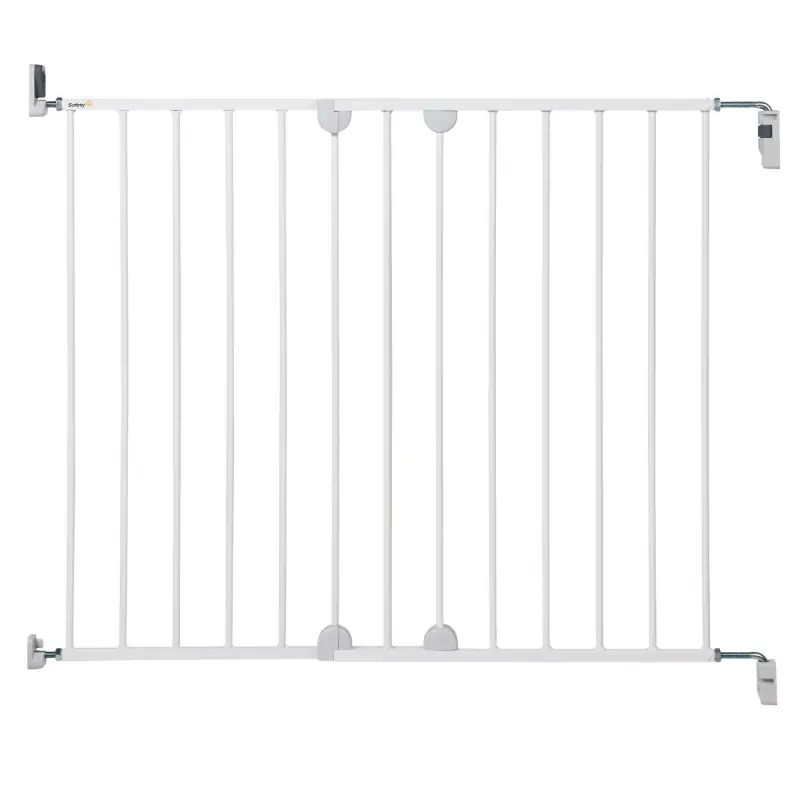
If your staircase opens onto a normal straight landing, this is the gate we would point most families to first. It screws to the wall, extends from 62cm to 102cm with no extension pieces to buy, and crucially has no bar across the floor. Either side lifts away from its wall fixing, so you get a wide, flat walk-through with only the brackets left behind.
The opening action is a tilt and lift, which you can do one-handed once you have the knack. At around £20 it costs less than many pressure gates, and you get the fitting style safety advice recommends for the top of the stairs. The trade-off is installation time, which is longer than the box suggests.
What parents love
- No trip bar. The floor stays clear, which is exactly what you want at the top of the stairs with a baby on your hip.
- Wide range, no extras. 62cm to 102cm covers most landings and hallways without buying extension kits.
- Solid once it is up. A parent shared: 'It took two of us a good hour or two to get it level, but once it was on the wall it didn't move at all.'
- Lifts off for cleaning. Parents like being able to lift the gate away to hoover the stairs, then drop it back into its brackets.
What to know before you buy
- Fitting takes time. Getting the brackets aligned is a two-person, one-to-two-hour job for many families.
- Not self-closing. You have to remember to shut it every time, so it rewards good habits.
- Age guidance stops at 24 months. It is rated for 6 to 24 months, so plan for a different solution if you have an older climber.
Best for
- Straight top-of-stairs landings up to just over a metre
- Budget-conscious families who still want a screw-fit gate
- Homes where a bottom bar would be a trip hazard
- Grandparents' houses that need a second, cheap but proper gate
3. Hauck Open n Stop Safety Gate + 21cm Extension

The Hauck Open n Stop is the gate for the openings where you cannot, or would rather not, drill. It clamps between the door frame or walls with adjustable fixing screws, so it leaves no holes behind, and this bundle includes the 21cm extension that takes it to a 96cm to 101cm opening. Further extensions take it up to 122cm. That makes it a good match for wider internal doorways, kitchen entrances and the bottom of the stairs.
The door opens in both directions with one hand, and a double safety catch makes it hard for small fingers to work out. Unlike some pricier pressure gates it does not swing shut on its own, and like most clamp-fit gates it is not one to put at the top of the stairs.
What parents love
- No holes in the wall. Ideal for rented homes and for a second gate at a grandparent's house. One parent put it best: 'We were never going to get permission to drill, so this was the only sensible option for the kitchen door.'
- Sturdy metal frame. Parents regularly describe it as well built and solid once the clamps are tightened properly.
- One-handed, two-way opening. Easy to get through with a baby in your arms, from either side.
- Banister option. Optional Y-shaped spindles help it grip on staircase posts at the bottom of the stairs.
What to know before you buy
- Not for the top of the stairs. Clamp and pressure-fit gates are a doorway and bottom-of-stairs solution.
- Manual close. There is no auto-close, so a gate left on the latch is a gate left open.
- Check your width carefully. With the included extension it suits 96cm to 101cm. Narrower doorways need the gate without the extension, so measure before you order.
Best for
- Renters who cannot drill
- Wide internal doorways and kitchen entrances
- The bottom of the stairs
- A quick, no-tools second gate for visits
What about Fred, BabyDan and Lindam?
Premium clear-acrylic gates such as Fred's screw-fit and pressure-fit models look lovely and fit well, but they cost three to four times as much as the gates here. We compared Fred's clear-view gate in a separate head-to-head, so it is not repeated here. BabyDan and Lindam make well-regarded screw-fit and configurable gates too, but they are not currently available through the retailers we work with, so we would rather point you to the fitting style than fake a recommendation. Whichever brand you choose, the checklist above applies: measure, match the fitting to the opening, and keep the top of the stairs bar-free.
How to choose
Choose the Dreambaby Newport Adapta Gate if your opening is wider than about 1.2m, angled, or spills out onto a landing on more than one side. It is the most expensive of the three, but it replaces two gates and a lot of improvising.
Choose the Safety 1st Wall Fix Extending Metal Gate if you have a straight top-of-stairs landing up to 102cm and can spend an hour with a drill. It is the best-value way to get the right fitting style in the most important spot in the house.
Choose the Hauck Open n Stop for a doorway or the bottom of the stairs, especially if you rent. Pair it with a screw-fit gate at the top if you can, rather than using it there.
Many homes end up with two gates: a screw-fit at the top and a clamp-fit at the bottom or across the kitchen. That is not overbuying, it is matching each gate to the job.
Add it to your Nest
Safety gates are one of the most useful things friends and family can buy, and one of the easiest to get wrong. Add the gate that fits your stairs, with a note of your measurements, to your free BubsNest registry so nobody buys the wrong size. For more ideas, browse our other guides in the community.
Ready to Create Your Baby Registry?
Start your free baby registry today and share it with friends and family.
Get Started Free