Tummy Time: Why It Matters and How to Make Your Baby Actually Enjoy It
Everything you need to know about tummy time, from when to start and how long to aim for, to the tricks that turn screaming into smiling.
Your newborn spends roughly sixteen hours a day sleeping. Of the remaining eight, health professionals recommend that a decent chunk of that awake time happens face-down on the floor. Sounds mad, right? But tummy time is one of those things that looks like nothing and does everything.
It builds the muscles your baby needs to hold their head up, roll over, sit, crawl, and eventually walk. Skip it, and you are not doing anything terrible, but you might notice those milestones arriving a bit later than expected. The good news? It does not have to be a screaming match on the living room carpet.
Why Tummy Time Actually Matters
When babies lie on their backs (which they should for sleep, always), they are not working very hard. Gravity does the job. Flip them onto their front, and suddenly every muscle from the neck down has to engage just to lift their head and look around.
That effort builds neck and shoulder strength first, then core stability, then the upper body control needed for pushing up, rolling, and eventually crawling. Without regular tummy time, babies can develop a flat spot on the back of their head (positional plagiocephaly) and may take longer to hit physical milestones.
Think of it as your baby's first workout. Nobody loves leg day the first time either. 💪
When to Start (and How Much)
You can start tummy time from day one. Literally. Those first sessions are tiny, just a minute or two on your chest while you are reclined on the sofa. Your baby does not need a mat, a gym, or any gear at all. Just your chest, your heartbeat, and your face to look at.
Here is a rough guide to build up gradually:
- Newborn to 6 weeks: 1-2 minutes at a time, 2-3 times a day. Chest-to-chest counts.
- 6 weeks to 3 months: Work up to 5-10 minutes per session, multiple times daily.
- 3 to 4 months: Aim for 20-30 minutes total across the day (not all at once).
- 4 months onwards: As much as your baby will tolerate. Many babies start to enjoy it around this age because they can finally see what is going on.
The key word is "total." You are not expected to plonk your six-week-old face-down for twenty minutes and hope for the best. Short bursts after every nappy change or feed (wait at least 20 minutes after a feed) add up quickly.
Making Tummy Time Less Miserable
If your baby screams the moment they hit the floor, you are not alone. Most newborns are not fans at first. They have spent nine months curled up in a warm, dark space, and now someone is asking them to do press-ups on a cold mat. Fair enough.
Here are the tricks that actually work:
Get down there with them. Babies are motivated by faces. If you lie on the floor at their level, making eye contact and pulling silly expressions, they have a reason to lift their head. Your face is the best toy they have right now.
Use your chest first. Recline on the sofa and place your baby tummy-down on your chest. This feels more secure, they can hear your heartbeat, and the slight incline makes it easier to lift their head. It also counts as a cuddle, so everyone wins.
Try the lap position. Drape your baby across your thighs while you sit, supporting their chest. This works brilliantly after a feed (gentle pressure can even help with wind) and gives them a new view of the world.
Roll up a towel. Place a small rolled towel under their chest and armpits. This props them up slightly and takes some of the strain off, making it easier and less frustrating.
Add something to look at. A high-contrast book propped open, a small mirror, or a sibling doing something ridiculous nearby. Babies will work harder when they have something worth looking at.
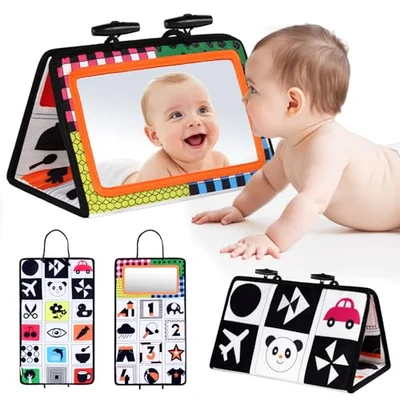

A floor mirror is genuinely one of the best tummy time investments. Babies are fascinated by faces, including their own, and the reflection gives them a reason to push up and hold their head higher. High-contrast patterns around the edge are a bonus for the early weeks when their eyesight is still developing.
The Gear That Actually Helps
You do not need much for tummy time. Your floor and a clean blanket will do the job. But a few well-chosen bits of kit can make it more comfortable and more interesting, which means your baby tolerates it for longer and you both enjoy it more.
A play gym with an arch. Once your baby can lie on their back and swipe at dangling toys, you can flip the experience. Many play gyms work for tummy time too, with toys repositioned lower so your baby has something to reach for while face-down.


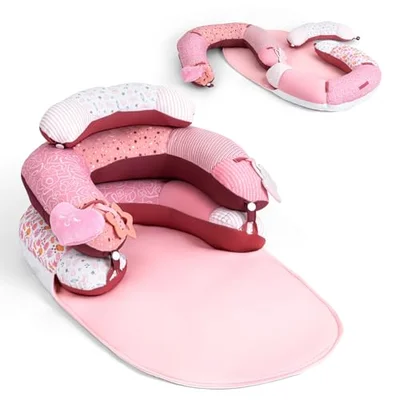
A tummy time support pillow. These are shaped to prop your baby's chest up at a comfortable angle, taking the hard work out of the early weeks. They are not essential, but if your baby really struggles with flat tummy time, a support pillow can make the difference between ten seconds and two minutes.
A sensory water mat. These inflatable mats are filled with water and floating toys. Press down and the toys move. Babies find them mesmerising, and the squishy surface adds a different sensory experience to standard floor time. Great for around 3 months onwards when your baby starts to show more interest in reaching and grabbing.

What If Your Baby Absolutely Hates It?
Some babies cry. Some babies scream. Some babies do a kind of starfish impression and refuse to move. This is all normal, and it does not mean you should stop.
Think of it like this: your baby is not in pain. They are just working hard and they are not thrilled about it. A bit of fussing during tummy time is expected, especially in the first few weeks. If they are genuinely distressed (bright red, inconsolable), pick them up, comfort them, and try again later.
The secret is consistency, not duration. Five one-minute sessions across the day are better than one five-minute session that ends in tears for both of you.
If your baby really will not tolerate the floor at all, stick with chest-to-chest and the lap position for a few weeks. These count just as much and let your baby build strength in a position that feels safer to them. Most babies come around eventually, usually once they are strong enough to see something interesting.
Common Questions (Answered Quickly)
Should I do tummy time after a feed? Wait about 20-30 minutes. A full tummy plus face-down pressure can lead to a spectacular spit-up situation. Ask anyone who has learned this the hard way.
Can tummy time happen on a bed? A firm, flat surface is safest. Beds and sofas are too soft and can increase the risk of suffocation. Always stay with your baby during tummy time, wherever they are.
My baby keeps face-planting. Is that okay? Totally normal in the early days. Their neck muscles are still building. Stay close, keep a hand nearby, and they will figure it out. If they consistently cannot turn their head to the side, mention it to your health visitor.
Does being in a carrier count? Not officially, because tummy time is specifically about loading those muscles against a flat surface. But babywearing builds core strength in a different way, so it is still valuable. Think of it as a complementary exercise, not a replacement.
When can I stop doing tummy time? Once your baby is rolling, crawling, and moving around independently, they are essentially doing their own tummy time all day long. You can stop formal sessions and just let them explore. 🎉
Your Tummy Time Cheat Sheet
- Start from day one, even if it is just on your chest
- Little and often beats long and tearful
- Get on the floor with them, your face is the best motivator
- Use a mirror, a rolled towel, or a support pillow if flat floor time is too hard
- Do not stress about hitting exact minutes, any tummy time counts
- If they hate it, try again later, they will get there
Building a registry? Add your tummy time essentials to your BubsNest wishlist so friends and family know exactly what to get.
Ready to Create Your Baby Registry?
Start your free baby registry today and share it with friends and family.
Get Started Free