Room Sharing with Your Newborn: How to Set Up Your Bedroom for the First Six Months
Current guidance says babies should sleep in your room for the first six months. Here is how to make it work without losing your bedroom entirely.
You have spent weeks painting a nursery, carefully positioning the cot at the exact angle Instagram recommends, and choosing a mobile that plays Brahms. Then you find out the guidance says your baby should actually sleep in your room for the first six months. Plot twist. 🌙
It makes total sense once you know why. Having your baby close by at night reduces the risk of sudden infant death syndrome (SIDS) and makes those bleary-eyed feeds significantly less dramatic. But nobody really talks about the practical side: where does the crib actually go? How do you feed without waking the entire household? And can you still watch telly in bed without feeling like a terrible parent?
This is the guide we wish someone had handed us at 36 weeks. No judgment, no scare tactics, just the stuff that actually helps when you are sharing four walls with a tiny human who has no concept of "quiet hours."
Why Room Sharing Is Recommended
The guidance is clear: your baby should sleep in the same room as you, on a separate safe sleep surface, for at least the first six months. This comes from safer sleep research showing that being close to a parent helps regulate a baby's breathing, temperature, and sleep patterns.
Room sharing is not the same as bed sharing. Your baby sleeps in their own space, whether that is a bedside crib, a moses basket, or a standalone cot. You sleep in yours. Close enough to hear every tiny snuffle, far enough that you are not lying rigid all night worrying about duvets.
Choosing Your Baby's Sleep Space
This is probably the biggest decision, and it depends entirely on how much room you have and how you plan to feed.
Bedside cribs are the most popular choice for room sharing. They attach to the side of your bed with the panel dropped, so you can reach your baby without getting up. If you are breastfeeding, this is genuinely life-changing at 3am. Most bedside cribs are suitable from birth to around six months, which is exactly the room-sharing window.
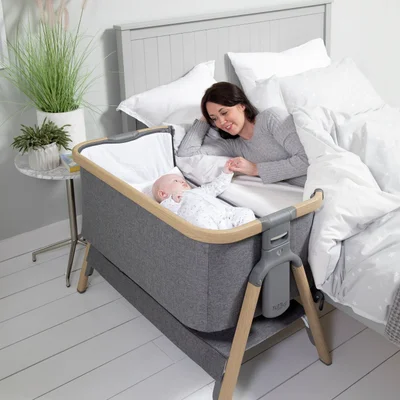





Moses baskets are lighter and more portable, so you can move them between rooms during the day. They tend to be outgrown faster, usually by three to four months, but they are often cheaper and take up less space.
A full-size cot works too if your bedroom is big enough. It will last longer than a bedside crib, but you will need to get out of bed for feeds, which matters more than you think at 2am.
Whichever you choose, the mattress should be firm, flat, and the right size for the crib. No pillows, no duvets, no bumpers, no toys. Boring looking? Yes. Safe? Absolutely.
Setting Up Your Bedroom
Here is where a bit of planning saves you a lot of 3am frustration.
Position the crib on the feeding side. If you breastfeed lying on your left, the crib goes on the left side of the bed. Sounds obvious, but getting this wrong means climbing over your partner every single feed. They will not thank you.
Keep a night feed station within arm's reach. A small caddy or basket on your bedside table with nappies, wipes, a spare muslin, a water bottle for you, and a snack. Getting up to fetch things in the dark is how you wake up properly, and once you are properly awake, good luck getting back to sleep.


Temperature matters more than you think. The recommended room temperature for a sleeping baby is between 16 and 20 degrees Celsius. That sounds cold to most adults, but babies overheat easily. A simple room thermometer takes the guesswork out of choosing sleep layers. If the room is 18 degrees, a long-sleeved bodysuit and a 1.0 tog sleep bag will usually do the job.

Sort your lighting. You need enough light to check on your baby and do a feed, but not so much that everyone is wide awake for an hour afterwards. A dim, warm-toned nightlight is perfect. Avoid blue or white light, which suppresses melatonin and tells your brain it is morning. Red or amber tones are much kinder on everyone's sleep.
Managing Noise (Yours and Theirs)
Here is the thing nobody warns you about: newborns are noisy sleepers. They grunt, snuffle, squeak, and make sounds that will convince you something is wrong approximately forty times a night. This is normal. Newborn sleep is just loud.
The flip side is that your noise can disturb them. A white noise machine helps on both fronts. It gives your baby a consistent, soothing background sound and masks the everyday noises you make, like talking, the telly, or that creaky floorboard you never noticed before children.
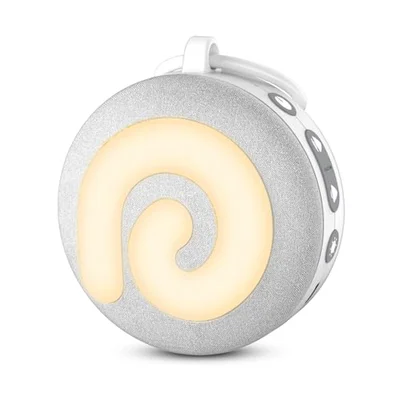
Place the sound machine at least a metre from your baby's head and keep the volume at a level where you can still hear them cry over it. The idea is gentle background noise, not a nightclub.
As for the telly question: yes, you can still watch things in bed. Keep the volume low, the screen brightness down, and the light angled away from the crib. Your baby is not going to be traumatised by the faint murmur of a boxset. You are allowed to have a life after 7pm.
Night Feeds Without the Drama
The key to surviving night feeds in a shared room is keeping everything calm, dim, and boring. You want your baby to understand that nighttime is not party time.
- Use the dimmest light you can manage. A red or amber nightlight, not the main bedroom light.
- Keep nappies and wipes right next to you so you do not need to stand up or turn on lights.
- If bottle feeding, prepare everything before bed. A thermos of hot water and pre-measured formula means you can make a bottle without leaving the room.
- Do not check your phone during feeds. The screen light wakes you up properly, and before you know it you are doom-scrolling at 4am instead of sleeping.
- Change the nappy before the feed if you can, so your baby drifts off during the feed rather than being woken up by a cold wipe afterwards.
If you are breastfeeding with a bedside crib, you can often feed lying on your side and barely wake up at all. It takes a few goes to get the position right, but once you do, it is a genuine superpower.
Your Relationship with Your Bedroom
Let us be honest: your bedroom is about to feel less like a sanctuary and more like a very small ward. That is temporary. But a few things help.
Keep the floor clear. You will be navigating in the dark. A rogue shoe or a forgotten mug becomes a genuine hazard at 3am.
Make your bed properly every morning. It sounds trivial, but when your bedroom also doubles as a nursery, making the bed is the single easiest thing you can do to make the room feel like yours again. Five minutes, massive difference.
Accept that the nursery you decorated will wait. It is not going anywhere. You will use it eventually, and when you do, it will be lovely. But for now, your baby does not care about the wall art or the matching storage baskets. They care about being close to you.
When to Move Baby to Their Own Room
The guidance says at least six months, but there is no hard deadline. Some families make the move at six months on the dot. Others wait until eight or nine months. A few keep room sharing well into the first year.
Signs your baby might be ready include consistently sleeping longer stretches, outgrowing their bedside crib, and you noticing that your movements are actually disturbing their sleep rather than helping it. If every time you roll over your baby wakes up, that is a sign they might sleep better with a bit of distance.
There is no rush. Move them when it feels right for your family, not because someone on a forum told you that six months is the absolute cutoff. It is guidance, not a legal requirement.
Quick Checklist for Your Room-Sharing Setup
- Bedside crib, moses basket, or cot positioned safely next to your bed
- Firm, flat mattress with fitted sheets (nothing else in the crib)
- Room thermometer to monitor temperature
- Dim nightlight with warm or red tones
- White noise machine placed at least a metre from baby
- Night feed station: nappies, wipes, muslins, water, snack
- Blackout curtains or blinds if streetlight gets in
- Clear floor space for safe nighttime navigation
Room sharing is not glamorous. Your bedroom will smell faintly of milk for a while, you will learn to interpret grunts like a sleep-deprived linguist, and you will definitely step on something in the dark at least once. But it is also one of those unexpectedly tender chapters, falling asleep listening to your baby breathe, reaching over to rest a hand on their chest at 5am, knowing they are right there. It does not last forever. And honestly? You might miss it when it is over. 💛
Planning your room-sharing setup? Add everything you need to your BubsNest wishlist and let family and friends help you get sorted before baby arrives.
Ready to Create Your Baby Registry?
Start your free baby registry today and share it with friends and family.
Get Started Free