Tummy Time: Why Your Baby Hates It (and How to Make It Bearable)
Your baby screams during tummy time. That is normal. Here is why it matters, when to start, and seven practical ways to make it less of a battle.
You lower your baby gently onto their tummy. You have read the leaflet, downloaded the app, watched the reel. You know this is important. Your baby lasts approximately four seconds before their face crumples, their fists clench, and they let out a wail that suggests you have placed them on hot coals rather than a perfectly soft playmat.
So you scoop them up, feel terrible, and silently add tummy time to the growing list of things you are apparently failing at. Sound familiar? Good, because this is one of the most universal newborn experiences there is, and your baby is not broken. They just need a bit of help getting there. 🤍
Why Does Tummy Time Actually Matter?
Tummy time is not some trendy wellness fad. It is genuinely one of the simplest things you can do to support your baby's physical development. When your baby spends time on their front, they are building the neck, shoulder, and core strength they will eventually need to roll, sit, crawl, and walk.
It also helps prevent flat spots on the back of the head (positional plagiocephaly, if you want the medical term to impress your health visitor). Babies spend a lot of time on their backs, and rightfully so for safe sleep. Tummy time is the counterbalance.
Beyond the physical stuff, it gives your baby a completely different view of the world. Literally. Looking up and around from their tummy engages their visual tracking and helps develop spatial awareness. It is a full workout for a tiny human.
When Should You Start?
Earlier than you probably think. You can begin tummy time from your very first days at home. In fact, those early chest-to-chest cuddles after a feed? That counts. Your baby is on their tummy, lifting their head slightly, and getting used to the position. You are already doing it.
For floor-based tummy time, most health professionals suggest starting from a few days old with very short sessions. We are talking one to two minutes at a time, a few times a day. That is it. You are not training for a marathon here.
By three to four months, you are aiming for around 20 to 30 minutes of total tummy time spread across the day. But please do not set a stopwatch and stress about hitting exact numbers. Some days you will manage loads. Other days, survival mode takes over and that is completely fine.
Why Do Babies Hate It So Much?
Here is the reassuring bit: almost all babies protest tummy time at first. It is not a sign that something is wrong. It is a sign that this position is unfamiliar and hard work.
Think about it from their perspective. They have spent nine months curled up in a warm, dark, cosy space. Now they are face down on a flat surface, trying to hold up the heaviest part of their body with muscles they have barely used. Of course they are going to complain about it. You would too.
The good news is that it gets easier. Babies who do regular, short bursts of tummy time tend to go from full screaming protest to happily playing on their front within a few weeks. Consistency matters more than duration.
Seven Ways to Make Tummy Time Less of a Battle
If your current tummy time routine consists of putting baby down, baby screaming, you picking baby up, and everyone feeling stressed, try these instead.
1. Start on your chest
This is the gentlest introduction to tummy time. Lie back on the sofa or bed and place your baby tummy-down on your chest. They get the physical benefits of the position while being close to your heartbeat, your warmth, and your face. Most babies tolerate this far longer than floor tummy time because it does not feel like an exercise, it feels like a cuddle.
2. Time it right
Tummy time after a feed is a recipe for spit-up and misery. The sweet spot is when your baby is alert and content, usually about 20 to 30 minutes after eating. Mid-morning tends to work well for most babies, when they are rested and not yet hangry.
3. Get down on their level
Your baby does not want to stare at carpet fibres alone. Get down on the floor face to face with them. Sing, talk, pull silly faces. You are their favourite thing in the world, and having you right there makes the whole experience less intimidating. It sounds simple because it is.
4. Try a water mat
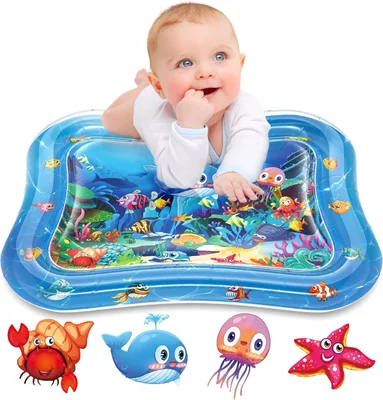
Inflatable water play mats are one of the best tummy time hacks going. The floating colours and shapes give your baby something fascinating to watch and bat at, and the slight squish of the mat can feel more comfortable than a hard floor. They are cheap, easy to store, and most babies find them genuinely interesting.

5. Use a mirror
Babies are completely fascinated by faces, including their own. Place a baby-safe mirror at their eye level during tummy time and watch them lock onto their own reflection. It is distracting enough to buy you an extra few minutes of happy tummy time, and it is brilliant for their visual development too. High-contrast cards and sensory toys propped up nearby work on the same principle.
6. Roll up a towel
If your baby really struggles flat on the floor, try placing a small rolled-up towel or muslin under their chest, just beneath their armpits. This gives them a little lift so they are not face-planting into the mat, which makes the whole thing feel less overwhelming. It is the tummy time equivalent of training wheels, and there is absolutely nothing wrong with using it.
7. Make it part of something else
Tummy time does not have to be a standalone event you schedule into your day. Pop them on their tummy during a nappy change (on the floor, obviously, not the changing table). Let them have tummy time on a play gym so they have dangling toys to reach for overhead. Carry them in the "aeroplane hold" along your forearm. It all counts.


What About Tummy Time Toys?
You do not need a cupboard full of specialist equipment. A muslin, a rolled towel, and your face will get you through the first few weeks brilliantly. But as your baby gets bigger and starts tolerating longer sessions, a few well-chosen toys can keep things interesting.
Look for things with high contrast (black and white patterns are perfect for young babies), crinkly textures, or gentle sounds. Anything your baby can bat at, grab, or stare at while they are on their front will extend the happy window. Purpose-built tummy time toys that prop up at the right angle can be particularly good for keeping little ones engaged.


When Should You Actually Worry?
Most tummy time drama is completely normal and resolves with patience and practice. But it is worth mentioning to your health visitor or GP if your baby is still unable to lift their head at all by three months, seems to strongly prefer turning their head to one side only, or appears to be in genuine pain (not just protest crying) during tummy time.
Reflux can also make tummy time genuinely uncomfortable, so if your baby is a sicky baby who really struggles on their front, chat with your GP. There are ways to modify tummy time to make it more comfortable while you get the reflux sorted.
The Bottom Line
Tummy time is one of those things that sounds so simple on paper but can feel surprisingly stressful in practice. If your baby screams through every session, you are not doing it wrong. You are doing it. That is the bit that matters.
Start small, be consistent, and remember that those first few weeks of protest do not last. Before you know it, your baby will be happily propping themselves up on their arms, looking around the room like they own the place, and you will wonder what all the fuss was about. 💪
Want to build a wishlist with all the tummy time essentials? Create your BubsNest registry and keep everything in one place.
Ready to Create Your Baby Registry?
Start your free baby registry today and share it with friends and family.
Get Started Free